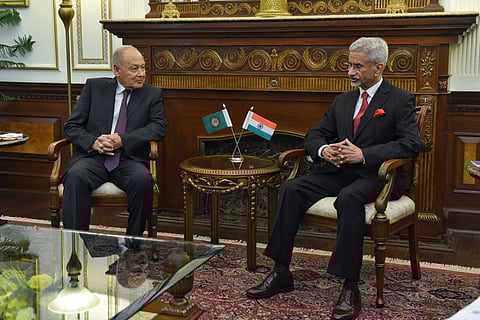

NEW DELHI: Ahead of the second India–Arab Foreign Ministers’ Meeting in New Delhi on Saturday, External Affairs Minister S Jaishankar on Friday held talks with League of Arab States Secretary General Ahmed Aboul Gheit, focusing on strengthening India–Arab cooperation across political, economic and strategic domains amid heightened regional and global uncertainties.
Following the meeting, Jaishankar described the interaction as “warm” and said the discussions covered a wide range of issues. “Had a wide-ranging conversation about our cooperation and strengthening it across various domains. Also exchanged views on the recent developments in the region,” the minister said in a post on X.
Aboul Gheit arrived in New Delhi on Thursday to attend the second India–Arab Foreign Ministers’ Meeting (IAFMM) and related engagements, marking a significant moment in India’s engagement with the Arab world. The Ministry of External Affairs (MEA) said the visit reflects a shared commitment to strengthening the India–Arab partnership across sectors. “High-level engagements over the next two days reflect the shared commitment for a stronger India-Arab partnership,” MEA spokesperson Randhir Jaiswal said.
India is hosting the second IAFMM on January 31, co-chaired by India and the United Arab Emirates. The meeting will see participation from Foreign Ministers of Arab League member states, along with ministers of state, deputy ministers and senior officials. This is the first time India is hosting the India–Arab Foreign Ministers’ Meeting in New Delhi. The IAFMM, the highest institutional mechanism guiding India–Arab engagement, is taking place after a gap of nearly a decade. The first such meeting was held in Manama, Bahrain, in January 2016, when both sides identified five priority verticals for cooperation, economy, energy, education, media and culture, and adopted the Manama Declaration and an Executive Programme for implementation.
Ahead of the ministerial dialogue, the fourth India–Arab Senior Officials’ Meeting was held on Friday, setting the agenda and reviewing progress under the cooperation framework. The current meeting is expected to expand collaboration in emerging areas while reinforcing existing partnerships in trade, energy security, connectivity and people-to-people ties.
India’s engagement with the Arab League is underpinned by strong economic and strategic linkages. India–Arab trade stands at over USD 240 billion, with bilateral hydrocarbon trade exceeding USD 107 billion and accounting for nearly half of overall trade. Arab League countries supply more than 95 per cent of India’s LPG imports, around 60 per cent of LNG and nearly 47 per cent of crude oil requirements, besides over 50 per cent of fertilisers and related products. Critical sea lanes such as the Suez Canal, Red Sea and Gulf of Aden remain vital for India’s external trade.
Indian companies have a significant footprint in the energy sector across several Arab countries, including the UAE, Saudi Arabia, Iraq, Oman and Egypt. Cooperation also spans food security, financial services, healthcare, education, information technology, renewable energy, start-ups and large infrastructure projects. Over nine million Indians live and work across Arab League nations, forming a key pillar of the relationship. The League of Arab States, formed in Cairo in 1945, currently has 22 member states across West Asia and North Africa. India has Observer status in the LAS and has institutionalised dialogue through an MoU signed in 2002. The Arab–India Cooperation Forum was established in 2008 and revised in 2013 to strengthen structural engagement.