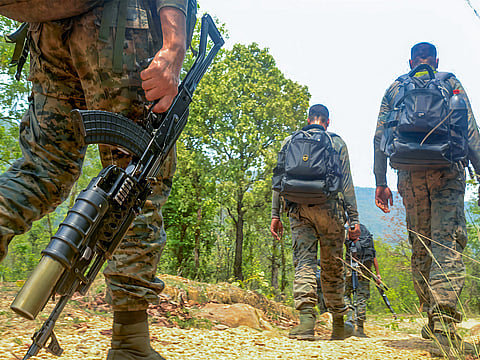

BHOPAL: Police personnel who once hunted the most wanted and dreaded armed Naxal cadres in the dense forests of Madhya Pradesh are now working diligently to rehabilitate the same former outlaws after their surrender.
Police officials from Balaghat district, earlier an integral part of anti-Naxal operations in the central Indian state, are now tracing the roots (villages) of the former cadres who, until a few months ago, carried rewards ranging from Rs 14 lakh to Rs 62 lakh.
Under the Madhya Pradesh Naxalite Surrender, Rehabilitation-cum-Relief Policy–2023, surrendered Naxals are entitled to both monetary and non-monetary benefits. These include the rewards earlier declared on their heads, along with other financial assistance such as Rs 3.5 lakh to Rs 4.5 lakh for surrendering weapons (ranging from AK-47 assault rifles to light machine guns), Rs 1.5 lakh as a subsidy for house construction, Rs 50,000 for marriage, Rs 20 lakh as a subsidy for purchasing immovable property, and Rs 1.5 lakh for skill development training.
They are also eligible for local employment under the VB-GRAM G Act (formerly MGNREGA), skill development training under relevant government schemes, and subsidized rations at their place of stay.
To avail these benefits, identity documents such as Aadhaar cards are required, particularly for opening bank accounts. A job card is necessary for local employment and skill development training, while a ration card is mandatory to receive subsidized food supplies.
Between November 2 and December 11, 2025, as many as 13 most-wanted armed cadres of the CPI (Maoist) Maharashtra–Madhya Pradesh–Chhattisgarh (MMC) Zone surrendered in Balaghat district. Of them, only one—Deepak Uike—was from Madhya Pradesh, while the remaining 12 hailed from Chhattisgarh. The surrendered cadres, including five women, carried rewards ranging between Rs 14 lakh and Rs 62 lakh. Following their surrender—which marked the end of listed MMC cadres in Madhya Pradesh—the reward money will now be deposited into their bank accounts.
“Our priority is to first ensure that the portion of the reward money declared by Madhya Pradesh is credited into their accounts. Subsequently, we will work with the governments and police of Chhattisgarh and Maharashtra in the same direction. Twelve of the 13 most-wanted Naxals who surrendered during November–December 2025 hailed from Chhattisgarh,” Special DGP (Anti-Naxal) Pankaj Srivastava told TNIE on Saturday.
However, the absence of adequate documentation—such as Aadhaar cards and Election Photo Identity Cards (EPICs)—has hindered the rehabilitation process, particularly the opening of bank accounts. Most of the surrendered cadres had left their villages in Chhattisgarh at a very young age.
“We first have to trace their roots in Chhattisgarh and identify their native villages. Once located, we approach the sarpanches and seek their written consent, based on which documents such as identity proofs, residential proofs, job cards, EPICs, and ration cards can be issued. It is a lengthy process, but the hard work of nearly a month, in coordination with the police and administration in Chhattisgarh, is finally paying off. Out of the 13 surrendered Naxals, we have successfully completed the documentation process for seven,” a senior police officer in Balaghat district said.
“We hope to complete the process for the remaining cadres in the coming months, after which the reward money related to all 13 Naxals will be credited into their accounts, helping them begin a new life,” the officer added.