
NEW DELHI: Seeking to advance India’s long-running effort to develop an indigenous jet engine, the Defence Research and Development Organisation’s Gas Turbine Research Establishment (GTRE) has issued an Expression of Interest (EOI) to identify an Indian industry partner for manufacturing and assembly of an Indigenous Advanced High Thrust Class Aero Engine.
The EOI, issued, seeks to shortlist a Development-cum-Production Partner (DcPP) capable of executing complex aero-engine manufacturing and integration tasks. According to the document, the deadline for submission is March 26, with bids scheduled to be opened the following day.
An EOI is the first step in a formal procurement process, aimed at assessing industry capability and interest before a detailed Request for Proposal (RFP) is issued. GTRE has clarified that participation in the EOI does not guarantee a production contract.
As per the EOI, the proposed engine comprises 11 sub-systems, 34 assemblies, 125 sub-assemblies and around 2,500 components, including compressors, combustor, turbines, afterburner, exhaust nozzle, gearbox, oil and fuel systems, and digital engine control units.
While GTRE will retain design authority, the DcPP will be responsible for production engineering, component manufacturing, sub-assembly, final engine assembly, quality assurance and documentation. The partner must also meet stringent aerospace standards and obtain approvals for specialised processes such as thermal coatings, advanced welding and non-destructive testing through Indian certification agencies.
The EOI sets out a long development horizon, with a tentative plan to deliver 18 development engines over a 10-year period. It also notes that a subsequent production contract, potentially covering up to 200 engines, could be issued later, subject to government approval and user requirements.
Although the EOI has been framed as a platform-agnostic programme, defence sources said the high-thrust engine under development is being viewed primarily in the context of the country’s indigenously developed fifth-generation Advanced Medium Combat Aircraft (AMCA) programme.
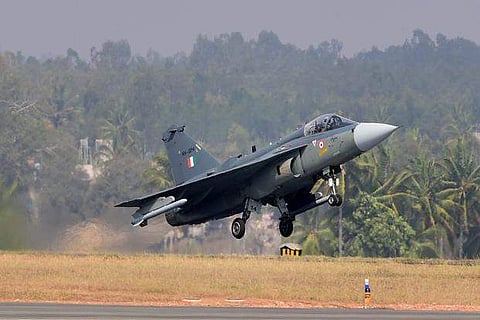
While the initial AMCA aircraft are expected to be powered by the GE F414 engine, the Indian Air Force and the government are seeking an indigenously developed high-thrust engine for subsequent phase of AMCA induction, including the planned AMCA Mk-2 variant. Sources added that the engine could also be adapted for the Tejas Mk-2, including for potential mid-life upgrade configurations.
The EOI further notes that GTRE is pursuing the programme “in collaboration with an International Engine House (IEH)”, without naming the partner. Safran is reportedly in advanced discussions with India on aero-engine cooperation, including technology transfer and co-development, while Rolls-Royce is also understood to be in contention.
Sources said the DcPP bid is expected to be submitted through a consortium model, given the scale and complexity of aero-engine manufacturing. Under this approach, GTRE would retain design authority, while an Indian entity could act as the lead integrator for assembly, certification and delivery. They added that Hindustan Aeronautics Limited (HAL) could emerge as a leading contender for this role, with private sector firms such as Tata Group, Larsen & Toubro and Bharat Forge participating as manufacturing and systems partners.
