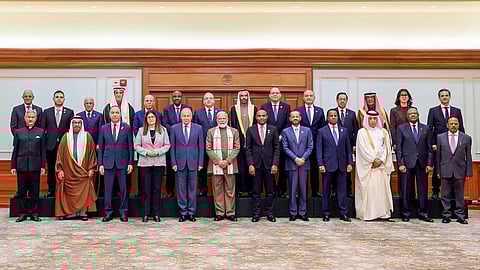

NEW DELHI: Prime Minister Narendra Modi on Saturday reiterated India’s continued support for the people of Palestine and welcomed ongoing peace efforts, including the Gaza peace plan, during his meeting with a delegation of Arab foreign ministers in New Delhi.
Modi received the foreign ministers of Arab countries, the Secretary General of the League of Arab States and heads of Arab delegations who are in India for the second India–Arab Foreign Ministers’ meeting and conveyed his appreciation for the important role played by the Arab League in supporting efforts towards regional peace and stability.
The Prime Minister underlined the “deep and historic people-to-people ties” between India and the Arab world, and said these connections have continued to inspire and strengthen relations over the years. He also outlined his vision for the India–Arab partnership in the years ahead, reaffirming India’s commitment to further deepen cooperation in trade and investment, energy, technology, healthcare and other priority areas “for the mutual benefit of our peoples,” the release said.
“Prime Minister reiterated India’s continued support for the people of Palestine and welcomed ongoing peace efforts, including the Gaza peace plan. He conveyed his appreciation for the important role played by the Arab League in supporting efforts towards regional peace and stability,” the statement added.
Addressing the India–Arab foreign ministers’ meeting, External Affairs Minister S. Jaishankar said the Middle East and West Asia had witnessed multiple developments of “considerable consequence” in recent years, many of which have had an impact beyond the region. He said the situation in Gaza, in particular, has been a major focus for the international community.
“Many of us were present at the Sharm-el-Sheikh Peace Summit in October 2025. This evolved into the UN Security Council Resolution 2803 of November 2025. Taking forward the comprehensive plan to end the Gaza conflict is today a widely shared priority,” Jaishankar said, and added that several countries have made policy declarations on the peace plan, both individually and collectively.
Jaishankar also flagged other conflicts and flashpoints in the region that require collective attention. “One is the conflict in Sudan that is exacting a deadly toll on its society. Another is that in Yemen, with the additional implication for the safety of maritime navigation,” he said. He also pointed to concerns in Lebanon, where India has troops deployed under the UN Interim Force in Lebanon (UNIFIL), as well as the need to advance the national dialogue process in Libya and closely watch developments in Syria. “Contemplating this multitude of challenges, our shared interest warrants strengthening forces of stability, peace and prosperity,” he said.
India’s engagement with the Arab League is anchored in strong economic and strategic linkages. India–Arab trade exceeds USD 240 billion, with bilateral hydrocarbon trade accounting for over USD 107 billion, nearly half of the total trade volume. Arab League countries supply more than 95 per cent of India’s LPG imports, around 60 per cent of LNG and nearly 47 per cent of crude oil needs, in addition to over 50 per cent of fertilisers and related products. The maritime routes such as the Suez Canal, Red Sea and Gulf of Aden remain critical for India’s external trade.
