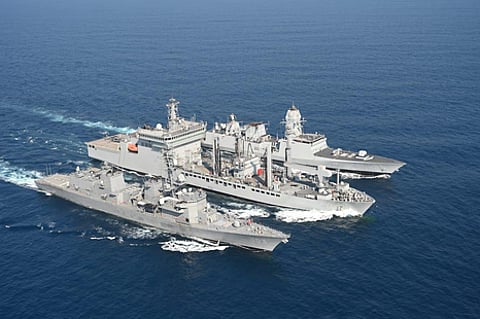

India took another step towards strengthening its maritime and aerial defence capabilities on Tuesday as the Ministry of Defence signed contracts worth Rs 5,083 crore for the procurement of Advanced Light Helicopters (ALH) Mk-III and Shtil surface-to-air vertical launch missile systems for the Indian Coast Guard and the Indian Navy.
The agreements form part of a broader push to modernise India’s frontline platforms amid rising strategic competition in the Indian Ocean Region and heightened security challenges across maritime domains. The contracts cover the acquisition of indigenously developed ALH Mk-III helicopters, along with advanced Shtil missile systems designed to enhance the Navy’s air defence capability against a range of aerial threats.
The Advanced Light Helicopter Mk-III, developed by Hindustan Aeronautics Limited, is a multi-role platform capable of undertaking search and rescue missions, coastal surveillance, maritime reconnaissance, casualty evacuation and logistical support. For the Indian Coast Guard, the helicopters will significantly expand operational reach, particularly in offshore patrol, disaster response and maritime law enforcement. With increasing commercial shipping traffic and evolving non-traditional threats such as piracy and smuggling, the addition of these helicopters is expected to improve rapid response capability along India’s extensive coastline.
For the Indian Navy, the induction of the Shtil surface-to-air vertical launch missile system will bolster ship-based air defence. The Shtil system is designed to intercept and neutralise incoming aircraft, helicopters and anti-ship missiles, providing layered protection to naval assets operating in contested environments. The vertical launch configuration allows faster reaction times and greater engagement flexibility, a crucial advantage in high-intensity maritime operations.
The procurement reflects the government’s emphasis on strengthening domestic defence manufacturing under its self-reliance agenda. The ALH Mk-III programme in particular underscores India’s progress in indigenous aerospace design and production. Expanding orders for locally manufactured platforms not only enhances operational readiness but also supports the domestic defence industrial base, generating employment and technological capability within the country.
Strategically, the timing of the contracts is significant. The Indian Ocean Region has witnessed increased naval deployments by major powers, while regional tensions and evolving maritime threats have underscored the need for robust surveillance and air defence systems. By enhancing both rotary-wing aviation assets for the Coast Guard and missile defence for frontline naval warships, India is reinforcing its layered security architecture at sea.
From an operational standpoint, the combination of enhanced aerial mobility and stronger ship-based missile defences improves deterrence and survivability. Helicopters like the ALH Mk-III extend situational awareness beyond the radar horizon of ships and coastal stations, while advanced missile systems reduce vulnerability to airborne threats. Together, they contribute to a more integrated and responsive maritime force structure.
The Rs 5,083 crore outlay also signals sustained capital investment in defence modernisation despite fiscal pressures. As India balances economic priorities with security imperatives, targeted acquisitions such as these reflect a calibrated approach that prioritises mission-critical capabilities.
Overall, the contracts for ALH Mk-III helicopters and Shtil surface-to-air missile systems mark a significant addition to India’s maritime defence arsenal. They reinforce coastal security, enhance naval air defence and align with the broader objective of building a technologically advanced and self-reliant defence ecosystem capable of responding effectively to emerging challenges.
