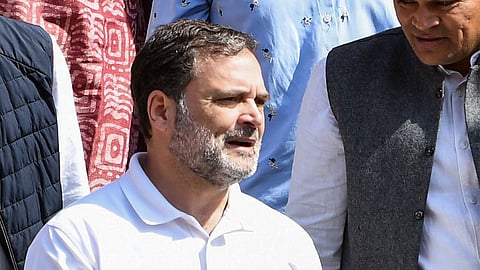

Congress leader Rahul Gandhi on Saturday alleged that India’s data resources have effectively been handed over to the United States following a trade deal between the two countries. He said critical issues like data ownership and protection are not receiving enough attention, while public debates are focused on less important matters.
During an interaction with members of the Information Technology (IT) fraternity at Technopark in Thiruvananthapuram, the Leader of Opposition in the Lok Sabha also called for a broader discussion on subsidies and “freebies,” questioning why assistance to the poor is criticised while benefits given to large corporate groups go largely unquestioned.
Responding to queries on data protection, Gandhi referred to the Indo-US trade deal, which he has earlier criticised. He argued that India failed to leverage the value of its data during negotiations.
"I mean, if in that deal, India turned around and said, listen, this is all fine, but our data is the most valuable data in the world, I can guarantee you there will be no taxes on agriculture. There would be no taxes on small and medium business. There would be none of that."
According to him, successful negotiations depend on recognising one’s own strengths.
"We have a huge diversity. So, we can understand many different things from many different angles. We have the largest pile of data on this planet. We have the best engineering talent. We have the best medical talent."
Gandhi compared the situation to a hypothetical scenario involving natural resources, suggesting that handing over a key national asset would trigger public outrage elsewhere.
He said that if Russia were to hand over its entire oil reserves to the United States, there would be widespread protests. However, he claimed there had been “not a peep” in India when its data was allegedly “handed over” to the US as part of the deal signed by the government.
He added that India’s political system should focus more on fundamental questions about data governance.
"These are the questions actually the political system should be discussing. Not whether, you know, what we should eat and what we should drink and whether cow urine is good for you. So, it is actually a democratic exercise. It's a listening exercise, because really nobody has the answer," Rahul said.
Gandhi also addressed the issue of welfare schemes when asked why political parties continue to distribute freebies even after nearly eight decades of independence. He countered by asking why similar scrutiny is not applied to benefits given to large industrialists, referring to business leaders Gautam Adani and Mukesh Ambani.
"What about freebies to Mr Adani and Mr Ambani? What about the huge amount of land given to them? Why don't we discuss that? If we are ready to stop those freebies, we can stop these freebies (to the poor)," Gandhi said.
Later, in a X post, he reiterated his point that subsidies for the poor are often criticised, while corporate incentives are framed as development.
"When the poor receive subsidies to survive, it is called 'revdi' and 'freebies'. When Adani and Ambani receive land at throwaway prices, tax exemptions, and lakhs of crores in loan write-offs - it's called development. The poor are shamed. The powerful are celebrated. I am open to a conversation about freebies - but let's be honest and account for both sides of the equation," Rahul said in his post.
He added that welfare measures for the poor often arise as a response to large loan write-offs and other benefits extended to big corporations.
"The poor people need freebies and you see that. But, you do not see the freebies when Adani gets it. Your question was not when are we going to stop freebies to Adani and Ambani. So, when you are looking at a political system, you have got to look at both sides of the equation. If we are going to have a conversation about freebies, then lets not talk about just one side of the equation," the LoP said.