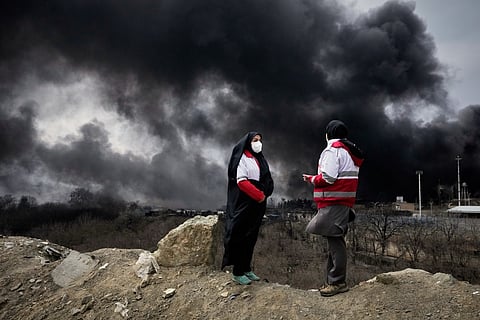

NEW DELHI: Amid concerns of a toxic cloud of black rain drifting towards India, the Indian Meteorological Department (IMD) is closely monitoring wind patterns. Currently, the wind patterns and their elevation have kept India safe, while affecting regions more heavily in Turkmenistan, Afghanistan, China, and Southeast Asian countries.
On the night of March 8, the United States and Israel bombed fuel depots in Iran's capital Tehran. This resulted in a widespread dark plume spreading throughout the city. By the morning of March 9, residents of Tehran experienced oil raining down and flames erupting in roadside sewer systems. The incident also contaminated the air for millions of people across multiple countries.
Some meteorological experts have raised alarms about the toxic cloud potentially triggering acid rain and moving towards Northeast Asia, affecting several nations, including India. This coincides with a new spell of Western Disturbance expected to hit on March 9 in the upper reaches of the Himalayas, including Jammu and Kashmir and Himachal Pradesh, while parts of Punjab, Haryana, and Uttarakhand may experience cloudy skies.
Repeated inquiries to the IMD regarding potential wind patterns have gone unanswered. However, unofficially, IMD has assembled a team of scientists to monitor the wind situation. They explained that the current patterns are expected to carry the toxic clouds away from India's western Himalayas.
"Both lower and middle-level tracking models indicate that, according to the latest model runs, there will be no direct impact on India. The models suggest that the air mass will likely move northeast towards Turkmenistan and Afghanistan, potentially bringing contaminated precipitation to that region," stated a scientist familiar with the developments, referring to the National Oceanic and Atmospheric Administration’s HYSPLIT model. This model tracks the dispersion and trajectory of substances transported by wind.

The HYSPLIT model presents three trajectories, all of which veer away from India. Two trajectories pass through China and Russia, ultimately reaching the South China Sea, while the third trajectory moves via Russia to the Arctic as of March 9. Another NOAA model indicates that the black cloud will rotate around the capital of Iran.
Additionally, scientists noted that the Western Disturbance had already passed over Iran before the oil depots were bombed, so the impact of this event would be negligible. The wind patterns show a lower trough over east Iran and Pakistan, which will pass over India at higher altitudes.
"Currently, the wind pattern from the Western Disturbance will help blow the toxic cloud away from the Indian Himalayas," the scientist added.
Both oil and desalination plants have come under attack in Iran and Bahrain. Following the US attack on an Iranian desalination plant, Iran retaliated by targeting a desalination facility in Bahrain, which is a crucial water source for Gulf countries.