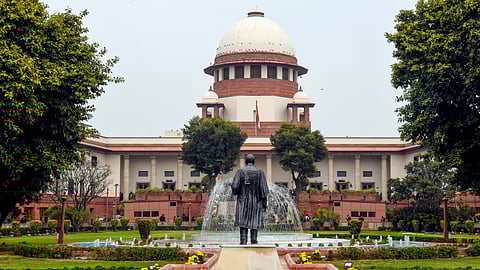

NEW DELHI: Pulling up the Central Bureau of Investigation (CBI) over its investigation into the alleged “unholy nexus” between banks and developers to dupe homebuyers in Delhi NCR and other parts of the country, the Supreme Court said that prolonging the probe would lead to more agony for flat buyers.
A bench headed by Chief Justice Surya Kant and comprising Justices Joymalya Bagchi and Vipul M Pancholi took exception to the CBI’s statement that some cases in which homebuyers were allegedly defrauded under the subvention scheme could be transferred to state agencies for investigation.
The top court bench, however, refused to transfer the cases to state agencies and asked the CBI to probe all matters and convert preliminary enquiries into regular cases.
“This court cannot wait for an indefinite period for the conclusion of the investigation,” the bench said. It added that “delay or prolonging of the investigation will only lead to more agony for the homebuyers who have already been harassed by the builders and developers, apparently in collusion and connivance with financial institutions and banks.”
The top court was hearing a batch of pleas filed by more than 1,200 homebuyers. The lead petition was filed by Himanshu Singh through advocate Akshay Srivastava.
The petitioners had booked flats under subvention plans in various housing projects in the NCR region, particularly in Noida, Greater Noida and Gurugram. They alleged that banks were forcing them to pay instalments despite not receiving possession of their flats. The bench had earlier ordered a CBI probe into the alleged “unholy nexus” between banks and builders to dupe homebuyers through subvention schemes. Under the subvention scheme, banks disburse the sanctioned loan amount directly to the accounts of builders.

The builders are then required to pay EMIs on the sanctioned loan amount until the flats are handed over to homebuyers. However, after several builders allegedly started defaulting on EMI payments to banks, and in line with the tripartite agreement, banks began demanding EMIs from homebuyers, who are the third party in the agreement.
The bench observed that if this remained the approach of the CBI, the court might consider setting up a committee to oversee the investigation being carried out by the agency.
The top court also said that if the CBI was facing a shortage of staff to probe the cases, it could write to state Directors General of Police and seek assistance from their Economic Offences Wings.
Expressing displeasure that bank officials were not being investigated by the agency, the bench asked a “responsible officer” from the CBI to file an affidavit by the next date of hearing on the pace of the probe in all the cases. The court further said that the CBI should consult a report filed in the matter by amicus curiae Rajiv Jain on April 29 last year, and directed the agency to indicate a probable timeline for completing the investigation.
The bench also said that all affected parties, including homebuyers, banks and builders, should submit their claims, suggestions and recommendations to the amicus curiae, who would then examine them and place appropriate material before the court.
“Homebuyers, financial institutions or builders shall be at liberty to submit their claims, suggestions and recommendations to the learned amicus curiae for his consideration. No such claims shall be directly entertained by this court unless it is screened through the amicus,” the bench said.