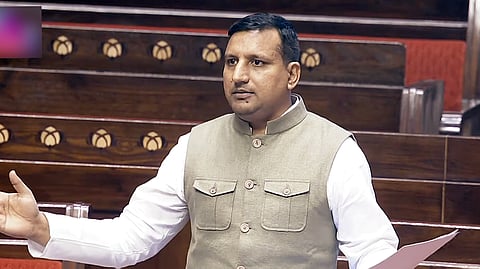

NEW DELHI: Sanjay Yadav, MP from the Rashtriya Janata Dal, on Friday raised a significant issue in the Parliament of India concerning malpractices and arbitrary deductions by health insurance companies during claim settlements.
Drawing attention to the matter, Yadav informed the House that insurers frequently cite various technical provisions to deduct a substantial portion of hospital bills.
“The annual premium collection of health insurance companies in India exceeds approximately Rs 3.20 lakh crore; the reality is that when a hospital bill is presented, and an insurance claim is filed, these companies cite various technical rules and provisions to deduct a substantial portion of the total bill. This places an additional financial burden on the patients and their families,” he said.
He stressed that the fundamental objective of health insurance is to provide financial security to citizens during times of illness, rather than entangling them in complex regulatory provisions.
“If a policy stipulates a specific room rent limit and the patient is admitted to a room with a higher tariff, a ‘Proportionate Deduction’ is applied not merely to the difference in room rent, but to the entire hospital bill. Many essential medical items included in the hospital bill, such as gloves, disposable supplies, sanitisers, injections, etc are designated as ‘non-payable’ and are subsequently excluded from the claim settlement,” Yadav informed the House.
Explaining the issue, Yadav said that if a policy has a room rent limit and a patient opts for a room with a higher tariff, insurers often apply a “proportionate deduction” to the entire hospital bill instead of only the difference in room rent. He also noted that several essential items in hospital bills, such as gloves, disposable supplies, sanitisers and injections, are frequently categorised as “non-payable” and excluded from claim settlements.
He further pointed out that insurance companies or Third-Party Administrators (TPAs) often negotiate fixed “package rates” with hospitals, resulting in only partial reimbursement of the billed amount.
He further pointed out in the House that policy conditions are often buried within 30 to 50 pages of dense documentation, making them extremely difficult for ordinary people to understand.
“A digital and transparent breakdown of the insurance claim settlement must be made mandatory at the time of the patient's discharge from the hospital, and insurance companies must be directed to implement these consumer-centric reforms without resorting to any increase in premium rates,” Yadav suggested.
Raising broader concerns, Yadav said India lacks a national standard for hospital billing, which leads to large variations in treatment costs for the same ailment across hospitals and cities.
“Despite the provision for cashless claims, and even when a hospital offers ‘cashless’ facilities, patients are often required to personally bear 10% to 40% of the bill at the time of discharge. Disputes frequently arise between hospitals and insurance companies regarding treatment packages; the patient invariably gets caught in the middle, as the hospital's billed amount often differs from the rates approved by the insurance company, leaving the patient to foot the bill for this discrepancy,” he said.
Going into further detail, he noted that a “claim settlement” does not necessarily mean full reimbursement. According to him, many insurance companies mark claims as “settled” even when they pay only a portion of the bill.
“As a result, the reported claim settlement ratio does not accurately reflect the actual financial relief provided to the patient,” he said.
He also told the House, “In India, medical inflation stands at approximately 12–14% annually, whereas general inflation hovers around 5–6%. Due to claim rejections, consumers are often compelled to bear the entire financial burden themselves.”
Yadav urged the government to give serious consideration to the matter and take necessary policy measures to safeguard the interests of consumers.
