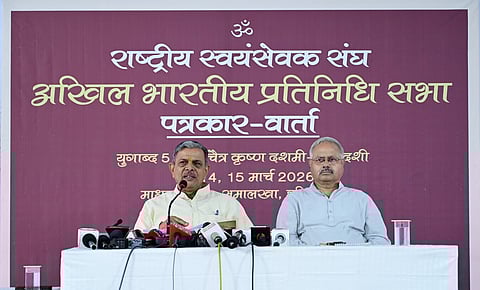

NEW DELHI: Rashtriya Swayamsevak Sangh (RSS) Sarkaryavah (General Secretary), Dattatreya Hosabale, on Sunday said the expansion of the organisation signifies the expansion of the national ethos. He was interacting with journalists on the final day of the Sangh's three-day All India Representatives' Sabha, held at Samalkha in Haryana.
Emphasising the need for freedom from colonial mindsets, he said, "It is Essential for the nation's citizens to liberate themselves from a colonial mindset . The Indian discourse embodies the vision of global welfare".
The three-day Akhil Bharatiya Pratinidhi Sabha concluded with a resolve to expand organisational activities and foster greater engagement of the "virtuous forces" (Sajjan Shakti) within society for the national interest. Hosabale further said the meeting emphasised and resolved to further promote social harmony.
On the final day of the meeting, Hosabale stated that the organisation's activities have witnessed remarkable expansion over the past year. The number of Sangh Shakhas (daily assemblies) has surpassed 88,000—marking an increase of approximately 6,000—while the number of locations where these assemblies are held has risen to over 55,000.
Moreover, the frequency of weekly gatherings, known as Saptahik Milans, and smaller group meetings called Mandalis has also increased.
"It is also pertinent to view this organisational expansion in the context that Sangh Shakhas are now operational even in regions such as the Andaman Islands, Arunachal Pradesh, Leh, and remote tribal areas. This organizational expansion is also clearly evident in the various programs being conducted as part of the Sangh's centenary year celebrations," he said.
He emphasised that along with organisational expansion, the Sangh is continuously working to enhance the quality of life and character within society. "It is crucial to inspire positive societal transformation through the concept of Panch -Parivartan (Five Transformations). The Indian ethos,or Hindutva, is not merely an ideology, but a way of life; through this way of life, the quality of societal existence must be elevated," he asserted.
"To this end, it is essential to mobilise the "virtuous forces" of society and to channel this "Power of Good" toward serving the national interest", he added.
He further said that society should acknowledge and embrace the contributions of great historical figures, rising above barriers of caste and creed, and should draw inspiration from them to advance towards positive change.
"Acting in this spirit, Sangh volunteers organised over 2,000 programs across the country on the occasion of the 350th martyrdom anniversary of the Ninth Guru, Shri Tegh Bahadur Ji, attracting the participation of more than 700,000 people. Similarly, the 150th anniversary of the national song, Vande Mataram, was also celebrated with great enthusiasm", he said.
He also added that plans have been formulated for various programmes to mark the upcoming year—the 650th birth anniversary of Sant Shiromani Ravidas Ji Maharaj.
At the meeting, information was provided regarding the Sangh’s regular training camps scheduled for the coming year. "It was stated that a total of 96 training camps, comprising camps across 11 regions and one central camp in Nagpur,will be conducted. During the Pratinidhi Sabha (Representative Assembly), plans concerning Gau Seva (service to cows) and rural development were also deliberated upon", he said.
The RSS at the meeting also decided to encourage citizens to cultivate vegetables on their rooftops, utilising indigenous cow dung and cow urine as fertiliser. "This initiative allows everyone to contribute towards the conservation and nurturing of cows. Similarly, citizens may resolve to establish green homes, thereby facilitating efforts such as minimising the use of polythene within the household and conserving water", he informed the media.
Responding to a query regarding changes to the Sangh’s organisational structure, he stated that the possibility of decentralising the structure has been considered; specifically, there is a proposal to replace the existing "Provinces" (Prants) with smaller administrative units known as "Divisions" (Sambhag).
Upon implementation, this would result in the creation of over 80 divisions, replacing the current 46 provinces.
In response to another question, Hosabale asserted that the media, too, must step forward to help eradicate caste-based discrimination within society and should cease publishing caste-based analyses of voter demographics during elections.
He commended the diplomatic efforts currently being undertaken by the national government in the interest of the nation amidst the prevailing international geopolitical landscape, reiterating that the Sangh stands as a proponent of global peace and development.
Addressing yet another query, he clarified that Keshav Baliram Hedgewar did not establish the Sangh to oppose any specific community, sect, or mode of worship. "The Sangh's second Sarsanghchalak, Shri Guruji, had similarly affirmed that we all share a common ancestry and that variations in modes of worship or religious rituals do not constitute a fundamental difference between us; although the term "DNA" was not explicitly used at the time, that was precisely the underlying intent", he said.
"The third Sarsanghchalak, Balasaheb Deoras, also famously had stated-'All those who regard India as their Motherland and their Nation—and who embody the spirit of Bharatiyata (Indianness)—are Hindus,'" he added.
He further said that the Sangh welcomes everyone; indeed, anyone engaged in constructive work for the betterment of society is regarded by them as a Swayamsevak (volunteer) of the Sangh.
Speaking about the Sangh’s work, he said, "In Andaman, more than 13,000 people from nine major islands participated in a Hindu conference held in the presence of the Sarsanghchalak. Similarly, even in a state with a low population density like Arunachal Pradesh, over 37,000 people participated in 21 Swadharma conferences."
He also stressed that great personalities should be honoured and emulated, rising above distinctions of caste and creed, and that society should acknowledge the contributions of great personalities by transcending such divisions.
"We should utilise their legacy to propel society forward toward positive change. In furtherance of this objective, Sangh volunteers organized over 2,000 programs across the country to mark the 350th anniversary of the martyrdom of the Ninth Guru, Shri Tegh Bahadur Ji; these events witnessed the participation of more than 700,000 people", he said.
