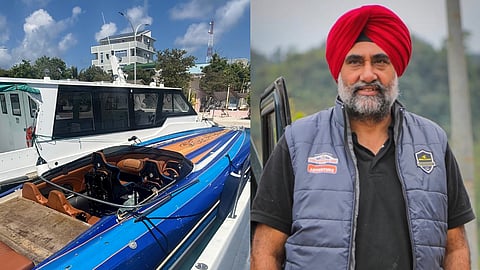

For decades, the turquoise lagoons of the Maldives have enjoyed a steady patronage of guests from India, including celebrities and the who's who of the business community. Once here, in these postcard-perfect settings, a leisure ride on the waters is almost always on the cards.
On March 20, however, one such ride spiralled into a tragedy, and with it sent ripples across India's business and sporting circles. In the wee hours of Friday, a small speedboat carrying seven people—five Indian men and two foreign women (one British, one Russian)—capsized near the Felidhoo islands of Vaavu Atoll, Maldives.
Among those on board were prominent names, including industrialist Gautam Singhania, the MD of the Raymond Group, motorsport legend Hari Singh, and decorated sailor and former naval officer Cdr Mahesh Ramachandran.
It is learned that five survived and two remain missing. They are Hari Singh and Cdr Mahesh. While the circumstances surrounding the accident remain hazy, initial accounts suggest that the group had been aboard a large luxury yacht, reportedly around 43 metres in length, before shifting to a smaller speedboat for a late-night ride.
"The timing itself stands out. They are believed to have left around 1.15am," said a sailing expert and former naval commander, who spoke on condition of anonymity. "That suggests that this was not a planned excursion in the usual sense. It was most likely spontaneous."
Night-time boating is not unusual in the Maldives, particularly in resort settings. In fact, the Vaavu Atoll region is renowned for such excursions. But it comes with its own constraints, such as reduced visibility, reliance on onboard lighting, and the need for heightened situational awareness, especially in reef-rich waters.
Some reports also indicated that the boat had entertained a party, suggesting that the group may have been under the influence of alcohol when the incident happened. However, The New Indian Express could not independently corroborate this.
That said, March is typically considered a benign period for sailing in the region. "This is generally a peaceful time of the year," the expert noted. "The transition between monsoon systems makes for relatively calm seas. Weather alone is unlikely to explain what happened."
With no official reconstruction yet available, attention has turned to the mechanics of how such a boat might capsize in otherwise calm waters. Two plausible scenarios present themselves.
"The boat might have hit something. Like a rock," the expert highlighted. However, when The New Indian Express analysed the photographs of the boat, no marks of damage could be immediately spotted. The expert said as much. "I could not identify any big damage to the boat. At least from the photographs available," he said.
The other plausible scenario centres on speed and manoeuvring.
"These boats can go very fast. If you take a sharp turn, even a full 360 degree-turn, the boat can end up hitting its own wake," the expert explained. "When that happens, it can lift off and then land hard. That impact can throw people off balance, even out of the boat."
Such events unfold in seconds. The design of most speedboats also means that the person steering is the least likely to be thrown off, as they are physically anchored to the wheel. In this case, it was Gautam, who reportedly survived with only minor bruises.
Passengers, especially if not securely seated or holding on, are more vulnerable. Compounding this, there are indications, though unconfirmed, that the boat may have been carrying more people than its visible seating capacity.
"If there are more people than the seating arrangement comfortably allows, it can affect stability, especially in the case of a hard turn," the expert said, while cautioning that only manufacturer specifications can confirm actual capacity.
Yet another critical unknown is whether those on board were wearing life jackets. Unlike larger vessels, where safety gear is stored on board, small speedboats operate differently.
"You don't keep life jackets on small boats and then put them on later," the expert explained. "You are supposed to be wearing them before you even get in."
Without a life jacket, the risks escalate sharply, particularly if a passenger is injured during impact. "If someone hits their head and loses consciousness, they can drown very quickly," he said.
Even for conscious individuals, survival is far from guaranteed, especially if they are inebriated. "The instinct is to swim, but that can actually reduce your chances. You get fatigued, you lose body temperature, and currents can keep you in the same place for hours. Your best bet is for someone to find you, throw you a life buoy."
The timing of the incident that deep into the night, may also have shaped what followed. In low-light conditions, spotting a person in open water is notoriously difficult. High-speed boats, unless specifically equipped, are not designed for search operations.
"You would ideally stop, mark your GPS location, and alert the main vessel," the expert said.
"But even searching carries risks," he added. "There is also a chance you might accidentally run over someone in the water."
There are also practical constraints. Fuel, lighting, and medical emergencies onboard can force difficult decisions. In this case, at least one survivor, The New Indian Express has learned, suffered severe injuries, including damage to an arm that later required amputation.
That may have necessitated an urgent return to shore, shifting focus away from immediate search efforts. By the time authorities were alerted and organised search operations began, the window for rescue may already have narrowed.
"Even with a lifejacket on, the best window is about seven or eight hours. After that, your body starts to disintegrate,” the expert said. Now, because it’s been three days since the incident, he said the chance of finding anyone alive after that much time has passed is "very, very poor".
"Or, they were washed up onto a remote island and are currently unable to communicate with anyone," he added.
But given how the Maldives is a high-traffic region, when asked how likely it is that a boat had indeed picked up the duo but was ill-equipped to notify anyone about it, the expert said, "There are ways to send an alert, be it via a satellite phone, a siren to nearby ships, etc. Also, it has been two days, and that's enough time to pick them up and sail back to a nearby port."
The incident also draws attention to a lesser-discussed aspect of maritime safety, namely the regulatory gap between commercial and private boating. In the Maldives, as in many parts of the world, vessels operating commercially are subject to stricter oversight. But private outings are governed more loosely.
"For a private boat, much of the responsibility rests with the owner," the expert noted. "There may not be the same level of mandatory checks for communication equipment, safety drills, or even licensing."
This distinction matters in high-tourism zones where luxury and informality often intersect. Also, speedboats are typically tethered operationally to a 'mothership'. In this case, the larger yacht. They are expected to remain within a short radius, relying on proximity rather than independent communication systems. "If something goes wrong beyond that radius, response becomes more complicated," the expert said.
As to what exactly transpired after the crash, much remains in the wind. "But they must have realised that two are indeed missing and in the waters. I can't tell for certain what circumstances led them to discontinue the search and make for the port," the expert said.
According to some reports, Gautam, who had arrived in his private jet in the Maldives, fled from the hospital without even revealing his name or personal details in fear that he might be charged for involuntary manslaughter, etc.
As to how they made it back to the port, the expert clarified that while Cdr Mahesh is indeed the captain of the yacht, there were likely others who were part of the crew and who could still navigate it. "Remember, the seven mentioned are riders on the speedboat. We don't yet know how many were on the yacht," he said.
Like with the accident itself, many more details remain conjecture. Was it speed? A sharp turn? An unseen swell? Human error? A combination of all of these? Only a formal investigation will establish the sequence of events.
At the time of this writing, it is understood that search operations in the Vaavu Atoll's shallow lagoons, which give way to sharp coral drop-offs and where strong undercurrents can pull debris (and bodies) into reef structures, have been successful in locating the bodies. Formal identification and official statements are still awaited.
