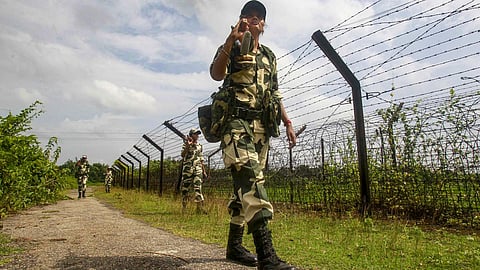

NEW DELHI: The Government of India has accelerated efforts to strengthen border security along its eastern frontier with Bangladesh by undertaking large-scale installation of floodlights, according to the Union Ministry of Home Affairs’ (MHA) latest annual report, 2024–25.
The initiative, already underway in multiple phases, covers states like West Bengal, Assam, Meghalaya, Mizoram and Tripura with Bangladesh.
Out of the total sanctioned length of 3,077.549 km identified for floodlighting, work has been completed on approximately 2,752.537 km.
"A significant portion of this progress has been reported in West Bengal, which shares the longest stretch of borders with Bangladesh", the report said, adding that remaining work is being executed in challenging terrains across the northeastern states.
The floodlighting project is being coordinated by the Border Security Force (BSF), which operates through 1,114 Border Out Posts (BOPs) along the India-Bangladesh boundary.
These BOPs serve as the primary operational units for border management and play a crucial role in surveillance, deterrence and response to cross-border threats.
The India-Bangladesh border spans a total of 4,096.7 km and traverses a diverse landscape that includes plains, riverine belts, hills and dense forests.
It is also one of the most densely populated border regions, with agricultural activity extending up to the zero line in many areas.
West Bengal accounts for 2,216.7 km of the border, followed by Tripura (856 km), Meghalaya (443 km), Mizoram (318 km) and Assam (263 km).
To further strengthen infrastructure, the government has approved the construction of 509 composite BOPs along the India-Pakistan and India-Bangladesh borders, of which 383 are designated for the Bangladesh frontier.
These upgraded posts are equipped with enhanced facilities for personnel accommodation, logistics and combat readiness, ensuring round-the-clock vigilance.
In parallel, fencing along the border has been a key focus area to curb infiltration, smuggling and other illegal activities. So far, 3,232.218 km of the border has been covered with physical fencing.
"For the remaining stretches, especially in difficult terrains, the government is exploring technological solutions as non-physical barriers", the report mentioned.
However, the report highlighted that several challenges continue to impede the work progress.
"Riverine and low-lying areas, habitation close to the border, land acquisition issues and resistance from local populations have slowed down work in certain segments. The older fence designs are being replaced with more advanced structures to improve effectiveness," the report highlighted.
To enhance mobility and operational efficiency, border roads have also been developed extensively. Of the sanctioned 4,223.04 km, approximately 3,785.30 km of roads have already been constructed, facilitating quicker deployment and better coordination among security forces.
The MHA emphasised that these integrated measures, including floodlighting, fencing, upgraded outposts, and improved connectivity, are critical to addressing security challenges and ensuring tighter surveillance along one of India’s most sensitive borders.
