
BHUJ: In Kutch, the ground won’t hold, distances deceive and salt-laden air degrades men and machines. The Army operates across two distinct battlespaces: the western tidal creek belt, where shifting channels and tides dictate mobility, and the inland desert, where exposed stretches complicate movement, targeting and sustainment. After last year’s hostilities with Pakistan, posture has been recalibrated for this harsh theatre.
The border where fencing fails
The ground here has tested India before. On 9 April 1965, Pakistan’s 51 Brigade Group launched a pre-dawn assault on Sardar and Tak posts in the Rann of Kutch. Then lightly held by the CRPF and Gujarat Police, two companies of 2nd Battalion CRPF blunted a brigade-level thrust before stabilisation. The episode exposed structural gaps, leading to the creation of the Border Security Force later that year. Kutch also served as an early probing ground before Operation Gibraltar and the wider 1965 war. With disputed Sir Creek and harsh terrain, control relies on surveillance, patrol, mobility, and integrated brigade capabilities. The Army’s 75 Independent Infantry Brigade Group, based at Bhuj, functions as a self-contained formation, with artillery, air defence and engineers built organically into the unit, alongside an embedded ordnance company.
Speaking to TNIE, Brigadier Neeraj Khajuria, who commands the brigade, described the Rann Creek sector as “among the Army’s most demanding operational environments outside Siachen”, shaped by “harsh terrain, dispersed deployment and the need for close multi-agency coordination”. He said Operation Sindoor demanded a calibrated posture that balanced defence with rapid response in “a complex environment”.
Troops here contend not just with hostile geography but also venomous snakes, scorpions and marsh fauna, particularly during night patrols and static deployment. Snakebite kits, protective drills and habitat awareness remain routine.
In the creek area, mobility is waterborne and tide-dependent. A specialised Sapper detachment attached to the brigade operates Fast Patrol Vessels (FPVs) through shallow channels, conducting patrol, surveillance and insertion tasks. Here, engineers effectively function as the primary manoeuvre force.
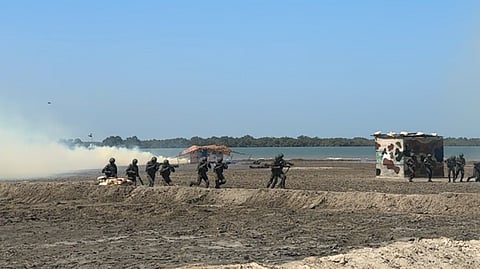
A tactical drill illustrated this operating pattern. FPVs advanced in assault waves organised into vanguard, main body and rearguard. Forward elements conducted reconnaissance and deception, the rear secured depth and the main body closed on simulated shoreline enemy positions.
Above them, UAVs maintained persistent ISR coverage while weaponised drones operated alongside the formation. Robotic mules moved near waterlines, All Terrain Vehicles exploited firmer creek edges and foot patrols crossed marsh stretches where mechanised mobility failed. Indigenously upgraded L-70 air defence guns were positioned inland during the drill, providing low-altitude cover. These same systems proved critical during Operation Sindoor, when the Kutch and creek sectors saw more than 100 Pakistani UAVs engaged through a layered grid of L-70 guns and counter-UAS systems.
Across this sector, land, water and air compress into a single multi-domain battle space.
Where distance lies and salt eats steel
Inland, constraints shift. The Kutch desert permits firepower deployment, but movement becomes the central challenge. Roads are sparse, tracks unreliable and load-bearing uneven, placing mobility burdens on ATVs for troops and logistics. Armour is used selectively, with T-72 tanks fitted with cope cages reflecting adaptation to drone warfare seen in Operation Sindoor. Artillery remains available but terrain-limited; 130 mm M-46 guns provide long-range support under stable conditions. Here, heat mirages distort line-of-sight, degrading targeting accuracy. Even at short ranges, depth perception becomes deceptive. Salt-laden conditions further erode engines, optics and metal, accelerating wear beyond normal maintenance cycles.
How Op Sindoor changed Kutch
Even before Operation Sindoor, the Army had begun integrating UAVs into its operational matrix, but last year’s hostilities turned that evolution into a doctrinal inflection point. Nearly 1,000 UAVs, largely low-grade Chinese and Turkish-origin platforms along with some suicide drones, were launched by Pakistan across the western frontier. The response was layered, with air defence guns, counter-UAS systems and surveillance networks operating in an integrated grid. Since then, UAVs have been pushed to lower tactical levels, counter-drone capability standardised and survivability measures like cope cages institutionalised.
In Kutch, this shift is evident in terrain adaptation. UAVs offset mobility constraints by delivering supplies to forward positions and providing real-time ISR and fire correction, improving targeting precision. Inter-agency coordination has also tightened. The BSF maintains the first line in the creek sector, with joint drills and shared drone training expanding across forces.
Post Operation Sindoor, activity along the western coastline has intensified, with India reinforcing presence, surveillance and mobility. As Defence Minister Rajnath Singh stated in Bhuj, any aggression in Sir Creek will invite a decisive response.
The infrastructure underpinning that warning is already visible. Drone labs operate from forward positions. UAVs take over targeting when heat mirages distort optical systems. Logistics drones push supplies where roads cannot. Counter-drone systems now move with formations, while FPVs and ATVs extend operational reach across terrain that can halt conventional movement cold. In this sector, where the ground itself resists occupation, battlefield advantage increasingly belongs to the force that can see farther, adapt faster and act first.
