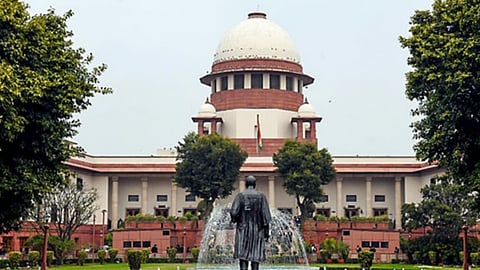

NEW DELHI: The Supreme Court on Monday issued notice to the Centre, all states and Union Territories on a batch of petitions challenging the Transgender Persons (Protection of Rights) Amendment Act, 2026, which allegedly violates the right to self-determination by mandating medical procedures for gender identity certification.
A two-judge bench od the apex court, headed by the CJI Surya Kant and also comprising Justice Joymalya Bagchi has constituted a three-judge bench headed by the Chief Justice of India himself to examine the matter.
The batch of writ petitions were filed in the top court, including that of noted transgender, Laxmi Narayan Tripathi, and others, challenging the Transgender Amendment Act 2026.
Tripathi, the Chairperson of National Council for Transgender Persons (NCTP), and its member Zainab Patel have moved the Supreme Court and filed a petition challenging the Constitutional validity of the Transgender Persons (Protection of Rights) Amendment Act, 2026 which introduced many changes to the legal framework governing the recognition, rights and protection of transgender persons.
The amendment was passed by the Parliament recently in March, taking away the right to self-determination of gender, the plea claimed. The law had received presidential assent on March 31.
The petition challenged the Amendment Act, as causing "irreparable constitutional injury" to the fundamental rights of transgender persons guaranteed under Articles 14, 15, 19 and 21 of the Constitution.
"Section 4(2) provided, in express terms, that a transgender person shall have a right to self-perceived gender identity. It was the direct statutory embodiment of the NALSA mandate. Parliament has simply deleted it. A legislature cannot repeal a provision that gives concrete form to a fundamental right recognised by this Hon'ble Court without violating Article 21. The unconstitutionality is in the act of deletion itself," the plea stated.
Criticizing the role of the state that it could not impose medical, psychiatric, or bureaucratic gatekeeping as a condition for the recognition of gender identity, the plea further added, this court held that informational privacy, including the right to control the disclosure of one's own sensitive personal and medical information, is a fundamental right.
The deletion of Section 7(3)'s protective Proviso strips certificate-holders of guarantees that their existing entitlements will not be disturbed. The drafting of Sections 18(e)-(h) stigmatises transgender presentation by making it the object of criminal offences rather than targeting coercion alone, the petition said.
"The failure to enhance the maximum sentence for sexual and physical abuse of transgender persons under Sections 18(a)-(d), while introducing life imprisonment for trafficking offences, reflects an arbitrary legislative hierarchy that continues to undervalue the bodily integrity of transgender persons. The continued failure to implement the reservation directions issued in NALSA for transgender persons under Articles 15(4) and 16(4) compounds this constitutional default. No legitimate state objective can justify this cumulative regression from the constitutional standard set by this Hon'ble Court over a decade ago," it added.
The plea further submitted that the deepest constitutional wound inflicted by the Impugned Amendment Act is the substitution of the definition of "transgender person" in Section 2(k) of the Principal Act. The original definition, which identified a transgender person as “a person whose gender does not match with the gender assigned to that person at birth,” faithfully reflected what this Court held in NALSA: that gender identity is determined by the person herself/himself, not by biology, birth assignment, or state verification, the petition claimed.
After the new legislation was made, it was being severely criticised by oposition parties and LGBTQIA+ (Lesbian, Gay, Bisexual, Transgender, Queer, Intersex and Agender etc) communities.
Those who opposed the legislation have argued that they were not consulted at all prior to the introduction of the Bill in parliament. Two members of the NCTP, Kalki Subramanium and Rituparna Neog, resigned from their posts the day the Rajya Sabha passed the Bill.
