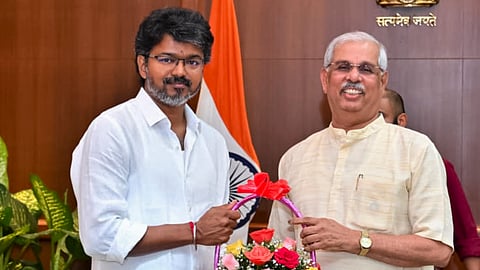

‘Thalapathy’ Vijay has scripted one of the most dramatic political ascents in contemporary Indian politics. In a political culture long shaped by charismatic film personalities, Joseph Vijay Chandrasekhar’s rise stands out not just for his cinematic popularity, but for transforming fandom into a functioning political machine and emerging as Tamil Nadu’s Chief Minister-designate within just two years of launching a party.
His party, Tamilaga Vettri Kazhagam (TVK), stunned observers in the 2026 Assembly elections by winning 108 seats in its debut electoral contest and later securing a governing majority with outside support from the Congress, CPI, CPI(M), VCK and IUML. The result transformed Vijay from a cinema icon into the most significant new political force in Tamil Nadu since M.G. Ramachandran (MGR).
A historic political debut
When Vijay formally launched TVK on February 2, 2024, and declared that the party would contest all 234 Assembly constituencies independently, many dismissed the move as another short-lived actor-led political experiment. Tamil Nadu has witnessed several film stars entering politics, but only a few succeeded in converting popularity into electoral success.
The verdict of May 2026 dramatically altered that perception.
TVK emerged as the single largest party in the Assembly elections, winning 108 seats and polling 1,72,26,209 votes with a standalone vote share of 34.92 percent. The party later crossed the majority mark of 118 seats through post-poll support from allied secular parties, taking the alliance tally to 121 seats.
The scale of Vijay’s debut immediately invited comparisons with MGR, the legendary actor-politician who founded the AIADMK in 1972 and formed the government in 1977 after winning 130 of the 200 seats his party contested. Yet the comparison also highlighted a major distinction: MGR entered politics after years within the DMK’s organisational structure, whereas Vijay built TVK without inheriting an established political apparatus.
But the rise was far from easy. Apprehensions that Vijay’s entry would turn out to be another short-lived actor-led political experiment were not entirely unfounded. The two-year-old party had to take on two giants rooted in the state’s deeply entrenched Dravidian political culture — the ruling DMK and the principal opposition AIADMK. Adding to the challenge was a third formidable rival: the BJP, the ruling party at the Centre, which contested in alliance with the AIADMK.
Building a political base before entering politics
Vijay’s political rise did not begin with the formation of TVK. For years, his fan network — the Vijay Makkal Iyakkam (VMI) — functioned as a quasi-political grassroots organisation engaged in welfare work, local mobilisation and social outreach.
The strength of this structure became visible during the 2021 local body elections, when 129 members associated with Vijay Makkal Iyakkam won seats even without the backing of a recognised political party.
By late 2025, TVK claimed more than 15 million registered members, reflecting Vijay’s enormous appeal among first-time voters and younger demographics. His party framed itself around secularism, social justice, administrative transparency and what it described as a “politics of equality” transcending caste and religion.
Vijay repeatedly projected TVK as a corruption-free and caste-free alternative to the existing Dravidian establishment. The party positioned the BJP as its ideological opposite, while describing the DMK as its principal political rival.
Its ideological themes included anti-corruption politics, Tamil identity, federal rights, social justice and resistance to what Vijay called authoritarian tendencies of the Union government.
Born into cinema, shaped by conviction
Joseph Vijay Chandrasekhar was born into a film family in Chennai. His father, S. A. Chandrasekhar, is a filmmaker and producer, while his mother, Shoba Chandrasekhar, is a singer.
Raised in a Catholic family, Vijay was baptised at the age of 12. His father is Christian and his mother Hindu — a background that later informed Vijay’s public emphasis on religious harmony. Speaking about faith, Vijay once remarked: “Church, temple or dargah – I feel the presence of the same divinity.”
He studied at Bala Lok Matriculation School in Virugambakkam, Chennai, where teachers remembered him as disciplined, calm and talented in sports. Vijay later joined Loyola College, Chennai, to study Visual Media but dropped out midway after deciding to pursue acting full-time.
“I was born into a film family,” Vijay recalled in an earlier interview. “My father was a popular commercial director at the time. I used to act in many of his films as a child star. I decided that cinema was my future.”
Vijay first appeared as a child actor in the 1984 film Vetri, directed by his father. He made his debut as a lead actor in Naalaya Theerpu (1992) before gaining wider recognition through Sendhoorapandi, in which he acted alongside Vijayakanth. His breakthrough came with Poove Unakkaga (1996), directed by Vikraman, which established him as a romantic lead and connected deeply with family audiences. He followed it with major successes such as Kadhalukku Mariyadhai (1997), which earned him the Tamil Nadu State Film Award for Best Actor.
By the late 1990s and early 2000s, Vijay had become one of Tamil cinema’s most bankable stars with hits including Kushi and Priyamaanavale.
A decisive shift came in 2003 with Thirumalai, which transformed his image into a mass-action hero. The blockbuster Ghilli (2004) cemented his position among Tamil cinema’s biggest stars. Films such as Pokkiri, Sivakasi, Kuruvi and Kavalan strengthened that image further.
Yet Vijay’s screen persona evolved beyond conventional action stardom. His films increasingly fused heroism with social messaging.
Cinema as political preparation
In his 2014 movie Kaththi, Vijay addressed farmer suicides and corporate exploitation. Mersal criticised healthcare corruption and even referenced the GST regime. Bigil championed women’s sports, while Sarkar explored electoral malpractice and political manipulation.
Over time, Vijay consciously shifted from hyper-masculine roles toward what critics described as a “saviour figure rooted in social justice”.
In a way, Vijay’s films and public appearances had begun carrying political undertones long before entering electoral politics. Audio launches frequently resembled political speeches, while punch dialogues in films increasingly echoed themes of governance, corruption and people’s rights.
Film researcher Mohamed Ilyas R noted that understanding Vijay’s political evolution requires understanding the ambitions and influence of his father, S.A. Chandrasekhar, who harboured political aspirations long before Vijay formally entered public life.
By the late 2000s, Vijay had become a dominant force in Tamil cinema, with major production houses linked to political power backing several of his films. Importantly, his cinematic narratives often mirrored themes later central to TVK’s ideology: justice for the underprivileged, anti-corruption politics, communal harmony and empowerment of ordinary citizens.
In Poove Unakkaga, Vijay became a symbol of inter-faith harmony. Kadhalukku Mariyadhai portrayed a romance between a Hindu man and a Christian woman. Thamizhan cast him as a lawyer fighting for social justice and the rights of the poor.
These films gradually helped construct a political image before the politician himself officially emerged.
The power of “Thalapathy” fandom
Vijay’s fan culture is among the most intense in Indian cinema. First-day-first-show screenings, midnight celebrations, giant cut-outs, milk abhishekams, drums and public processions became integral to the phenomenon surrounding him.
But unlike many fan clubs, Vijay’s network increasingly evolved into a disciplined grassroots structure capable of political mobilisation.
The Vijay Makkal Iyakkam effectively functioned as the foundation upon which TVK was built. Fan clubs were transformed into booth-level networks, social-service units and local outreach platforms. This organisational groundwork proved critical during the 2026 elections.
Apart from acting, Vijay also built a successful career as a playback singer. He debuted as a singer in 1994 with “Bombay City Sukkha Rotti” from Rasigan.
Over three decades, he collaborated with leading composers including A. R. Rahman, Ilaiyaraaja, Anirudh Ravichander and Yuvan Shankar Raja.
Songs such as “Vaadi Vaadi” and “Google Google” became immensely popular and further strengthened his connection with younger audiences.
True transition to politics
Following The Greatest of All Time (2024), Vijay announced that his 69th film, Jana Nayagan, scheduled for release in 2026, would likely be his last before devoting himself fully to politics. Reports that he was paid Rs 275 crore for the project underscored his extraordinary commercial value and status as one of India’s highest-paid actors.
Vijay’s rise reflects a larger shift in Tamil Nadu politics at a time when the state’s traditional Dravidian order is undergoing transition after the eras of M. Karunanidhi and J. Jayalalithaa.
Unlike earlier actor-politicians who relied primarily on charisma, Vijay combined celebrity appeal with a carefully cultivated grassroots network, issue-based political messaging and a youth-centric mobilisation strategy.
Whether his government succeeds or struggles will shape the next phase of Tamil Nadu politics. But his emergence has already redrawn the political landscape, establishing Joseph Vijay as not merely a film superstar who entered politics, but as the architect of one of the most consequential political breakthroughs in recent Tamil Nadu history.
