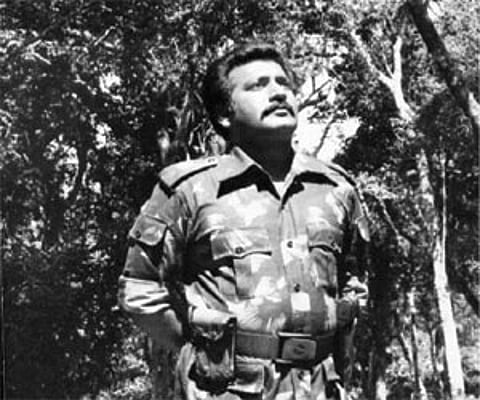

V Prabhakaran had led the movement for Tamils ‘by example’. However, he had broken norms too. Though the LTTE did not allow its cadre to marry or even get into romantic liaisons, he himself courted a young college student, Mathivathani Erambu, after virtually kidnapping her. His marriage in Tirupporur, near Chennai, on October 1, 1984, led to the relaxation of the ban on marriage. Today, the exact whereabouts of his wife, a daughter named Thuwaraka, and a son named Balachandran, are not known. His eldest son, Charles Anthony, joined the movement, and had masterminded the air raids carried out by the LTTE over Colombo and other parts of the country. Anthony was killed by the Sri Lankan forces on Monday.
The LTTE leader’s strong point was that he had a fierce sense of independence, which he exercised in his judgments. He would not budge an inch from a decision he had taken after much thought or on a gut feeling. His political and ideological advisor, Anton Balasingham, gave an instance that exasperated even a staunch follower of Prabhakaran like him. In the late 1980s, Indian Prime Minister Rajiv Gandhi had given him an offer which no moderate leader would have rejected. Balasingham was keen that Prabhakaran accepted power and asked for more gradually. But Prabhakaran was silent and when pressed said that the LTTE should not accept any proposal that would tie it to the apron strings of India or any other world power.
Prabhakaran was a self-taught military man who read books on military science translated into Tamil, so that he could read them. He watched American war movies with a keen eye for detail. Though he went in for smuggled modern weapons, he encouraged the indigenous manufacture of weapons including mortar bombs and mines and even a submarine. He encouraged innovations in battle and gave his commanders a great deal of leeway, though he decided the grand strategy. He rewarded the meritorious and punished those who failed to perform.
His drawbacks
Prabhakaran’s main drawback was that he would not democratise the organisation or the Tamil movement. He discouraged a mass movement. He had no interest in doing anything for the welfare of the people. His goal was the achievement of an independent Tamil Eelam through violence, a Tamil Eelam that he would rule dictatorially.
The second major drawback was his contempt for the gradual step-by-step approach to achieve the goal of an independent Tamil Eelam. He rejected Balasingham’s advice that the Tamils should assume power with a modicum of autonomy and seek greater autonomy over time.
The third drawback was Prabhakaran’s belief that the Tamils and their vanguard the LTTE, should achieve independence without any obligation to any other country.
This approach alienated him from many well-wishers,
admirers and countries, including neighbouring India. One of the main reasons why the LTTE failed was that it had no powerful supporter outside Sri Lanka. Everyone who had dealt with the LTTE on the political plane had broken away after some time saying no one could do business with the LTTE, as it was a law unto itself.
