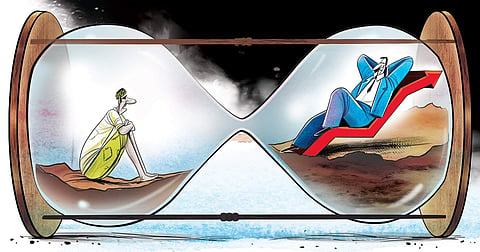

Amidst Prime Minister Narendra Modi’s hard push for investment in India at the World Economic Forum (WEF) in Davos, two recently released reports merit serious attention. An Oxfam survey revealed that the richest one per cent in India pocketed 73 per cent of wealth generated in 2017.
Similarly, a WEF survey placed India at 62 among the 74 emerging economies on an Inclusive Development Index—much below China and even Pakistan. In this context, Mahatma Gandhi’s statement, “A Nation’s greatness is measured by how it treats its weakest members,” assumes relevance. Bringing weaker sections to the mainstream has been the biggest challenge for policymakers.
It is true that economic growth, scientific and technological advancement, and the rise of the educated Indian have improved the poverty situation in the country. The attention India receives in international and multilateral forums is also testimony to its rising importance. The fact that India’s candidate was re-elected to the International Court of Justice highlights the rise of the developing world for which India is a leading campaigner.
In Davos too, India projected itself as a global power. Never before has the country displayed its economic and development agenda so aggressively as it did in Davos now. Modi rolled out the red carpet for world business leaders by promising to cut down ‘red tape’ and create a favourable business environment. Since the 1980s, the Indian economy has grown phenomenally and today, we are the fourth-fastest growing economy. This remarkable progress contributed to substantial reduction in poverty. Our economy is showing good signs. Access to education has improved and life expectancy has risen to 68.
But as the Oxfam and WEF surveys say, growth has not been equally distributed. Income inequality, regional disparity, poverty, malnutrition, gender inequality and socioeconomic stigmas still persist and blunt our development agenda. According to World Bank, India is home to 224 million poor people, the highest in the world. India is ranked 131st in the Human Development Index—below countries like Namibia and Libya.
On the other hand, in the last two decades or so, the number of Indian billionaires increased from just two to 65. This shows that the economy is growing, but growing unequally. The growth has been exclusive rather than inclusive.
In order to make growth inclusive, we need to create equal economic opportunities for all. It is incorrect though to say that the government is not addressing the challenges. Various policy decisions have been taken by successive governments in order to eradicate poverty, generate employment and ensure inclusive growth—especially since the Eleventh Five Year Plan. Various welfare programs and employment generation schemes like MGNREGA were introduced focussing on marginalised sections such as SCs, STs and women.
A Ministry of Rural Development report reveals that around 813 crore person days of employment have been generated from 2014-17 under Awaas Yojana, PMGSY and MGNREGA. This is a huge accomplishment in addressing inclusiveness in the employment segment. Though there have been reports of irregularities like manipulation of muster rolls of labourers, Aadhaar is helping us avoid such irregularities. The biometric-based identity program is making sure that the poor benefit from government schemes.
Similarly, under the Jan Dhan Yojana, around 30.71 crore beneficiaries have been linked with the formal banking set-up with a total of `69,841.16 crore balance in beneficiary accounts. This is a remarkable step towards financial inclusion which will further contribute towards the bigger goal of inclusive growth. Likewise, under the MUDRA Yojana, crores of rupees in loans have been sanctioned to people belonging to disadvantaged groups.
It is time to narrow down the gap that exists between states, regions and people belonging to various social and economic groups. Policy initiatives have been taken up, but this needs to be followed up more vigorously for us to dream of a better and inclusive India. Cluster-based and robust implementation mechanism need to be followed to ensure people have access to quality education, healthcare, employment and livelihood. There is an urgent need to promote skill development and entrepreneurship among disadvantaged groups including women. Encouraging skill development among rural handicrafts artisans will not only sustain our centuries-long craftsmanship but also contribute heavily towards employment generation, poverty reduction and economic growth. Another equally important factor that needs urgent scrutiny is the reformation of our taxation system.
The quantum of government spending on welfare measures and social development largely depends on the revenue generation in an economy. Keeping in mind the low tax-to-GDP ratio in India, we surely have to broaden our tax base.
The monumental GST introduced recently will rationalise many of the problems faced in the indirect tax arena while substantially increasing the tax base. It is heartening that the GST council is meeting at regular intervals and addressing the shortcomings and revising the tax rates. A similar increase in tax base in direct taxation merits urgent attention. Economic growth would be futile if growth is not distributed equally. Everyone should be contributing for the growth and development of a nation and everyone should be reaping its benefits. There is no point in contributing billionaires to the Forbes lists while being home to millions suffering from poverty, malnourishment, and unemployment.
Pradeep Kumar Jena
Serves in the Indian Defence Accounts Service Views expressed are personal
Email: pradeepjnu@gmail.com
