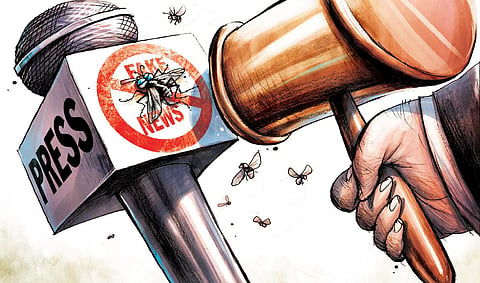

Last week, a division bench of the Bombay High Court began the final hearing on pleas challenging the amended Information Technology Rules (Intermediary Guidelines and Digital Media Ethics Code) Rules, 2021, that empower the government to identify “fake news” about government policies and conduct on social media platforms. The amended Rules are before the court because they have been challenged by standup comedian Kunal Kamra, the Editors Guild of India, the New Broadcast and Digital Association and the Association of Indian Magazines.
It’s true that misleading information and propaganda disguised as news pose significant challenges in democratic systems, and there is an ongoing discussion on how to combat this problem, especially in digital media. The amended Information Technology rules seek to target “fake news” by directing social media intermediaries to remove any post that is tagged as “fake or false” by the fact check unit at the Press Information Bureau or “other agency authorised by the Central government for fact-checking”. The “other agency” is intended to be the government’s new Fact-Check Unit (FCU). While the legislative intent to regulate fake news and misinformation is justified, authorising the Central government to assume discretionary power to determine what content is “fake” without prescribing any procedures or recourse seems capricious. The Bombay High Court even said last week that if the effect of a rule or law is unconstitutional, it has to go, no matter how laudable its motive may be.
There has been reason for concern about the misuse of social and digital platforms to mislead or harm others by creating or sharing fake news and disinformation. Fake news is typically spread by sites that appear credible media sources but propagate false or misleading information intended to deceive the public. When such activities become organised and systematic, they transform into disinformation campaigns that can potentially disrupt governance and even entire countries. For example, during the 2016 US presidential election, there were reports of apparently coordinated efforts, allegedly with Russian government involvement, to spread false information. Yet introducing government control may be a cure that is worse than the disease.
We must maintain a balance between the freedom of the press and tackling misinformation or fake news. Freedom of the press is a fundamental human right and a cornerstone of any democratic society. It is the mortar that binds together the bricks of our freedom as well as the open window embedded in those bricks. While the spread of fake news can have serious consequences, including harm to public health, damage to social cohesion, and interference with democratic processes, it cannot be overcome by restricting press freedom or giving the government more power.
Fact-checking has become a critical tool in modern journalism. To address the issue of rising fake news and misinformation, various guidelines and best practices have been developed by international bodies such as the International Fact-Checking Network (IFCN). The EU also came out with a Code of Practice on Disinformation in 2018 to tackle the spread of fake news by getting leading social networks, advertisers and the advertising industry to agree on a self-regulatory code. The IFCN guidelines emphasise the importance of transparency, impartiality, and accuracy in fact-checking. They also recommend a thorough and rigorous process of verifying facts through independent regulators, using multiple sources, and providing detailed explanations of the methodology used. In addition, fact-checkers are encouraged to avoid bias and clearly distinguish between facts and opinions. A government fact-checking unit would not pass these tests.
In situations where false information is rampant, governments have been tempted to use regulation or prohibition to deal with offensive content and fake news. For instance, in Germany, a law was enacted in June 2017 requiring digital platforms to remove hate speech and misinformation. It obliges social media firms to delete illegal, racist, or defamatory comments and posts within 24 hours, with a maximum penalty of $57 mn for content that remains on the platform. But identifying objectionable content is not always simple. Defining hate speech or defamation is challenging, and watchdog organisations have raised concerns around the broad and imprecise language used in regulations. Overly intrusive regulation of internet platforms in democratic societies can encourage autocrats to expand censorship, abridging democratic governance and limiting freedom of expression. India must not fall into this trap.
This becomes even more imperative for us since India’s rank in the Global Press Freedom Index has slipped to 161 out of 180 countries in 2023, dropping 11 places even below the ranks of neighbouring countries like Pakistan and Afghanistan. International observers say the situation has deteriorated here due to the heightened aggression of government agencies in the media, along with large-scale disinformation or propaganda campaigns. Against this backdrop, a government-backed mechanism to fact-check news can act as an impediment in uplifting Indian media’s standards and risks being used as a tool to muzzle the press.
Our country needs better independent mechanisms that detect fake news, decrease financial incentives for those who profit from disinformation, and enhance online accountability. One approach is to encourage responsible journalism by establishing ethical standards and providing training and resources for journalists to verify information and fact-check their reporting. Best practices can be drawn from the EU and the IFCN to develop clear guidelines and standards for fact-checking and verifying information and to establish an independent media regulator. The regulator would oversee journalistic practices and hold media outlets accountable for spreading misinformation, imposing penalties on those who intentionally spread fake news or engage in other forms of disinformation. It is also important to promote media literacy and critical thinking skills among the public so that individuals are better equipped to evaluate the credibility of news sources and the accuracy of the information they come across.
Maintaining a balance between freedom of the press and addressing misinformation or fake news is easier said than done, but it’s the only way. One can only hope the Bombay HC will come to the same conclusion.
Shashi Tharoor
Ambedkar: A LifeThird-term Lok Sabha MP from Thiruvananthapuram and the Sahitya-Akademi winning author of 24 books, most recently
(The author is grateful to Jameela Sahiba for assistance in preparing this article.)
