
An elephant joke comes to mind as I look at the twists and vaults at the Paris Olympics and the role technology and categorisation plays in deciding winners. Question: What did the elephant say to the ant? Answer: Pick on someone your own size. Seriously, the elephant has a point. The pachyderm may well lose out if the game was about getting into a narrow alley.
There’s also Aesop’s fable about the fox and the stork, symbolic of how playing fields can be manipulated. As the story goes, the fox invites the stork to a meal and the long-beaked bird misses dinner as it cannot drink from a bowl. The return offer from the stork sees the fox in a fix as the host offers the meal in a narrow-necked vessel. The story can be an early lesson for kids in warfare—and its milder versions, politics and sports.
George Orwell described competitive sport as “war minus the shooting”. Talking of shooting, Turkish Olympian Yusuf Dikec is a perfect muse for longtime watchers of sports, technology, and politics, and their fascinating interplay. Dikec sparked viral memes as he wore only an ear plug to the shooting range, unlike most shooters who wear visors, ear-defenders and special lenses with a blinder to improve focus. Dikec won an Olympic silver and an unofficial gold from netizens for being casually cool—featuring grey hair, an intense gaze, t-shirt and plain specs.
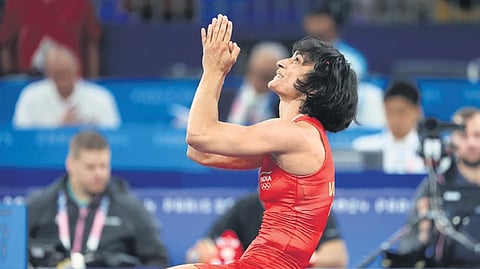
India’s own darling, Vinesh Phogat, won a moral gold from her supporters at home, especially those who saw her wrestling with powerful men in a sexual harassment scandal. But she missed her stab at an Olympic gold because she was 100 gm overweight in the 50 kg category just ahead of the final bout. This is truly heartbreaking.
Should we have a points system where minor category-linked flaws can be adjusted? What about having a shooting category for those like Dikec who do not sport artificial props?
As a sports-loving kid, I heard with equal fascination and dismay tales of how technology enhanced games and also played spoilsport. Helmets made a stealthy entry into cricket fields in the 1970s, about 100 years after crotch guards and 120 years after gloves. We now have arm, thigh and abdomen guards too. As far as I can see, such things have enhanced the sport by reducing mortal fear.
But hockey is another story altogether. Stars like Dhyan Chand and K D Singh ‘Babu’ played barefoot on the grass and displayed dazzling dribbling skills before India’s golden run ended. Between Amsterdam 1928 and Tokyo 1964, we won seven golds and one silver. As hockey shifted from natural grass to synthetic AstroTurf surfaces a decade later, the game steadily slipped out of India’s grip. Dribbling gave way to long passes.
Athletics has a similar tale. At the Rome Olympics, Abebe Bikila of Ethiopia ran the marathon barefoot to set a new world record after discovering that the official gear supplier, Adidas, had run out of shoes his size. India’s Shivnath Singh, who ran with taped feet and no shoes, won a 5,000-metre gold at the Teheran Asian Games in 1974.
Should we reverse-swing sports and have separate games for groups separated by culture, training and technology? Is there a hidden kind of cultural imperialism in which the rich West resembles the cunning fox in Aesop’s fable? Perhaps not, but proper segregation is a good thing. You only have to look at wrestling, boxing and gender to get my point.
I covered the Commonwealth Games at Kuala Lumpur in 1998. Though deputed to mainly cover cricket, my task included interviewing boxers, who included a rather frail Canadian kid. Boxers and wrestlers need not all be heavyweight.
Cricket, too, can stretch for five days, or be only 50 or 20 overs long. Why not pepper up other games with similar categories? We could host a Barefoot Olympics to give Westerners an idea of how the field can be levelled. We did some of that in cricket when India’s spinners used to excel on the turning pitches of Kolkata and Chennai before Bharat started producing its own battery of excellent fast bowlers.
We may have to take a fresh look at gender classification as well if the Paris Olympics is any indication. Even against the backdrop of a growing LGBTQ rights movements, some mistook Algerian woman boxer Imane Khelif for a transgender and raised an ugly controversy over testing and testosterone. Khelif had failed a questionable gender test by the International Boxing Association in 2023, but the International Olympic Committee declared her fit for Paris. She became a target of disinformation after she won against Italian Angela Carini. The international boxing and Olympic associations are having a heavyweight bout over this issue.
I don’t quite know who will deliver the knockout punch. I am certainly not an expert at testing testosterone. However, I do know that categories work better than controversies. Some futuristic fiction may categorise someone as part-female or give minus points if someone’s weight is only mildly off the category.
Most of all, I think we need to separate the men from the boys and the elephants from the ants.
(Views are personal)
(On X @madversity)
Madhavan Narayanan | Senior journalist
