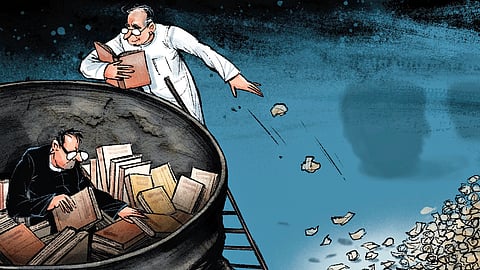

Narrative wars have been around from the beginning of civilisation. Kingdoms, republics, tribes and rebel groups have long used disinformation and ideology to manipulate political narratives to their advantage. The spread of digital networks and social media, however, has allowed for an unprecedentedly rapid penetration of such narratives. Artificial intelligence now presents the danger of an algorithm-driven mass-scale manipulation that all sovereign governments and citizens need to guard against.
One could argue that people will adjust their behaviour to the new environment and become more sceptical. Notice, however, that sources that establish themselves as credible become very important in such an environment of doubt. Therefore, the new battlefield is for the ‘legitimacy’ and ‘credibility’ of information sources. The labelling of a source as credible is especially powerful as its data would be used to train AI platforms that then run the default responses of many systems.
Those attempting to manipulate global narratives are aware of the credibility issue and have been investing in taking control of default sources even as they have been taking great pain to mask the takeover. One tactic, drawing inspiration from academic publishing, is to create cross-references in order to echo a particular view so that it comes to be seen as the accepted truth. Akin to money laundering, legitimacy laundering then creates layers of sources that hide the original manipulators.
Notice how, in recent years, there has been a proliferation of global indexes and rankings. These rankings are themselves derived from other indices—often entirely subjective opinions—and, in turn, flow into sovereign ratings, investment weightages and so on. In this way, real-world decisions get influenced by sources that are not easily visible to the end user.
A good example of such legitimacy laundering is the World Bank’s World Governance Indicators (WGI). The WGI is widely used in applications like credit ratings. However, the indicators included in WGI are sourced from a few North Atlantic think tanks and NGOs. In turn, these think tanks and NGOs are funded mostly by a tiny clique of sponsors. In this way, the World Bank effectively gives legitimacy to the views of this small clique.
The WGI was not actually run by the World Bank, but by two external researchers. A hard-to-find disclaimer stated that the organisation did not bear any responsibility for the WGI even though it had been on its website for many years. A number of developing countries including India finally called out the sleight-of-hand to the Bank’s board last year.
Following sustained criticism, the Bank was forced to do an external review of the WGI and, in November 2024, announced the following changes.
The indicators will officially be considered a World Bank product and go through a similar process of review as other official documents. In other words, the institution will no longer be able to escape responsibility by claiming some external researchers run the WGI.
The Bank would institute a systematic process of including new data sets, especially from the Global South. In other words, there is an opportunity to break the monopoly of the North Atlantic think-tank-NGO cabal. The Bank would document the sponsors, methodologies and primary use cases. In theory at least, a small group of funders will no longer be able to do legitimacy laundering with such ease.
The Bank will clearly list out the limitations of the data and methodology, including potential biases. This means that the WGI will, hopefully, no longer be used unquestioningly on everything from finance to academia.
The Bank will try to document the indicators’ uses with real-world consequences for countries, including by credit rating agencies. Again, the Bank would not take responsibility for inappropriate downstream uses, but would be responsible for providing better “health warnings”.
Over the next year, the World Bank will update the WGI methodology to address the indicators’ sensitivity to each underlying data source, examine the sensitivity and robustness to alternative methods of weighting, and consider the value of including additional datasets on governance from the Global South.
The changes announced are a small but important victory for a number of reasons. First, it removes an important route used by a small clique of sponsors to manipulate global narratives and normalise their agenda. Second, it demonstrates that an intellectual deconstruction and systematic pushback can force reform. Third, it opens up space for new sources of information, including those from the Global South.
Nevertheless, we should be clear that the WGI is just one of many places where legitimacy laundering takes place. An important current battlefield of mass manipulation is Wikipedia. The platform was built on the principle of crowd-sourcing knowledge. The idea was that mistakes and deliberate vandalism would eventually be washed away by subsequent corrections.
The system worked quite well for a while and did indeed create an incredible database. However, it has become noticeable in recent years that a large number of entries have a distinct ideological slant—all in the same direction. If Wikipedia was genuinely a neutral platform, then surely the biases would follow a normal distribution.
It turns out that Wikipedia is not the open-sourced platform that one was led to believe. In reality, it is run by a closed hierarchy of anonymous “editors” who decide what information can be displayed and which changes retained. They even have the power to decide the sources referenced and to ban the contributors who present contrary evidence. In short, it is a bank of carefully-curated information in the guise of a neutral platform.
The layered approach of disinformation not only makes it difficult to pin down Wikipedia, but also to seek legal remedy. The Delhi High Court recently reprimanded Wikipedia for not complying with its orders in the Asian News International case.
The problem with Wikipedia is not merely the fact that it is used widely as the first port of call for basic information. The bigger problem is AI is now being trained on it. This means the biases of Wikipedia will get hardwired across multiple systems and, through feedback loops, get amplified.
Note that both WGI and Wikipedia are just examples of the systematic legitimacy laundering used to manipulate global narratives. Sovereign governments and the general public need to be alert to its dangers.
(Views are personal)
Sanjeev Sanyal -Member, Prime Minister’s Economic Advisory Council
