
Prime Minister Narendra Modi’s recent visit to Moscow attracted extraordinary global attention. It was his first visit after Russia’s invasion of Ukraine and the first bilateral visit of his third term. It roughly coincided with a NATO summit, which was formulating strategies to defeat Russia in Ukraine. It commenced on a day when a barrage of Russian missiles hit Ukrainian cities; one allegedly hit a children’s hospital in Kyiv.
The timing of his visit, the demonstration of his personal chemistry with Russian President Vladimir Putin and fulsome praise for his contribution to the India-Russia partnership all sought to convey that the partnership—shaped by history, geography and economic interests—would survive the current global geopolitical flux.
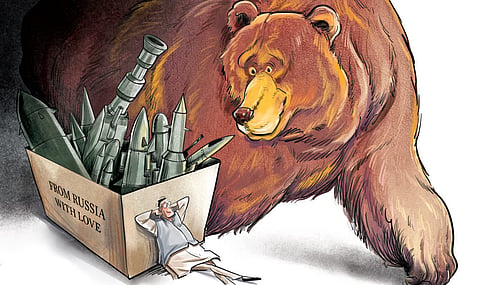
The history is well-known: political, economic and military relations forged during Cold War. A legacy is Russian military equipment forms over 60 percent of Indian armed forces’ inventory. The transfer of weapons and military technologies continued as the US and allies dragged their feet on lifting technology restrictions on India.
The geography is equally compelling. Russia straddles the Eurasian landmass from Central Asia to the Caucasus, which is important for India’s security interests and strategic ambitions. Sandwiched between Russia and China, Central Asia is India’s near-neighbour, bordering Iran, Afghanistan and Pakistan-occupied Kashmir. It is dominated by Russia and China, but now has many regional and extra-regional actors jostling for influence. India needs to closely monitor the interplay of forces here, keeping Russia onside in this endeavour.
Connectivity is key for effective presence in this region. This explains the importance of the trade corridor from India to Central Asia through Iran—the International North–South Transport Corridor (INSTC)—that India, Iran and Russia have been trying to operationalise for years. Refinement of logistical arrangements for this was discussed during Modi’s visit. INSTC could boost India’s trade with Eurasia to $170 billion from under $15 billion today.

Over the years, the Modi government has striven to broad-base the relationship to encompass energy, industry, agriculture, natural resources and niche technologies. Bilateral trade has burgeoned to over $66 billion, though most of it is Russian export of hydrocarbons. Balancing this has been a subject of discussion. Payment difficulties arising from western sanctions are partly to blame. A bilateral settlement system using national currencies is a solution under discussion. Russia’s huge rupee reserves open the possibility of joint ventures in India for manufacture of a range of industrial products, including defence components.
Indian companies have invested billions of dollars in Russian hydrocarbon projects. Six nuclear power plants are being constructed with Russian collaboration in TN, of which two are already in operation.
The surge in Indian purchase of Russian oil over the past two years, after EU banned Russian imports, has fed domestic consumption and served demand for refined products in Europe, which continue to criticise India for “circumventing” sanctions. Modi subtly addressed this hypocrisy by remarking that India’s imports of Russian oil helped stabilise the global hydrocarbons market.
Even while sustaining the Russia relationship, India has fast-tracked relations with the US and allies, which have acquired extraordinary breadth and depth, embracing trade, investment, technology, defence and deep cooperation on a range of bilateral and international issues. Intensifying US consciousness of the Chinese challenge to its global dominance coincided with rising Indian concerns over border tensions with China and apprehensions of the latter’s ambitions in our continental and maritime neighbourhood. This convergence forged a strong India-US strategic partnership (which is not entirely friction-free, as we saw in recent months). Engagement in the Quad and other cooperative mechanisms has cemented ties. Our expanding economy attracts international companies barred from Russia and discouraged from China.
These factors have expanded space for India to pursue its interests with Russia. In 2018, the US threatened sanctions if India acquired the Russian S-400 air defence system. Modi went ahead with the acquisition. The sanctions did not materialise.
Meanwhile, India has diversified arms procurement to expand choice and promote indigenisation. Russia’s share in India’s arms imports fell from 56 percent in 2015-19 to 36 percent in 2019-23. France, Israel and the US occupied the vacated space.
Modi’s visit was criticised abroad for undermining the international isolation of Russia and Putin. This narrative ignores the fact that countries like Vietnam, Saudi Arabia and UAE have recently rolled out the red carpet for Putin, and many non-Western leaders have been visiting Russia. The nation’s political isolation does not extend much beyond the western world.
Modi addressed the Russian missile strikes in this meeting, when he invoked the ravages of war, including the heart-breaking loss of children’s lives, and revealed it had figured in their discussions. Modi said he was encouraged by thoughts emerging from their mutually respectful conversation and affirmed India was committed to working towards peace. Speaking before Modi, Putin also referred to that conversation, thanking the Indian PM for exploring options to resolve the “Ukraine crisis” by peaceful means. It is not clear if this signalled the possibility of a breakthrough.
The elephant in the room, not recognised publicly, was China. It would certainly have figured in closed-door discussions. The Russia-China strategic partnership has been under intense focus, particularly after Ukraine’s invasion. As Russia-West relations have plunged, its dependence on Chinese political and economic support has grown. Indian strategists worry about this dependence diluting Russian sensitivity to our interests. Russia has, by actions and in interactions, sought to assuage these apprehensions. India will continue to keenly monitor weaponry and technologies transfers, intelligence-sharing, and actions in international forums on India’s core interests.
India-Russia relations will remain sensitive to the geopolitical flux. Geography, economics and Eurasian politics create overlapping interests. Both countries seek a multipolar world, though their definitions vary. Each pursues strategies based on opportunities and challenges. Unlike during the Cold War, their interests are not congruent. It means building on convergences and managing differences, so that they do not impact core national interests. Enlightened diplomacy should ensure India’s shared interests with Russia do not clash with those of its other strategic partners.
P S Raghavan
Distinguished Fellow, Vivekananda International Foundation, and former diplomat
(Views are personal)
(raghavan.ps@gmail.com)