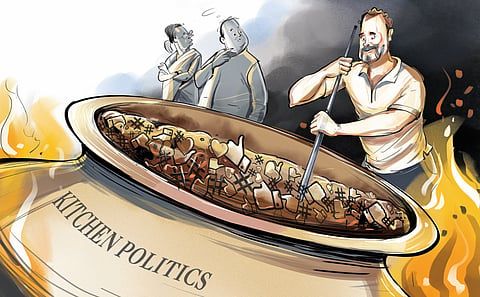

Last week, Rahul Gandhi visited the kitchen of Shahu Patole, a Dalit who is also a retired government officer and a Marathi writer. The two made a dish together besides making small and big talk. Patole was the cook in the video, his wife was in the background kneading dough, and Rahul stood like an inveterate cultural apprentice. It seemed the Congress leader was observing the flames of India’s discriminatory food practices more than absorbing the fragrance of the dish or noting the foundation of its recipe.
This is not the first time Rahul has been inside a kitchen with cameras in tow. Cooking and food in recent years have emerged as the cornerstone of his cultural politics. He made a Bihari mutton dish and bantered about the ‘masala’ of politics with Lalu Prasad Yadav. On New Year’s Eve, he made his mum’s favourite marmalade. When he joked that his saffron opponents too could get some of the jam made, his mother sharply retorted, “They will throw it at us.”
Very early, before the Tamil Nadu assembly polls, Rahul was with a Tamil YouTube channel trying out mushroom dum biryani. Similarly, he made an exotic bamboo chicken dish with Telangana women during the Bharat Jodo Yatra. As it cooked, he was told it was a delicacy specially made for a plebeian goddess. When it was served, his party leaders built a conversation around it. They said if they cooked and ate together, they could win elections together.
During the yatra, Rahul also had a Maharashtra team meeting with a bhakri meal. At another place, with kanda bhajjis, he gave lessons in martial art and mental resilience. He then cooked chole bhature with an army veteran, Naik Deepchand, who had lost both his legs and a right arm in the Kargil operation.
He discussed the Agniveer scheme with him. In May 2023, he rushed into the Delhi University canteen to have lunch with students. He also tried golgappas in Delhi, ate kulfis by the roadside in Bengaluru, and on yet another YouTube channel, said he “tends to be a non-vegetarian”.
As the bromance with M K Stalin took shape in Chennai, he carried Mysore pak from Coimbatore for him. Most recently, in August, he went to Srinagar to cement a secular alliance with the Abdullahs and treated himself to the Kashmiri wazwan. In Haryana, he propounded jalebi economics.
This kitchen politics of Rahul, if one were to invert a familiar phrase, has had a far greater impact than his futile temple visits. To appear devout was his unformed cultural strategy in a different phase, where the strange and twisted rules of religion and caste often helped his hawkish and virulent opponents tie him up in knots. Getting less worked up about the sanctum sanctorum of a temple, he has now tried to enter the sacred space in homes—the hearth—as an entry point to hearts.
Dining with others on formal or informal occasions is different from getting into a kitchen and being part of the cooking process. Rahul is leveraging both. Politicians across the globe frequently walk into cafes to either grab a sandwich, get a coffee or pick up an ice cream to create camaraderie. But food is not as stratified or bound by rules of religion and caste in western democracies as it is in India. It is a complicated terrain to navigate here. When the finance minister says she does not eat onions and garlic, or the prime minister says he fasts during Navratri, it reflects this complexity.
If somebody is lynched for keeping beef in their home or if pork can create communal tension, then the violence that food can cause in India is more than apparent. Here, food is often bottled in strange categories of pure and impure. It was illustrated in the case of the Tirupati laddus recently. ISKCON’s reluctance to serve eggs for midday meals in schools has been more about the sect’s beliefs.
In spite of all this, food is a relatively more accessible category for Rahul with a complicated pedigree, where his claims of a particular religion or caste has been severely challenged in the past. Food creates a wider elbow room and a universality for his politics. It essentially breaks down barriers, when he approaches food as a life-sustaining necessity and not as an extension of a ritual. Ingredients that go into any food are universal and the acids that dissolve them in our bodies are common. This approach helps surmount the cultural restrictions Rahul has so far encountered. Religion puts taste and pleasure in the guilt category.
Food also helps Rahul create accessibility and intimacy, which helps shed the image of a distant and elite dynast. The kitchen makes possible the conversation of social change far easier than being reformist or a conformist in the contentious caste and religious space. His approach may not bring people of various castes and classes to sit together and eat—sahabojana—however, it creates a personal ideal in our cynical times.
Whether this will fetch Rahul electoral gains is difficult to predict, but it is obviously in greater alignment with his ideological choices. Food and kitchens also automatically showcase the diversity of India, where spices change every 20 km and there are as many recipes and methods as there are households. It also puts women at the centre, although people Rahul has cooked with so far have mostly been men. That perhaps breaks a gender stereotype too in a conservative setting.
This kitchen politics is bound to bring its share of criticism. How do people feel when their kitchens are invaded and exposed? Will it be a violation of their dignity? The slick modular kitchen where Rahul made marmalade is very different from the cramped rural kitchen of a poor Dalit. Will all this be seen as a staged event where the poor are showpieces? Why can’t Rahul do the same kitchen exercise without the cameras on?
Is he using this to overcome his political struggles and seek personal salvation? Or is this about feeding social media? After all, the Congress’s social media engagement has witnessed exponential growth. Will he be accused of merely tapping into a fad, and of exhibitionism? Will this further make him a ‘less serious’ politician?
Sugata Srinivasaraju
Senior journalist and author of Strange Burdens: The Politics and Predicaments of Rahul Gandhi
(Views are personal)
(sugata@sugataraju.in)
