
US President Donald Trump’s special envoy for Russia, Steve Witkoff, predicted in an interview last weekend that it would be a success if a settlement of the Ukrainian conflict is achieved by the end of the presidential term in January 2029. The remark signals Washington’s belated awareness that it is futile to press Russia to compromise on its vital national interests.
Witkoff was talking to the media after a 2-month silence during which General Keith Kellogg, Trump’s hawkish special envoy for Russian-Ukrainian settlement, dominated the diplomatic arena advocating a tough stance towards Moscow. The Kellogg line peaked with Trump’s July 14 announcement of a 50-day deadline to Russia to end the war. A fortnight later, Trump said that Russia had “10 days from today” to end its war.
The week since then witnessed a breathtaking cascade of US-Russia tensions characterised by some calibrated brinkmanship—transfer of US nuclear weapons to the UK for the first time in 17 years; belligerent posturing vis-à-vis the Russian nuclear base of Kaliningrad; and deployment of US nuclear submarines near Russia.
Last Friday, the Russian response came with the stunning announcement by President Vladimir Putin on the deployment of Oreshnik, the intermediate-range hypersonic ballistic missile with multiple warheads and a speed exceeding Mach 10 (12,300 km/h) against which the West, including the US, has no defence. The Russian foreign ministry followed through last night with a historic announcement on lifting of Moscow’s moratorium on the deployment of intermediate-and shorter-range missiles as a new reality in strategic balance in the face of “a growing number of facts indicating the emergence of US-made weapons in a variety of regions around the globe including the regions that are of particular national security importance for Russia”.
Trump, who killed the Intermediate Range Nuclear Forces Treaty in 2019, no longer has space left to hide from the humiliating defeat that Nato faces in Ukraine and the bleak future for the US’s European allies having to live under the shadow of Russia’s Oreshnik hypersonic missile.
The Moscow visit by Witkoff, Trump’s counterweight to American hawks on Russia, signifies that the locus of Trump’s policy is gradually switching back to the Russian track. Evidently, Trump is desperate to reopen peace talks. On July 31, in a radio interview, Secretary of State Marco Rubio calmed the troubled waters by signalling that first, although the sanctions route is an option, “our hope is to avoid that and to sort of figure out a way that we can get the fighting to stop… we’ll continue to be available and willing to participate in something like that, if it becomes available”; and, second, “a war between the United States and Russia is not something we can ever see”.
Putin reacted the very next day, saying, “Not long ago, our adversaries were confidently speaking of inflicting a ‘strategic defeat’ on Russia. Today, their rhetoric has shifted: now, their singular and desperate goal is to halt our offensive at any cost.” But Putin won’t relent until the Russian military operation fully realises its objective.
In the above fluid backdrop, Rubio, interestingly, also chose to empathise with Delhi’s trade in Russian oil. Rubio said, “India is an ally. It’s a strategic partner. Like anything in foreign policy, you’re not going to align a hundred percent of the time on everything. India has huge energy needs and that includes the ability to buy oil and coal and gas and things that it needs to power its economy like every country does, and it buys it from Russia, because Russian oil is… cheap… So it is most certainly a point of irritation in our relationship with India… We also have many other points of cooperation with them. But I think what you’re seeing the President express is the very clear frustration that with so many other oil vendors available, India continues to buy so much from Russia, which in essence is helping to fund the war effort.” Rubio’s remarks hinted that there is no inevitability about the US imposing a “penalty” on India.
We are, arguably, at an inflection point as Witkoff has arrived in Moscow. There is a high probability that the Russian-Ukrainian talks will be resumed. Putin has disclosed that at the Istanbul talks, the Ukrainian side had suggested that “it could make sense to discuss security for both Russia and Ukraine in the context of a pan-European security framework”. Putin shared this view.
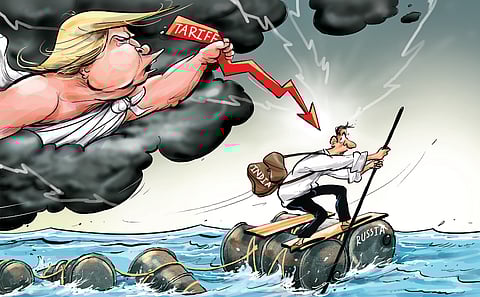
In sum, Trump is inexorably moving toward grabbing Witkoff ’s talks in Moscow as alibi to retreat from his threats to impose punitive sanctions against Russian oil and secondary sanctions on China and India. However, alarmed that the whole raison d’être of secondary sanctions is withering away, Trump has a Plan B. He is presenting a new ingenuous argument that regardless of the revival of peace talks, he’d still “substantially raise” the tariffs against India since it is allegedly profiteering by re-selling Russian oil “on the open market for big profits”.
This is an astounding performance in political chicanery that is absolutely repugnant at the level of a world statesman at the helm of affairs in a superpower. Apparently, America’s businessman-president abhors profitmaking! Yet, by a rough estimate, the US made a profit of $10 trillion in recent years by simply letting its paper currency to be used by other countries as ‘world currency’. If that is not profiteering, what is? Now we know why Trump is so morbidly obsessed with the spectre of a BRICS currency.
That said, when it comes to profiteering, Trump can be choosy. Big Oil cashed in on the European energy market after destroying Russia’s Nord Stream gas pipelines to make windfall profits to the tune of $400 billion. The sordid story appears on the balance sheets of American oil companies during the period of the Ukraine war.
What began as a rewriting of the tariff regime in US-India trade is transforming as brigandage. Trump’s move is spiteful. Rather than getting entangled in the shenanigans of America’s avaricious and petulant president, the honourable thing to do for the Modi government will be to suspend the trade talks pending an explanation as regards Trump’s itch to humiliate India.
M K Bhadrakumar | Former diplomat
(Views are personal)