
In no other democratic country has the institution that conducts elections been under such a harsh spotlight as the Election Commission of India (ECI) is today. In no other country has an election commission been accused of deleting more ‘false’ voters in a decadal registral revision than population growth over that period makes arithmetically feasible. In no other country has an election commission implied to the highest court that a voting-age citizen cannot necessarily vote.
Since its formation in 1950, the ECI has, even while being lauded on certain occasions, been criticised for systemic issues, stupefying lapses and overlooked challenges. The first general election in 1952, marred by issues such as vote-buying, coercion and intimidation, was an omen of troubles to come.
The Representation of the People Act, 1950 profiles and delimits electoral offences, but penalties remain outdated and undeterrent. The ECI responds with advisories rather than decisive action. Over the past decade, the ECI’s reflexive defence of the putative wrongdoer—contestant or campaigner—has become its default mode.
This becomes particularly thorny when the hypocentre is the ECI itself. The Special Intensive Revision (SIR) in Bihar has proved to be an exercise so supremely controversial that it has taken on the contours of the undoing of Indian democracy itself—an unprecedented charge against an institution considered the edificial symbol of democracy. Not that the ECI has never conducted SIRs before, but those between 1952-56 and 2004 were not as contentious (despite some being accused of subpar coverage of the citizenry).
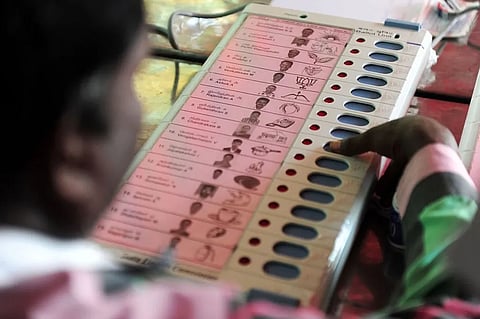
The ECI sought to address the booth-capturing and harrying with measures such as voter ID cards in 1993 and electronic voting machines in 2004—but they have been unravelling, too. Perhaps we need to ask ourselves why the ECI has attracted charges of omnipotent electoral malintent only over the past decade—despite never quite having been out of the woods of controversy even during the Congress times.
In February, Rahul Gandhi dissented over the appointments of the sitting Chief Election Commissioner (CEC) Gyanesh Kumar and Election Commissioner (EC) Vivek Joshi, questioning their non-partisanship. The fact is that the appointment process has a history of opacity. In 2009, the CEC N Gopalaswami recommended the removal of EC Navin Chawla, who had been accused by the BJP of partisanship. Chawla went on to become the CEC. The ECI has long ignored calls for a collegium-based appointment system, as recommended by the Vithal Mahadeo Tarkunde Committee in 1975 and the Dinesh Goswami Committee in 1990 to reduce executive control.
Over time, the ECI began being accused of running with the ruling party. However, it exercised a questionable whimsicality when it wanted to. It flipped, for example, on electoral bonds, opposing them in 2017 but supporting them in 2021. And that it didn’t break a sweat when the Supreme Court eventually outlawed electoral bonds speaks of how impervious it has become to steadfastness of purpose as well as public accountability.
Faced with doubt, the ECI consults itself. Decisions are taken by majority vote—which are always and intriguingly consensual—between the CEC and the two ECs. The ECI and State Election Commissions (SECs)—autonomous bodies constitutionally established and appointed by governors—have at times cut out state governments (as the Bengal SEC did when informing the ECI it was ready to conduct an SIR in Bengal without having intimated the state government).
This is despite the fact that SECs and the ECI have separate electoral functions: the ECI handles national, state legislative, state council elections and elections for the president and the vice-president; the SECs administer elections to the third tier of governance—panchayati raj institutions and urban local bodies.
The ECI’s once-firm stance on the Model Code of Conduct (MCC), formally released in 1974, has been dwindling towards nonchalance. Absent statutory backing, the MCC could have been impuissant, but a decade and a half after its formulation, CEC TN Seshan gave it a backbone. But subsequent CECs have been unable or unwilling to be good conductors to the point that today the MCC is considered more an unrealisable ideal than a doable mandate.
In 2019, the ECI responded to MCC violations by claiming to be a “toothless tiger”. It was a stunning admission from the least disempowerable amongst all Constitutional bodies—but it was humble-bragging, because the violations involved the ruling party. This was hardly the least of its absurdities: in 2024, CEC Rajiv Kumar quoted poetry to dismiss poll rigging allegations in 2024.
Seshan is often hailed as the most transformative CEC. He introduced voter ID cards, staggered polling, and strict monitoring of campaign spending. Incensed by MCC violations, he postponed elections and disqualified candidates. But his legacy has also been one of positional truculence and self-regard: he had, after all, challenged the 1993 ordinance expanding the ECI to a multi-commissioner office. Indeed, previous CECs left a spoor for their successors to follow. Navin Chawla’s tenure was marred by allegations of partisanship towards the then ruling UPA. Lenient towards MCC violations, especially during UPA campaigns, he also had persistent issues with voter-roll inaccuracies.
India has had several Chawlas. But if this democracy is to survive, we cannot afford not to have another Seshan.
Kajal Basu | Veteran journalist
(Views are personal)
(kajalrbasu@gmail.com)
