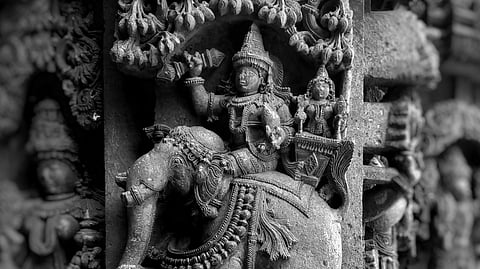

We are used to thinking of Indra, king of the celestials, as a complex personality. In story after story, he comes across as libidinous, crafty, and jealously guarding his turf. But over time, I began to realise that he is often a catalyst, just like Narada Muni and Rishi Durvasa. Indra's interventions can bring out stark truths. This is also noticeable in Buddhist tradition, wherein he is usually called by one of his other names, Sakra.
Sakra, also pronounced Shakra, means 'mighty' and 'powerful' in Sanskrit, a name found in verses from way back in the Rig Veda. In Buddhism, which came much later and drew heavily on Hinduism, Sakra, spelt Sakka in Pali, is a prominent figure, considered the ruler of the Trayastrimsa heaven. That is the name of the heaven at the top of Mount Meru – the celestial realm. Mount Meru is the name assigned in Hinduism to the polar centre of the physical world. Indra has many versions of his name across the Indic world, in Chinese, Japanese, Korean and Vietnamese. In Buddhism, he is often held to consult with the Buddha on matters of morality, and along with Brahma, he is cast as a Dharmapala, meaning a guardian of the Buddha's dharma or dhamma, that is, a protector of Buddhism.
I discovered several stories of Sakra's interventions while going through the stories in the Aryasurya Jatakamala. But first, a word about the book itself. It was originally in Sanskrit and contains thirty-four jatakas. Scholars say it is written in sophisticated language, using Sanskrit literary devices, and a mixture of prose and verse. I could not discover a definite date for the original. But scholars agree it was a very influential work, translated by several later writers. The collection travelled across the Eastern Sea and overland into China. Borobodur, the massive 9th-century Buddhist site in Java, contains depictions of all thirty-four stories from the Aryasurya Jatakamala. I had the good fortune to visit Borobudur and count it as a stunning experience.
One such jataka reminds us of the case of Raja Harishchandra. In this tale, the Bodhisattva or Buddha in a previous birth is a leading merchant named Aviṣahya. Sakra hears of his generosity and decides to test him by making his possessions disappear. But Aviṣahya is committed to giving. Undeterred, he starts to cut grass with a sickle and sells it so that he can continue giving money to beggars. Impressed, Sakra appears before Aviṣahya and, as one more test, tries to make him change his mind. Instead, Aviṣahya tells Sakra about the many benefits of giving. Convinced, Sakra praises Aviṣahya and gives back all the possessions that he had made disappear.
Another story makes us think of Shibi Raja from the Mahabharata. Shibi was the king of Hastinapur and a devotee of Lord Vishnu. He was known for his generosity and commitment to protecting the weak. Agni and Indra decided to test him. Agni took the form of a dove and flew to Shibi's throne, fluttering in fear. Indra followed in pursuit as an eagle and demanded the dove from Shibi as his rightful prey. Shibi offered to compensate the eagle with anything else, saying he could not betray a creature that had sought his protection. The eagle then demanded a portion of Shibi's flesh equal to the dove's weight. The court gasped, but Shibi did not hesitate. He took up his sword and began carving out a portion of his thigh. Seeing his genuine intention, Indra and Agni took their real forms. Indra healed Shibi's wounds instantly, and both celestials blessed him.
In the Aryasurya Jatakamala, the Bodhisattva is the king of a dynasty of 'Shibis' and famous for his generosity. One day, he notices with disappointment that because he has given away so much, there are, in fact, few takers left. He declares that he is willing to give away anything, even his limbs. Of course, Sakra has to test him on this assertion. He comes up, disguised as a blind brahmin, and asks the king for his eyes. Despite his ministers' shocked protests at this outrageous demand, the king asks the royal physician to remove his eyes and give them to the brahmin. Sakra then restores his eyes, but now the Boddhisatva's eyes are endowed with the magical power to see anything anywhere, which, presumably, makes him an even better ruler.
In a variation on this stark theme, in another jataka from this collection, the Bodhisattva is a king called Maitrībala. Instigated by Sakra, five yakṣhas or powerful nature spirits visit his kingdom. Disguising themselves as humans, they start chatting with a cowherd and learn that the citizens of Maitrībala's kingdom have no fear because of his kindness and generosity. The yakṣhas show up at court and beg the king for food. After the king says he will feed them anything they want, the yakṣhas reveal their true selves and ask for human flesh. Though his courtiers protest in shock, Maitrībala feels sorry for the yakshas and offers his own body. As the first step, he has five veins opened, and the yakṣhas drink his blood. He then slices off parts of his flesh and keeps giving them to the yakṣhas. Amazed, they salute him and ask him to stop. Sakra appears and restores the king's body to a healed, whole state.
There are more such stories, featuring Indra not only as the rain-maker but as a change-maker, causing Bodhisattvas to be severely tested and thereby established as extraordinary Buddhist examples.
Renuka Narayanan | FAITHLINE | Senior Journalist
(Views are personal)
(shebaba09@gmail.com)
