
We pray to Ganesha to remove difficulties from our path. However, on the ground, this means developing our emotional intelligence to get out of difficulties ourselves with minimal damage control. So, let us revisit in greater detail than September 2022, a story of high emotional intelligence.
This tale concerns one of the world’s oldest royal houses, which went under the rubble of time. Trigarta was an ancient kingdom in Punjab, traversing the rivers Ravi, Beas, and Sutlej. It is mentioned in the Ramayana, Mahabharata and the Brahmanda Purana. The Trigartas are said to have fought off the Persians and Assyrians and appear in the annals of Alexander’s expedition to India in 326 BCE. Raja Parmanand Chandra is believed to be the ‘Porus’ who fought and lost to Alexander on the banks of the Beas. When ‘Porus’ was brought captive to him, Alexander, who considered him a worthy foe, asked him how he wished to be treated, and ‘Porus’ reportedly answered with superb simplicity: “Like a king.”
In the Mahabharata, the kings of Trigarta are described as sworn territorial enemies of Matsya, a kingdom allied to the Pandavas. So, they fought against them under their first cousin, Duryodhana, at Kurukshetra. Susharma, the Trigarta raja, led a do-or-die squadron called the Samsaptaka to capture Yudhishtira. He and his entire force were killed by Arjuna.
Just so, the Trigarta rajas are said to have fought and lost to Sri Rama. The Trigartas are nobles of the Chandravanshi or ‘lunar dynasty’. The Katoch Rajputs, who claim descent from the Trigartas, founded the kingdom of Kangra in the hills to the east of Punjab that later became the modern Indian state of Himachal Pradesh. The first-known Katoch raja was Bhumi Chand, and the Brahmanda Purana says he built the original temple to Devi Parvati at Jwalamukhi in the Kangra Valley, which still draws flocks of devotees. The Chinese Buddhist pilgrim Zuan Xang visited the Katoch kingdom in the seventh century, then known as ‘Jalandhara’.
The Katoch also fought the great kingdom of Kannauj, from which the royal houses of Marwar and Bikaner sprang. They battled Mohammed of Ghazni and Mohammed of Ghori, and resisted Akbar’s siege in 1615. They sided with Guru Gobind Singh against Aurangzeb and fought Maharaja Ranjit Singh, who visited Jwalamukhi in 1815 and covered the temple spire with gold. The Katoch also fought the British. In 1847, Raja Parmodh Chandra fired a 101-gun salute, a practice later reserved by the British Crown for itself, to inform his people that their king was on the throne. He led an army of 8,000 Katoch across the Beas against the British forces stationed in Pathankot for the Second Anglo-Sikh War. Parmodh Chandra was betrayed by a person named Pahad Chand, defeated, and deported to the hill town of Almora, where he died in 1851. Kangra was subsumed in the British Empire. Today, any number of Katoch fight in the Indian armed forces. To follow the annals of the Katoch clan is to unspool the history of North India in one skein, for they appear in every epoch—sturdy warriors who repeatedly fought forces greater than theirs. Their fortunes foundered, but they went on. No other noble house seems to have had quite that continuity.
Although the princely order was abolished by modern India in 1971, a Katoch raja by name still exists today, and there are four branches of Katoch: Jaswal, Guleria, Sibaia and Dadwal.
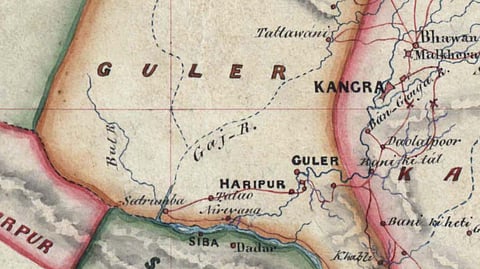
Our tale is about a scion of this ancient clan sometime in the fifteenth century. He was the founder of the scenic hill kingdom of Guler, a Katoch king called Raja Hari Chand from the old royal family of Kangra.
Like most royals and feudal chiefs around the world, Hari Chand loved the hunt. One fine day in late summer, his quarry led him on a long chase, and the king left his companions far behind. Along the way, he dismounted to look for tracks. His foot slipped and he fell into a deep hole. “A dry well,” he thought before his head struck a rock and he passed out. The grasses that hid the well closed over it again.
Meanwhile, the king’s companions searched the forest, growing increasingly afraid. When the king’s horse was discovered, a companion rushed back to the fort to get reinforcements. The king’s younger brother, the prime minister, the senapati, and a select band of soldiers and trackers went looking. After days of desperate search, they were forced to mourn the king as dead. His younger brother was crowned the new raja of Guler.
Months into the new reign, the court was disturbed one day by a great commotion in the forecourt. Into a shocked silence walked Raja Hari Chand, leaner, scarred, and simply dressed. The new king ran forward to hug his elder brother and touch his feet. Tears in his eyes, he bowed and indicated the throne to him.
And this is when emotional intelligence spoke. Hari Chand refused to take back his rightful kingdom. Life had ordained that his brother should sit on the throne. To take it away seemed wrong and impractical. It was miraculous enough that gypsies had found him, nursed him, and brought him home.
To everyone’s amazement, Hari Chand said, “With your Majesty’s permission, I will make myself another fort below Guler, on the banks of the Banganga river.” And that’s what happened. In one graceful move, he not only secured his own status but also retained his brother as an ally, rather than an enemy. Surely, Ganesha would have approved.
Renuka Narayanan | FAITHLINE | Senior journalist
(Views are personal)
(shebaba09@gmail.com)
