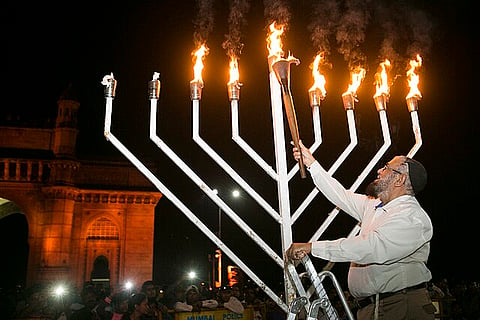

Hanukkah, or Chanukah, pronounced Kha-nu-kah, began last evening, December 14, and ends on December 22. It is the Jewish eight-day winter ‘festival of lights’, celebrated with nightly candle-lighting, prayers, food and gifts.
The Hebrew word Hanukkah means ‘dedication’, and is so given because it celebrates the rededication of the Jewish temple in Jerusalem, the spiritual capital of the Jews. In the second century BCE, Israel was ruled by the Seleucids, ‘Syrian-Greeks’, who tried to force the Jewish people to accept Greek culture and beliefs instead of their own observances and belief in their god Yahweh. Against all odds, a small band of poorly-armed but determined Jews, led by ‘Judas Maccabeus’, meaning Judah the Hammer, defeated a force that vastly outnumbered it. The Jews drove the Greeks from Israel, reclaimed their temple and rededicated it to the service of their god.
As told in Jewish history, when they sought to light the temple’s menorah or candelabrum, they found only a single cruse or earthen pot of olive oil that had escaped contamination by the Greeks. But they lit the menorah anyway, and miraculously, that one-day supply of oil lasted for eight days, until new oil could be prepared under conditions of ritual purity. To commemorate and publicise these miracles, the Jewish elders instituted the festival of Hanukkah.
At the heart of the festival is the nightly menorah lighting. The Hanukkah menorah holds nine flames, one of which is the shamash (attendant), which is used to kindle the other eight lights. This reminds us of our Indian practice of lighting one oil lamp with another for Diwali—as the old Hindi song goes, “Jyot se jyot jalate chalo”. On the first night of Hanukkah, the Jews light just one flame. On the second night, they light two. By the eighth night of Hanukkah, all eight flames are lit.
After kindling the first Hanukkah candle, three blessings are recited.
The first blessing honours Yahweh as the ruler of time and space and gives thanks for the commandment to light the Hanukkah candles. The second Hanukkah blessing is for the miracles their god performed in olden days and in modern times. The third blessing is the Shehecheyanu, thanking Yahweh for bringing Jews to a new season. This also marks the first time in the year that one eats a seasonal fruit, which is duly blessed.
This blessing is said only if the fruit is ripe, not dried. Apparently, some seasonal fruits over which Jews can say this blessing are kiwi, fresh figs or dates, pomegranates, cherries, tangerines, cantaloupes, and strawberries. The poignant, grateful blessing goes, ‘Blessed are You, Lord our God, King of the Universe, who has granted us life, sustained us and enabled us to reach this occasion.’
After the Hanukkah lights are lit, Jews sing the praiseful hymn Hanerot Halalu, and the Ma’oz Tzur, which retells Jewish history and celebrates deliverance from four ancient enemies: Pharaoh, Nebuchadnezzar, Haman and Antiochus.
On Hanukkah, it is the custom to play with a dreidel. This is a four-sided spinning top bearing the Hebrew letters nun, gimmel, hei and shin, an acronym for nes gadol hayah sham, meaning “A great miracle happened there”. The game is usually played for a pot of coins, nuts, or other things, which is won or lost based on which letter the dreidel lands on when it is spun.
Since the Hanukkah miracle involved oil, it is customary to eat foods fried in oil. The Eastern European classic is the delicious grated-potato latke (pancake), garnished with apple sauce or sour cream, and the top Israeli favourite is the jelly-filled sufganya (doughnut). Indian Jews celebrate with pakoras, bajji, jalebis or pazhampozhi (banana fritters).
A sweet Hanukkah tradition, adopted by other Semitic cultures, is to give ‘Hanukkah gelt’, or gifts of money to children. In addition to rewarding good behaviour and devotion to the study of the Jewish holy book, the Torah, these cash gifts give children the chance to share and give in tzedakah (charity). This led to the modern tradition of giving gold foil-covered chocolate coins as Hanukkah gelt. A child-pleasing practice that older Indians in Bombay, Delhi, Calcutta and Madras (yes, those, before names were changed) may remember as a Diwali custom, perhaps picked up from the Jews of India. I remember it, too.
In 1975, the Chabad or Jewish centre of San Francisco partnered with impresario Bill Graham, a child survivor of the Holocaust, to put up a giant mahogany menorah. A new tradition was born of large public menorahs in several places. This year, that tradition turns 50.
But it was not only twenty-two centuries ago in ancient Israel that the practice of Judaism was banned. For 70 years, it was banned in the Soviet Union. Where the Nazis sought to kill Jews, the Soviets tried to kill Judaism. Stalin’s assault on this ancient faith was brutal. In 1967, after Israel’s victory in the Six-Day War, many Soviet Jews asked to go to Israel. Not only was permission refused, but often these Jews lost their jobs and were imprisoned. Jews around the world campaigned for these Refuseniks, as they were called, to be freed and allowed to leave.
Communism had not brought freedom and equality, but repression, a police state and cruel dictators. It was only after the USSR broke up in 1991 that Soviet Jews regained the freedom to be themselves and go to Israel. Small wonder that the constantly beleaguered Jews lavish love on their archangels with beautiful names like Rephael, meaning ‘The Lord heals’.
Renuka Narayanan | FAITHLINE | Senior journalist
(Views are personal)
(shebaba09@gmail.com)
