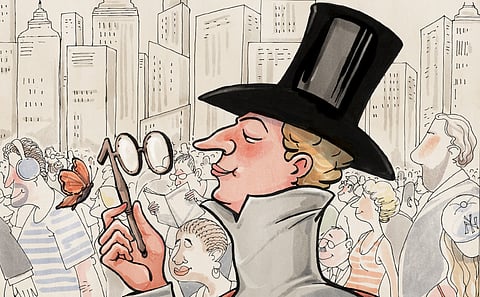

The New Yorker, one of the anglophone world’s most respected weekly news magazines, died the same year it was born in 1925. However, it was resurrected the same day before the world could even realise that it was briefly dead. Despite the uncertainty of its early months and years, the magazine has survived, and now celebrates its centenary year of existence.
James Thurber in his classic 1957 memoir, The Years With Ross, on Harold Wallace Ross, the founder-editor of The New Yorker, wrote with characteristic humour that the magazine was an “outstanding flop of 1925” when there was so much of success around in literature, music, and entertainment: “Its continued existence may be accurately called life after death… the weekly was declared dead at an executive luncheon in New York, presided over by its chief backer, Raoul Fleischmann. Then a miracle, in the form of a chance encounter, resurrected the deceased. Several hours after the coroner’s verdict, Ross ran into Fleischmann at the wedding of Franklin Pierce Adams, and, in that atmosphere of hope, beginning, and champagne, they decided to have another go at it.”
In what seems to have come a full circle, the magazine celebrates its 100 years at a time when all the talk is about the demise of the print media, especially the magazine format. The New Yorker itself has spread its wings and vision in recent years to become a multimedia brand. The magazine did not merely survive in the city of its making, but over the decades became a gentle obsession of a distinct class of readers across the globe.
For a magazine that saw so much of history unfold, from world wars to cold wars to culture wars, the refinement of reason it cultivated was miles away from being an ideological smithy. It did not impatiently try to proselytise anybody or propel a social and political movement, but was still a movement that gently, humanely, shaped the worldview of its readers.
It’s never easy for old institutions to weather transformation; but The New Yorker, in its present avatar, does not look wrinkled with crumbling knees. It is among the news brands that has successfully learnt to carry the weight of its own history, even while being constantly reminded by its own readers and writers as to what it really is, and what it should always be.
To wade past the departments of nostalgia, to keep old loyalties, and cultivate new ones simultaneously is the trickiest part of the business. To ensure that one is not read by habit alone, but for quality, and to manage disruptions in the editorial mix is a stupendous challenge. A recent Netflix documentary on the magazine directed by Marshall Curry captures these transitions rather skillfully. The documentary is just one slice of the understated celebrations of The New Yorker’s skyscraping landmark.
Since we live in an age of fake news and post-truth assertions, it is significant to note that right from its beginning, The New Yorker was obsessed about the idea of fact-checking. As science and technology progressed through the 20th century and made life and things precise, the magazine perhaps borrowed the method of science to make prose not just incisive but verifiably precise. It established a protocol around opinion very early. Thurber wrote: “[Ross’s] checking department became famous in the trade for a precision that sometimes leaned over backward. A checker once said to me, ‘If you mention the Empire State Building in a Talk piece, Ross isn’t satisfied it’s still there until we call up and verify’.”
This fact-checking culture became more established with Ross’s successor William Shawn, then the two editors who followed him, Robert Gottlieb and Tina Brown. The magazine has continued to answer the complexity of the question under its current editor, David Remnick. In the Netflix documentary, an Indian woman with a nose pin is seen verifying cat names.
The great novelist, Julian Barnes, who contributed for five years from London in the 1990s, wrote that writing for The New Yorker “means, famously, being edited by The New Yorker: an immensely civilised, attentive and beneficial process which tends to drive you crazy… Making a statement on oath before a judge is nothing compared with making a statement before a New Yorker fact-checker”.
This American magazine has a solid Indian connection through the brilliant Ved Mehta, a staff writer who was also blind. He was with the magazine for over three decades and had a splendid output that included fiction, essays, and memoirs. He was devoted to Shawn’s editorial genius and considered him a father-figure: “Without exactly realising it, I made every teacher I loved into my father—into an almost god-like figure,” Mehta wrote in his book Remembering Mr Shawn’s New Yorker: The Invisible Art of Editing. Shawn was with the magazine for 53 years and was its editor for 35.
Besides Mehta, who made The New Yorker experience more Indian for this columnist, there are two long profiles of two eccentric and passionate Indians published in the magazine that are favourites—of Sirdar Jagjit “J J” Singh and Akumal Ramachander, published in March 1951 and December 1985, respectively.
The J J Singh profile was written by Robert Shaplen and titled ‘One-man lobby’. Singh had lobbied with the Truman administration in 1946 to get the Luce-Cellar Act passed, which made it possible for South Asians to become naturalised citizens of the US: “[Singh] has established himself as the principal link between numberless Americans and the vast, mysterious Eastern subcontinent where he was born… As a living refutation of Kipling’s never-the-twain-shall-meet thesis, he eclectically embraces India and the US with equal and unflagging devotion.”
A very similar thing was said about Akumal by Salman Rushdie in the profile written by Lawrence Weschler, titled ‘A strange destiny’. Akumal, who had discovered the abstract expressionist painter Harold Shapinksy, had rewritten the history of modern art. Rushdie said: “For centuries now, it has been the fate of the peoples of the East to be ‘discovered’ by the West, with dramatic and unpleasant consequences. The story of Akumal and Shapinsky is one small instance in which the East has been able to repay the compliment, and with a happy ending, too.”
Here's to the next century of The New Yorker and to credible journalism.
Sugata Srinivasaraju | Senior journalist and author of The Conscience Network: A Chronicle of Resistance to a Dictatorship
(Views are personal)
(sugatasriraju@gmail.com)
