
America’s love affair with monumentalism is hardly a secret: with buildings, warships, automobiles, aircraft—and, most importantly, self-image. So, when this core of self-esteem begins to crack and eventually crumble, we can be sure that something is afoot that will redefine America’s sense of self. For better or for worse—which might actually go hand in hand.
Never before has the US introspected more than after Donald Trump took office this January. The most monumentalist president in the 80 postwar years, according to Gallup, he began with approval ratings of 47 percent (21-27 January) but is now down to 36 percent (1-15 December), where it has been stuck since November 3.
This steadily declining graph is a reliable mirror to America’s glissading sense of self under the Trump presidency. Trump has been promising big and delivering small. The Epstein files fiasco is a case in point. One of Trump’s presidential election planks was the unconditional release of the entire, unredacted Epstein files. In January, Trump reiterated his promise. In February, his attorney general Pam Bondi told an interviewer that an Epstein “client list” was on her desk. The department of justice (DoJ) ostentatiously sent “declassified” dossiers to far-right influencers—but it was material already in the public domain.
On February 21, Trump’s ratings fell to 45 percent. A month later, they were down to 43 percent. On April 25, Virginia Giuffre, one of the early Epstein accusers, died by suicide—and between then and May 18, his ratings plateaued. Giuffre’s death forced his ratings further down to 40 percent on June 19, two weeks before the DoJ denied that Epstein maintained a ‘client list’ at all, and that it wouldn’t release any more files. On July 21, Trump’s ratings plummeted to 37 percent. On October 1, Trump hit a relative high of 40 percent, until Giuffre's posthumous memoir, published on October 19, clubbed the ratings down to 37 percent. They slid further to 36 percent on November 3, where they remained until last declared on December 1.
Meanwhile, the Trump dispensation doubled down on halting the skid, first by releasing emails sent between Epstein and others, then by the Congress passing and Trump signing into law the Epstein Files Transparency Act, and then by the DoJ releasing the records—only to begin massively redacting them from its website within hours of release, especially for documentation to do with Trump.
In the interstices of this stormy diminution of ratings and the public outcry against the harm done by presidential duplicity to juvenile-focused familyism—one of the foundations of American society—other self-critiques began doing the rounds. Trump has always trumpeted his height as 6’3”. When photographs surfaced of him walking beside Prince William, who is confirmed as 6’3”, in September, Trump appeared six inches shorter. The war of tallness—or gröꟗekrieg, a war of grandeur—broke hearts across social media platforms, with MAGA warriors sharing the quicksand of doubt with left liberals. Potus guaranteed being larger-than-life in two crucial forms—an ethical promise and his own persona—and fell short in both senses.
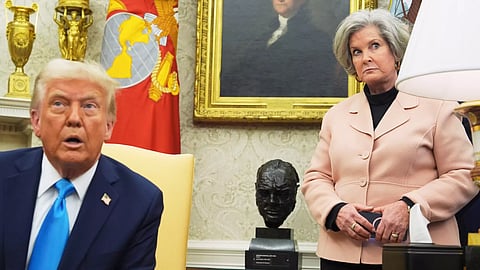
There was more to come. On December 16, Vanity Fair published ‘Eye of the Hurricane’, a wrap of the year in two parts featuring interviews of Susie Wiles, the Trump White House’s chief of staff, at length and in depth.
But the most extraordinary revelations came not from the text, but from the posed photographs by Christopher Anderson. They seem prima facie passable portraits of people in power, posing with their best face forward. But the snarky commentary was in the inconsequential dimensions that Anderson reduced these movers-and-shakers to in their architectural environments.
Anderson posed Vance next to a light switch, installed at a particular height by regulation—and this juxtaposition immediately reduced Vance from his self-proclaimed 6’2” to at most 5’10”. Karoline Leavitt, the White House press secretary whom Trump has occasionally been raffish about, was photographed in close-up, highlighting her spotted lips pierced by filler injections. Right or left, the horror at the careless feet of clay in the mythified high echelons of the White House left the hoi polloi distressed and ‘schadenfreuded’ in equal measure.
Meanwhile, Trump is mirroring the citizenry—both shrunken and bullfrogged, but still figure-skating on personal and social bewilderment as if none of this resizing was psychologically revealing or long-term. On December 13, following a trip to Japan, Trump spoke positively about “really cute” kei cars, asking, “How would that do in this country?” It sent the bellwether US automobile industry, predicated on design and factory largeness, into a lather. On December 22, he went big, announcing the commissioning of a new series of ginormous ‘Trump class’ battleships.
Things are changing in America, but, as a March 2020 report by the University of Georgia pointed out, “Americans who do change tend to report a lower sense of well-being.” I wonder if this is going to end well.
Kajal Basu | Veteran journalist
(Views are personal)
(kajalrbasu@gmail.com)
