
Just over a month ago, COP30 placed extreme heat, collapsing harvests and rising health risks at the centre of global climate negotiations. For India’s farmers, the conference delivered urgent lessons and a narrowing window for action.
At Belém, the focus shifted decisively towards people—not just the planet. It was a long-overdue acknowledgement that climate change is no longer a distant environmental threat but a daily stressor eroding livelihoods, productivity and well-being. Nowhere is this more visible than in agriculture, where extreme heat is emerging as the most pervasive and least insured climate risk.
Scientific assessments show how heat stress is quietly but relentlessly reshaping agrifood systems. Labour capacity is declining, livestock productivity is falling, perishable produce is spoiling faster and staple crop yields are suppressed as night-time temperatures rise.
This reality is already playing out in India’s farms and mandis. Over the past decade, heatwaves in the country have become longer, hotter and more geographically widespread. Wet-bulb temperatures—where heat and humidity combine to threaten human survival—have approached dangerous thresholds across Odisha, Andhra Pradesh, Telangana, Tamil Nadu and coastal Karnataka.
Heat-related declines in wheat and rice yields are no longer anomalies. Irrigation costs are surging as soils dry faster. Milk production has dropped in heat-stressed districts. Farmers increasingly report dehydration, kidney strain, dizziness and cognitive fatigue—symptoms consistent with global research on chronic heat exposure.
A recent national assessment shows that more than half of India’s districts now fall under high or very high heat risk. Heat is no longer an episodic shock; it is a structural threat to food security and rural incomes. What COP30 discussions only began to capture—and what Indian policy still underestimates—is the gendered nature of the stress.
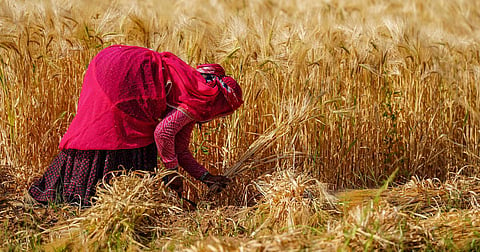
The M S Swaminathan Research Foundation (MSSRF) highlighted how extreme heat disproportionately affects women in agriculture, particularly in the southern states. Women agricultural labourers often work longer hours in the open and perform physically demanding tasks such as transplanting, weeding and harvesting.
Heat stress is not only affecting women’s health but also reducing workdays, incomes and nutritional outcomes—deepening the existing inequalities. Yet, these impacts remain largely invisible in official statistics, insurance products and heat action plans.
Smallholder farmers—who constitute over 85 percent of India’s agricultural workforce—are the most exposed and least protected. Many have shifted labour to early mornings or late nights to avoid lethal heat, but this comes with trade-offs: lower productivity, safety risks and household strain.
Informal agricultural workers and migrant labourers face even harsher realities. International research shows that farmworkers are many times more likely to die from heat exposure than workers in other sectors. In India, the absence of systematic heat-health surveillance means the true scale of illness, lost productivity, and premature mortality remains unknown.
COP30 reinforced a crucial point: adaptation tools already exist, but they are not being deployed at the speed or scale required.
Across India, farmers are experimenting with heat-resilient crop varieties, mulching, adjusted sowing calendars and soil-moisture conservation. Community-led adaptation models in Maharashtra, Odisha and Karnataka show that local knowledge, when combined with scientific advisories, can reduce losses.
One of the most underused opportunities lies in impact-based early warning systems. Heat is predictable. With timely forecasts and advisories, farmers can adjust irrigation, protect livestock, manage labour safely and reduce crop stress. When early warning becomes early action, losses are prevented rather than absorbed.
Financial protection is where India now has a chance to leapfrog. Traditional crop insurance has struggled to capture heat-related losses, especially those affecting labour, livestock and health. Recognising this gap, Tamil Nadu’s recent move toward parametric insurance for climate disasters marks a critical policy shift. By linking payouts to measurable climate thresholds rather than damage assessments, parametric insurance can deliver faster, more predictable relief—especially for heatwaves, droughts and cyclones.
Equally pioneering is Self-Employed Women’s Association’s (SEWA) heat-stress-linked insurance for women workers. By explicitly recognising heat as an insurable risk affecting income and health, SEWA’s model reframes adaptation as social protection. It offers a template for protecting informal workers who are otherwise excluded from conventional insurance and compensation mechanisms.
These innovations show that climate finance can move beyond post-disaster relief toward anticipatory, people-centred resilience.
With COP30 concluded, India faces a defining responsibility: to translate global recognition of heat risk into a coordinated national response.
First, heat-risk management must be embedded into agricultural planning. Climate and heat forecasts should inform district advisories, crop calendars, extension services and labour safety guidelines.
Second, India must institutionalise early action. Forecasts should trigger automatic responses—irrigation advisories, livestock protection measures, work-rest protocols and targeted cash or insurance payouts.
Third, the country needs heat-health surveillance for rural and informal workers, disaggregated by gender. Without data, policies will continue to underestimate heat’s true cost.
Fourth, financial resilience must evolve. Parametric insurance, heat-linked safety nets, and social protection for women workers should become core pillars of adaptation policy, not pilot experiments.
Finally, local institutions—panchayats, farmer producer organisation, women’s self-help groups and cooperatives—must be empowered to decide on resources needed for adaptation.
Heat resilience is economic policy. Delay will deepen losses, widen inequalities and undermine food security. India has the science, the institutions and now the policy innovations to act. What remains is political urgency. For India’s farmers, the time for incrementalism has passed.
Sanjay K Srivastava | S Radhakrishnan Chair Professor, National Institute of Advanced Studies, Bengaluru; former Chief of Disaster Risk Reduction at UNESCAP
(Views are personal)
