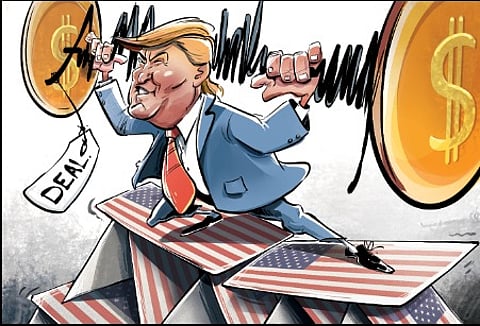

US President Donald Trump has popularised the idea of transactional approaches to everything. Yet, careful analysis suggests that his deal-making prowess is questionable and grasp of the process deficient outside of scripted deal-making on reality TV shows.
First, he frequently exceeds his executive powers. Initiatives, such as tariffs and requiring chipmakers to give the US government 15 percent of revenues from sales to China may not be legal. He frequently negotiates with parties who also lack the requisite authority. Outside of autocracies, deals with foreign leaders who have limited capacity to commit private actors, or which must be ratified by elected representatives are meaningless.
On commercial matters, private producers and purchasers are rarely parties to the “huge” deals. On diplomatic matters, Trump intervenes arbitrarily and usually negotiates with one side. New Delhi did not welcome his peacemaking in the 2025 India-Pakistan border conflict. A peace agreement with Moscow is being seen as unacceptable in Kyiv. In West Asia, Trump’s plans frequently ignore the key parties.
Second, with his well-known resistance to briefings, Trump’s deals discount historical, economic and cultural context. His real estate plans for Gaza ignore the root causes of the conflict. Russian President Vladimir Putin’s patient explication of the reasons underlying complex relations between the West and Russia would be lost on Trump. Ignorance of China’s near-monopoly in rare earths, essential for defence and technology supply chains, means the US is losing a war it did not even know it was in.
Third, trade and investment treaties typically take time, sometimes years, to agree. Trump’s short attention span means his deals lack essential clarity and detail. They are rarely-written agreements, discounting his insomniac, incoherent, aggrandising tweets. Given a telegenic but administratively inept cabinet, bureaucrats—at least those left after the Stalinist purges—must sort through multiple exclusions and side bargains to try to work out the terms. Commercial agreements, like sale of aircraft, which has been championed by the president, are highly technical and frequently subject to options and changes. Many of the so-called deals may never be fully implemented.
Fourth, Trump’s deals are often implausible. Under their trade agreement, the EU has committed to purchase $250 billion of US energy products per annum for 3 years, but has little control over what private European companies import. It would require redirection of most US energy exports, currently around $318 billion a year in total, towards Europe. The EU would have to import two-thirds of all its energy needs from the US, which lacks the production, refining and logistical capacity to supply this amount. It would also divert energy from the domestic market and could drive up US oil and gas prices. Europe would need to build the requisite infrastructure which is likely to take years.
South Korea’s $350-billion investment promise would equal around 20 percent and 80 percent of its GDP and currency reserves, respectively. It would require Korea to liquidate its reserves, putting upward pressure on US interest rates or for the US to lend it the money via currency swap lines.
Boeing, whose aircraft Trump has marketed aggressively, suffers from quality problems and production delays. Depending on the aircraft type and configuration, customers can expect a wait of upwards of 5 years for delivery, which can lengthen depending on labour and supply chain issues. In defence, one commentator joked that under another Trump deal, Europe would be paying with money it did not have, for weaponry which the US could not produce, for Ukraine, which did not have the personnel to deploy them.
Fifth, a central element of Trump deals is related-party dealings, which often directly or indirectly benefit interests associated with the president and his allies. Such transactions are problematic in the commercial world and complicate arrangements.
Sixth, compliance with the terms is essential. Influenced by the last person to have his attention—dubbed Trump Proximity Theory—the president constantly renegotiates deals. His dismissive treatment of his own US-Mexico-Canada Agreement, his tariff flip-flops and other policy reversals are cases in point.
Trump’s deals are best understood as mechanisms to exert power, extort tributes and gain media coverage. This means that tariffs, capital and currency measures, and diplomatic initiatives will continue to change without any stable end-state achieved. Agreements will be renegotiated constantly based on the president’s economic, political or personal concerns at any given time.
There are winners and losers in every deal. Trump’s need and demand that he wins big every time runs contrary to the reality that the only lasting deals are ones where both sides see lasting benefit in it. This means that Trump must coerce or intimidate opponents to reach agreements. His coercive power over Canada and Mexico rely on their economic and security dependence on America. He can use Europe and Japan’s military weakness and fear of foreign aggressors to reach deals that cast them as vassal states. But it means that the only deals achievable are with weak parties who must agree at least until they find a work-around, such as alternative markets and suppliers or, in the case of Europe and Japan, building up their own defence capabilities. In contrast, the approach is less successful with powerful counterparties such as China and Russia, who hold better cards.
None of this should surprise, as Trump’s 1987 book, Trump: The Art of the Deal, now an essential reading for foreign leaders alongside guides to self-abasement, foreshadows the current modus operandi. The flimflam book argues that the basis for success requires simply thinking big, self-promotion with sensationalism and controversy, flexibility, playing to one’s strength and especially untruthful hyperbole. His biographer Gwenda Blair commented on Trump’s “continuous self-inflation” and thought the book was, in polite terms, an exaggeration. Tony Schwartz, his co-author, suggested that it should be treated as ‘fiction’ in the light of Trump enterprises’ indifferent financial performance.
Trump’s big deals are likely to prove counterproductive and irretrievably damaging to America’s economic and strategic interests as well as its standing as a trusted partner. Schwartz admitted that ghost-writing the book was his greatest regret. The cost to America and the world will be much greater.
Satyajit Das | Former banker and author
(Views are personal)
