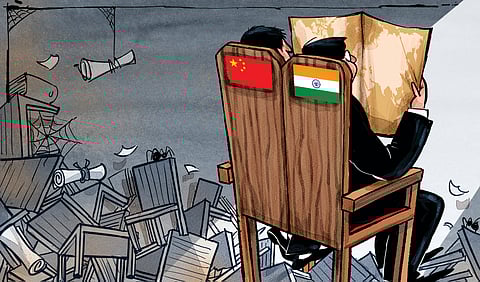

India-China relations started with hope in the 1950s with the Panchsheel Agreement, stuttered later in that decade and deteriorated sharply in the wake of the 1962 war. Since then, it has fluctuated, with a sharp downturn over the last decade. Of late, it is again showing signs of revival.
The early 1950s are often referred to as the age of Nehru, during which he, along with a few other leaders, helped unite the Global South into a bloc of non-aligned nations as a counterbalance to the US and the USSR. While Nehru emerged as a prominent figure, his Chinese counterpart Zhou Enlai was less visible internationally. Nevertheless, the two leaders forged a strong relationship. Zhou’s visit to India in 1954 generated considerable excitement, and later that year, Nehru visited China.
The New York Times described the atmosphere during Nehru’s visit, saying people crowded the six-mile route from the Beijing airport to the city, joyfully chanting the Chinese slogan that translates as “Long live peace” and the Hindi phrase “Hindi-Chini bhai-bhai”. Nehru and Mao Zedong’s meeting lasted four-and-a-half-hours, during which Mao candidly acknowledged that China was less developed than India, a fact only revealed in the minutes of the meeting released in 2015.
The relationship began showing signs of strain after the 1955 Bandung Conference of Afro-Asian nations, co-hosted by Nehru and Indonesia’s Sukarno. Zhou played a significant role at the conference, garnering support from many leaders. It was during this period that Pakistan and China began strengthening their ties.
Tensions escalated with the Lhasa uprising in March 1959, fueled by rumours that the Chinese authorities intended to arrest the 14th Dalai Lama. Despite India’s clear support for Chinese rule over Tibet, uncertainty grew within the Chinese leadership over India’s intentions. Chris Ogden, in his 2022 paper, ‘The Double-Edged Sword: Reviewing India-China Relations’, observes, “Although India had recognised Chinese suzerainty over Tibet and classified it as an autonomous region, the Indian government’s decision to harbour the Dalai Lama after his escape in 1959 heightened distrust and frustration in their diplomatic relations.” Additionally, Chinese support for the Mizo and Naga uprisings in the Northeast exacerbated India’s concerns.
During this time, low-intensity conflicts began in the Northeast, with China asserting claims over territories that India considered its own. Tensions escalated, reaching a peak in 1962 when Nehru and defence minister Krishna Menon significantly misjudged the capabilities of the Indian Army and ordered it to reclaim territories held by China along the Thagla Ridge. The result was a catastrophic defeat for India with the Chinese forces advancing down the Himalayas and reaching within kilometres of the Assam plains.
A chastened Nehru was forced to send an urgent request for assistance to US President John F Kennedy on November 19, stating, “With the Chinese advancing in massive strength, the entire Brahmaputra Valley is seriously threatened. Unless immediate action is taken, Assam, Tripura, Manipur, and Nagaland could also fall to the Chinese.” The Chinese, however, unilaterally declared a ceasefire and withdrew towards their stated boundary.
Since 1962, the India-China relationship has remained unsteady with Pakistan significantly contributing to the tensions between the two. In December 1988, Rajiv Gandhi’s visit to China resulted in a joint communiqué emphasising the restoration of amicable relations based on the Panchsheel Agreement. Both countries committed to seeking a “fair and reasonable settlement” of their border dispute while fostering cooperation in various sectors beneficial to both sides. In January 1994, Beijing expressed interest in negotiating a resolution to the Kashmir issue and opposed any push for independence in the region.
During his first term, Prime Minister Narendra Modi undertook a series of cordial visits to China, and Xi Jinping too visited India on multiple occasions, reflecting the mutual goodwill. However, tensions rose following the incidents in Galwan and Doklam, further complicated by Pakistan’s negative influence on the bilateral relations.
With global diplomacy taking a significant blow from the unpredictable and confrontational approach of US President Donald Trump, relations between India and China have once again entered a crossroads.
Modi met Xi on the sidelines of the BRICS meeting in Kazan, Russia last October. China’s foreign ministry reported on its website that Xi said, “It is in the fundamental interest of our two countries and two peoples to keep to the trend of history and the right direction of bilateral relations.” India’s foreign ministry said that Modi welcomed the recent agreement on complete disengagement and resolution of issues that arose in 2020 in the border areas:
“He underscored the importance of properly handling differences and disputes to maintain peace and tranquillity. The two leaders agreed that the special representatives on the boundary question will meet at an early date to manage peace and tranquillity in border areas while exploring a fair, reasonable, and mutually acceptable solution.” Dialogues at the foreign ministers’ level would also be used to “stabilise and rebuild bilateral relations”. A positive outcome was agreeing to restore the border to pre-Galwan positions.
In a three-hour conversation with podcaster Lex Fridman in March 2025, Modi articulated his aspiration to enhance bilateral relations, highlighting the historical connections and the importance of preventing “differences from escalating into disputes”. He talked about the time when India and China together accounted for over 50 percent of the global GDP, emphasising that their collaboration is crucial for international peace and prosperity.
The Chinese response was encouraging, with their spokesperson stating, “For over 2,000 years, the two countries have maintained friendly exchanges and learned from each other, contributing to civilisational achievements and human progress… The two nations should partner in each other’s success, and a ‘cooperative pas de deux’, a ballet between the dragon and the elephant, is the only viable path forward.”
External Affairs Minister S Jaishankar visited Beijing earlier this month to attend a meeting of the Shanghai Cooperation Organisation and met Xi on the sidelines. During his meeting with the Chinese foreign minister Wang Yi, Jaishankar reportedly said, “India stands ready to work with China to speed up the resumption of cooperation mechanisms, enhance people-to-people and cultural exchanges, facilitate personnel travels, and jointly safeguard peace and tranquillity in the border areas.”
Perhaps we are on the brink of a new chapter in global diplomacy that could reshape our world.
K M Chandrasekhar | Former Cabinet Secretary and author of As Good as My Word: A Memoir
(Views are personal)
(kmchandrasekhar@gmail.com)