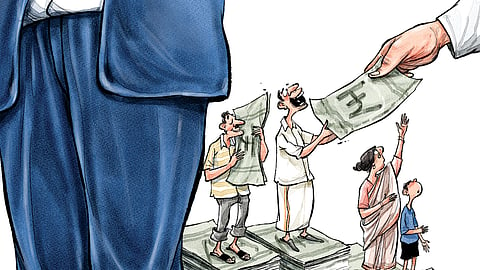

All the peninsular states have dramatically reduced extreme poverty and made considerable improvements in living standards, human development, and economic modernisation. These are fantastic achievements when measured against the abysmal state of affairs in North and East India. However, the next phase of economic transformation necessitates a strategy of prosperity that secures higher incomes for the majority of people to improve the lives of their families—without relying on public subsidies. And the biggest challenge to executing such a strategy will be reversing the persistent and ubiquitous inequality that characterises the contemporary economic landscape of the peninsula.
To understand this better, it is essential to distinguish between inclusion and redistribution. Consider a family of working adults. One earns 80 percent of the family income, and the rest, 5 percent each. The top earner will subsidise the others, but that will make the family entirely dependent on this single earner. In a family where all four members contribute 25 per cent each to the total income, the question of dependence does not arise.
When growth enriches the few at the expense of the many, governments spend more on redistribution to compensate for inequality. This gives rise to “schemes” to provide the majority with subsidised medicines, affordable meals, pensions, income support, and free transport, among other benefits. These subsidies are more affordable the richer a State. Hence, a lot of people who suffer from unequalising growth in the peninsula are better off than those in poorer states.
However, fiscal policy is a hard taskmaster. States with a $3,500 per capita income (PCI) are spending the same proportion of their budgets on providing compensating subsidies as states with a $1,100 PCI. Both categories of states have no resources to invest in growth, employment and human capital. The peninsular states will be at higher levels of income and human development due to past progress, but will also be stuck in a development trap. The success of peninsular states in fostering growth is precisely why they need to pay the most urgent attention to reducing inequality, not inequality of consumption through redistributive subsidies, but inequality of participation in delivering growth and enjoying the income rewards that come with it.
Take Kerala. It has the highest per capita income (PCI) of all major states and topnotch human development. However, there are not enough quality jobs for a well-educated young population. Female labour force participation is falling. Income and consumption inequality in Kerala are now among the highest of all Indian states. This means that the state government must undertake increasingly heavy fiscal lifting to compensate those not benefiting from the Kerala story.
Tamil Nadu (TN) has the highest manufacturing-GDP ratio in the peninsula. Consumption inequality is declining. While deprivation and inequality between rich and poor districts are pronounced, state government interventions and subsidies have considerably improved the quality of life in poorer districts in recent years. Yet, wages offered by foreign mega corps like Samsung and Foxconn are too low for these workers to be eligible to pay income tax.
So, manufacturing has not been the engine of inclusive prosperity in Tamil Nadu. The state continues to subsidise these workers and their families with meals, education, and transportation, despite their employment in high-quality manufacturing jobs. It also spends a significant amount of public money offering incentives to foreign investors, but the resultant investments do not deliver a quantum increase in inclusive prosperity—the rich continue to disproportionately enjoy the income and wealth benefits of the manufacturing boom, leaving the government with the task of compensatory redistribution.
In Telangana and Karnataka, the picture is stark. Nearly 38 percent of Karnataka’s GSDP is generated in the Bengaluru urban district. The Hyderabad metropolitan area (Hyderabad and Ranga Reddy districts) accounts for over 50 percent of Telangana’s GSDP. These metros have concentrations of high-net-worth individuals and serve as a hub of luxury consumption, in stark contrast to the picture of low prosperity and high vulnerability that prevails in the rest of the state. This, despite excellent human development, and near elimination of extreme poverty. Again, therefore, the major activity of these state governments is redistribution—spending money to compensate the majority who have benefited very little from the transformational increases in the aggregate per capita of these states. Better to be an average Kannadiga than a Bihari, but a long way to go to approach the prosperity of an average Malaysian.
Two important corollary features of inequality cause further roadblocks to investing in future prosperity. Much of the concentrated wealth and income is stowed “under the hood” to avoid taxation and accountability. Hence, gold and real estate markets boom in these locations. I am unable to buy a resale property in the four major cities of South India without being asked for at least half the payment in “cash”. Young families and small businesses, therefore, confront outrageously expensive asking prices for the limited stock of “clean money” real estate. This is a pan-India phenomenon, but a particularly serious challenge for the peninsula.
The second is the persistence of the informal sector. Tamil Nadu and Kerala have the same PCI as Indonesia, but the cheapest cup of tea costs about the same as in Bihar. A low-paid, low-productivity, informal sector, fuelled by cheap labour from the poorer northern and eastern states, is deployed in substantial measure to subsidise feudal lifestyles that are otherwise anachronistic in a middle-income region. This perpetuates an extractive culture of low wages and low productivity, which throttles progress toward the next stage of high-wage, high-productivity development transformation.
If the peninsula is to grow and prosper, building on its impressive achievements, compensation for inequality is not enough. A strategy of inclusive prosperity, rather than fiscal redistribution, needs to be urgently executed. There is the talent to do this, but is the peninsular elite and political leadership capable of rising to meet the challenge?
Rathin Roy| PENINSULA | Distinguished professor at Kautilya School of Public Policy, Hyderabad; visiting senior fellow, Overseas Development Institute, London
(Views are personal)
(rathin100@gmail.com)
