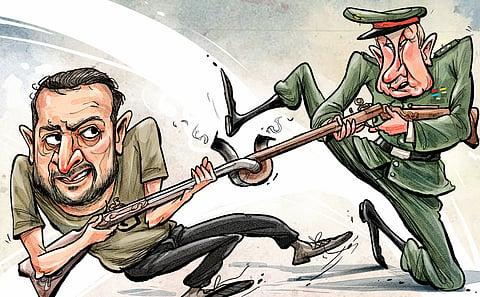

Operation Sindoor and the Iran-Israel-US standoff took the world’s eyes off the scanner on Eastern Europe. The focus has now returned to Ukraine, especially with the spate of Russian drone and missile attacks and the US decision to resume supply of military hardware to Ukraine.
Three years since Russia launched its invasion of Ukraine, the battlefield remains frozen in more ways than one. Despite billions of dollars in Western aid, thousands of lives lost, and relentless offensives, the war shows few signs of a decisive conclusion. Instead, it has evolved into a grinding war of attrition—with military breakthroughs elusive and the political will for total victory giving way to discussions on containment, ceasefire and face-saving ‘off ramps’—in effect, the Americanisation of the war.
Ukraine failed to make major territorial gains through its much-anticipated counteroffensive in 2023, highlighting not just how well-entrenched the Russian forces are, but also the limits of modern Western weaponry. For Russia, despite its superior numbers and recent gains in places like Avdiivka, the advance has been incremental and costly.
Neither side currently possesses the capability to inflict a decisive blow. Ukraine lacks the strategic depth and offensive firepower to roll back Russian positions across the entire front. Meanwhile, Russia has neither the political cover nor the operational capacity to overwhelm Ukraine without incurring massive costs—both militarily and diplomatically. In short, even if militarily possible, Russia cannot justify a total war or occupation of Ukraine in a politically sustainable way.
The war has thus settled into a brutal equilibrium. Localised gains are made, but strategic momentum is absent. This military deadlock mirrors the diplomatic one. A key variable in prolonging this balance has been the sustained Western military aid to Ukraine—particularly from the US. The recent U-turn by Donald Trump and the Republican-controlled House by agreeing to support fresh aid to Ukraine marked a significant shift. For months, they had stalled arms packages and questioned the logic of endless support for Kyiv. Yet, facing mounting pressure from both Nato allies and the US defence industry, aid has been given the green light—albeit with strings attached.
This aid, while vital for Ukraine’s survival, may paradoxically contribute to prolonging the conflict. It is enough to prevent Ukraine’s collapse but insufficient to guarantee victory. It sustains the battlefield stalemate without fundamentally altering its dynamics. The logic of ‘fighting until victory’ becomes more uncertain when neither side can define what victory looks like.
In recent months, whispers of a potential ceasefire or negotiated settlement have grown louder, particularly in Western policy circles. A ceasefire might appear pragmatic—halt the bloodshed, prevent escalation, and freeze the lines for eventual diplomacy. However, such a pause could also prove strategically disruptive. Russia could cement control over the occupied territory, fortify it and integrate it administratively. This would normalise a new status quo, potentially undermining Ukrainian sovereignty permanently. Ukraine fears this the most. Besides demoralising Ukraine, it might also strain Western unity if Kyiv is pressured to accept it.
For Ukraine, any freeze along the current lines would legitimise Russian gains in Donbas and Crimea. For Russia, a ceasefire would offer time to regroup, consolidate and diplomatically outmanoeuvre the West— possibly through platforms like BRICS or the Shanghai Cooperation Organisation, where Russia continues to find sympathetic ears.
The problem lies in mutual distrust. Neither Moscow nor Kyiv believes the other would respect a truce unless guaranteed by force. Could a peacekeeping force be inducted? Unlikely, considering the experience of the Balkans many years ago.
Another complicating factor is the broader instability in West Asia, particularly the simmering Iran-Israel conflict. Iranian attacks on Israel in April 2024 and Israel’s retaliatory strikes demonstrated how regional conflicts can consume Western attention and resources. Ukraine faces the risk of aid diversion and strategic fatigue. Of course, the power of asymmetric warfare without too many territorial gains or losses is likely to continue playing out.
The Ukraine war is also reshaping global geopolitical alignments. The G7 remains largely united, but fatigue is evident—especially in countries like Germany, which is facing rising energy costs and domestic dissent. On the other hand, BRICS and SCO have become platforms for Russia to bypass Western isolation.
India, for its part, continues to maintain its strategic autonomy quite admirably, condemning civilian suffering but avoiding any direct condemnation of Moscow. With its strong defence ties with Russia and a growing strategic partnership with the US, India exemplifies multipolar diplomacy grounded in strategic autonomy.
Unfortunately, the ability of multilateral forums to resolve conflicts remains highly questionable. The most probable outcome in Ukraine is not victory, but endurance. Russia may continue its slow advances, Ukraine may hold its urban strongholds, and Western aid may keep the frontline stable—but at a cost.
A frozen conflict, reminiscent of the Line of Control between India and Pakistan, could emerge as a de facto solution—undesirable, but sustainable. Such an arrangement would require security guarantees for Ukraine, demilitarised zones, and mechanisms for monitoring compliance, perhaps under a UN or Organization for Security and Cooperation in Europe mandate. However, the political will for such a framework is currently lacking.
Escalation cannot be ruled out, too. Russia could test Nato’s resolve with hybrid threats in the Baltics or cyberattacks. Ukraine, in desperation, might hit targets deep inside Russia. There is potential for vertical escalation—into space, cyber, or even the nuclear domain. It’s the technology-testing times in the new world.
As a military professional, I recognise that wars are not always won by firepower alone. Political clarity, logistical sustainability and timing are equally crucial. In Ukraine, all three are now in flux. We are witnessing the slow transformation of a conventional war into a geopolitical contest of stamina. The challenge for Ukraine’s allies is to ensure that ‘support’ does not become a euphemism for ‘indefinite survival’. For Russia, the question is whether tactical gains can ever yield strategic peace without concessions. A resolution without compromise is unlikely.
Ultimately, the war in Ukraine has become a mirror to the limitations of war in the 21st century. The world must now decide: are we managing a war, or just delaying its transformation into a wider one?
Lt Gen Syed Ata Hasnain (retd) | Former Commander, Srinagar-based 15 Corps; Chancellor, Central University of Kashmir
(Views are personal)
(atahasnain@gmail.com)
