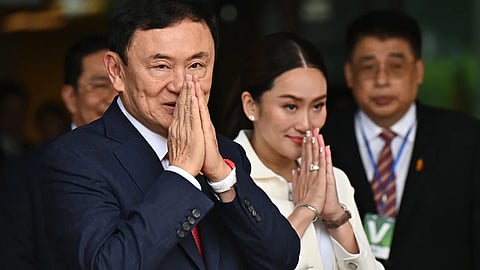

On August 29, the Thai constitutional court, in a 6:3 ruling, dismissed the government of Prime Minister Paetongtarn Shinawatra, which had been in power for less than a year. The roots of the current crisis lie in the 2023 elections, following which Thailand’s political fortunes have unfolded as a complex drama.
Pita Limjaroenrat’s Move Forward Party (MFP) delivered a major upset by emerging as the largest formation in an election where no one secured a clear majority. The MFP had earlier been in opposition from 2014 to 2023, when the government was headed by Prayut Chan-o-cha, a former military general who came to power following the 2014 coup d’état. Though the MFP won in 2023, it failed to find support in the senate and the house of representatives that selects the prime minister.
With the MFP not getting the legitimacy to form the government, the Pheu Thai party founded by former PM Thaksin Shinawatra was in the reckoning. The adage that politics makes strange bedfellows was in play when the Pheu Thai allied with the conservative parties that are close to the country’s powerful monarchy-military combination.
This unusual alliance between erstwhile political rivals was not likely to offer long-term stability, but the short-term goal of keeping the MFP out of the ring and allowing for Srettha Thavisin to be anointed PM. As part of the alliance with military-backed groups, the return of Thaksin was a clear driver of Srettha’s government. Thaksin’s eight-year prison sentence was set aside, and when Srettha himself lost the confidence of the conservatives, the rise of the Thaksin family with Paetongtarn as PM took the centre stage. Now, with Paetongtarn’s dismissal, the nation’s constitutional court has dismissed two PMs in two years on matters of ‘unethical conduct’, with Shrettha’s as the first.
Srettha’s selection of a minister with a criminal record and jail term led to his ouster in August 2024, after being in office for just about a year. For Paetongtarn, the court linked her removal to a phone call she had had with former Cambodian PM Hun Sen, father of the current PM Hun Manet. The call indicated that the Thai leadership was opposed by the military, which was the factor driving the deadly Preah Vihear conflict between the two countries. The call recording was leaked and Paetongtarn’s stance was seen as antinational and unethical.
On the surface, the cause behind both these dismissals addresses the issue of integrity and lack of ethics. However, a deeper understanding of the dynamics driving Thai politics shows two other causes: first, the tensions brewing along the border with Cambodia, and second, the Shinawatra factor that triggers deeper schisms in the military-monarchical political elite that remains at the core of Thailand’s political authority.
The border conflict began in July and continued for five days, with intense firing resulting in casualties on both sides. The ceasefire, worked out in Kuala Lumpur, was merely an end to the armed conflict. But the Preah Vihear crisis is rooted in the domestic political dynamics of Thailand and its ramifications on Cambodia.
Thaksin Shinawatra’s support base during his active political years—prior to his exile for 15 years—was mostly in the northeast of Thailand, which borders Cambodia. In the past, the country has witnessed protest movements by Thaksin’s supporters, popularly called the Red Shirts, and the military-elite backed groups known as the Yellow Shirts. Thaksin’s overreach into some areas the monarchy considered sacred led to the formation of a separate group under the leadership of Sondhi Limthongkul, who headed the Yellow Shirts. Protests by these two groups paralysed Bangkok for days in the run-up to the 2006 coup.
The military-backed conservatives and the monarchy are deeply entrenched, and the military has been part of the power structure for nearly a century. The rift between the Shinawatra family and the military runs deep, and the military resorts to its own machinations to control the political outcome.
Preah Vihear has been a flashpoint for several years. To add to it, the Thai monarchy has coveted the Angkor Wat, the sprawling Hindu-Buddhist temple complex in Cambodia, linking the claim to its historical relations with the Angkor dynasty. In the pre-colonial times, the decline of the Khmer empire saw inroads from Siam, or Thailand. During this time, the provinces of Battambang and Siem Reap exchanged hands between the Siamese emperor and the Khmer kings.
Later, European colonialists drew the boundaries, though Thailand was never colonised—leading to the continuation of territorial disputes in the post-colonial period. The dispute became even more complicated when, in 1962, the International Court of Justice stated that Preah Vihear belonged to Cambodia; but 4.6 sq km of land near it still remains contested. The regions around the Preah Vihear complex are seen as the historical base of the Shinawatra supporters, and civilian casualties in the area trigger sharp reactions among political groups in Thailand as well as Cambodia.
Though the actual violence in the recent clash lasted only five days, the repercussions—in terms of Thailand’s political stability—raise long-term doubts on the role of the military. Its discomfort with the Shinawatra family is neither new, nor innocuous. Now it’s clear the military will try to guard its grip on Thai politics—whoever the threat and whatever the cost.
Shankari Sundararaman | ASIAN AXIS | Professor at School of International Studies, Jawaharlal Nehru University
(Views are personal)
(shankari@mail.jnu.ac.in)
