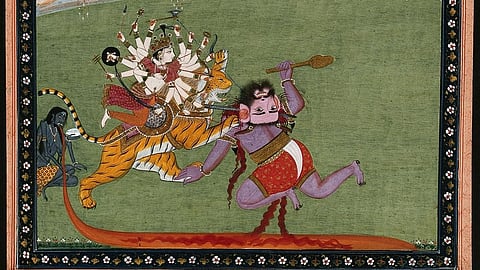

Sharad Navaratri begins today, commemorating the battle fought by the Goddess Durga against the titan Mahishasura, a shape-shifter long before the advent of the Harry Potter books. He was half-man, half-buffalo, and kept changing his form in the fight until he was finally killed when Durga plunged a trident into his chest.
Mahishasura had gained a boon from Agni that no man could kill him. So, it had to be a woman, a possibility he found too absurd to remotely consider. He went on a rampage, terrorising the three worlds with his brutality. The celestials, led by Indra, were unable to vanquish Mahishasura. So, they strategised. They assembled in the mountains and decided to transfer their combined divine energies into the goddess Durga. Suitably armed, she set forth to challenge Mahishasura.
At first, he laughed at her, confident of his brute strength against a mere ‘woman’, failing to recognise her power as the Parashakti, or Supreme Goddess, for had he not beaten all the celestials soundly? When she didn’t back down, he tried frightening her with threatening moves. Durga did not budge, only looked at him with calm contempt. Finally, he was forced to attack head-on, unable to believe that a feminine entity had the strength and skill to withstand him. In desperation, he tried to change from his original form, which was halfman, half-buffalo. In turn, he became a charging buffalo, a lion, a man and an elephant, before finally being killed. He returned in his dying throes to his original half-and-half form.
At a symbolic level, Mahishasura represents arrogance, cruelty and ignorance, the dark forces that repeatedly threaten the smooth functioning of life. But they can be overcome by the bright, sincere strength that the goddess represents. That is the underlying message of the festival, with its fasts and its holdbacks from meat and drink—that the recommended physical detox should enable a process of mental detox. That we should ask ourselves honest questions without excuses or deflections, and without transferring blame. That we should pray for the strength and wisdom to identify whatever we may be doing that is harmful to others and to ourselves, and resolve to fix it. This is the greatest gift that the festival wants to give people—an annual calendar opportunity to update our software and give ourselves new beginnings, the chance to positively refresh both our thinking and our doing.
The central text of the Sharad Navaratri is the Devi Mahatmyaham, meaning ‘The Glory of the Goddess’. It is part of the Markandeya Purana, Chapters 81 to 93. Some scholars suggest that it dates back to the fifth century, while others propose the seventh. It is also known as the Durga Saptasati, or ‘Seven Hundred Verses for Durga’, which are arranged into thirteen chapters. However, while wrapped in a powerful story and beautiful verses of praise that begin ‘Ya Devi’ (Hail, Goddess), the Devi Mahatmyaham is essentially a philosophical text on the reality of the human condition and the nature of life.
The frame story of the Devi Mahatmyaham concerns a dispossessed king called Suratha, who has lost his kingdom, and a merchant named Samadhi, who is betrayed by his own family. Both men have been evicted from their respective homes. Shattered by these events, they decide to renounce the world and retreat to the forest ashram of a famous sage of their era, Rishi Medhas. They meet in the forest and discover each other’s unhappy stories. What troubles them most is that despite the betrayals and being kicked out of their home, they still yearn for their families. They find Rishi Medhas and pour out their woes.
The rishi’s teachings lead them out of their misery into a state of better understanding. The sage tells them about Mahamaya, an epithet of the Parashakti, who is both the Creatrix and the cause of the world’s delusion. It is she who creates attachments to keep the world going, and it is our job as frail humans who are nevertheless blessed with intelligence to realise that nothing is permanent, and learn to detach from too much attachment.
The Devi appears in many different ways, explains the sage, and her most famous form is that of Mahishasura Mardini, the Slayer of the Buffalo Demon. As we further know, this legend is widely known among modern Indians, and it has been depicted in paintings and sculptures across various regions and eras.
The sage then tells the king and merchant several stories of the Devi’s manifestations, which were taken to fight a succession of demons. The explicit message here is that the fight against darkness, both external and within ourselves, never ends and must be faced with fortitude. The sage advises the king and the merchant to take refuge in the Devi to be free of delusion. They undertake penance, and the Devi grants them a vision of herself. She gives the king back his kingdom, as he knows no other trade, and, intriguingly, grants the merchant wisdom so that he can work off his karma and attain moksha.
It turns out, although not mentioned in the Devi Mahatmyaham, that Suratha, the restored king, became a legendary ruler of ancient Kalinga, which is now modern Odisha. It is he who is credited with having initiated the tradition of Durga Puja. Fascinating, is it not, how the supernatural and historical coexist seamlessly in our heritage?
In sum, like the Bhagavad Gita, the Devi Mahatmyaham is a philosophical battle plan expressed through Navaratri rituals, for winning our life wars.
Renuka Narayanan | FAITHLINE | Senior journalist
(Views are personal)
(shebaba09@gmail.com)
