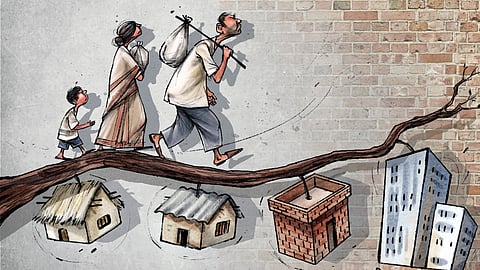

Since 1980, the global landscape has undergone a tectonic shift. For the first time in human history, the ‘urban’ is no longer the exception, but the rule; approximately 55 percent of the world’s population now inhabits urban spaces. In India, this transition is not merely a demographic statistic; it is a profound reorientation of a civilisation. In 1990, just 25 percent of Indians lived in cities. Today, that figure has climbed to a third, and by the end of this decade, 40 percent of the nation is expected to reside in urban clusters.
This shift represents a fundamental departure from the Gandhian ideal that India “lives in her villages”. As the country moves from the paddy field to the pavement, the national consciousness is being rewritten. It is time to explore the policy-driven nature of this shift, its impact on the social fabric, and the urgent need for a politics that addresses the unique pressures of the Indian city.
India’s urbanisation was not an accidental byproduct of growth but a directed effort, often prodded by global financial institutions. Following the 1991 liberalisation, the International Monetary Fund and the World Bank advocated that India see urban centres as “engines of growth”. This led to a series of landmark missions designed to upgrade the country's decaying infrastructure. The Mega City scheme of 1993 was an early attempt to channel funds into five major metros to handle the initial post-liberalisation surge. The Jawaharlal Nehru National Urban Renewal Mission in 2005 marked the first comprehensive effort to link infrastructure funding with institutional reforms. Ten years later came the Modi government’s Atal Mission for Rejuvenation and Urban Transformation and Smart Cities Mission, which shifted the focus toward technology-driven governance and ‘rejuvenation’, aiming to create sustainable, digitally-integrated urban hubs.
These policies reflect a State that has pivoted away from the village-centric development of the mid-20th century. However, the speed of this transition has often outpaced the capacity of our institutions, leading to cities that are hyper-modern in their aspirations but crumbling in their execution.
The move to the city is more than a change of address; it is a psychological migration. In the village, identity is often fixed—inherited through caste, family and land. In the city, identity becomes fluid. For the Indian youth, the city is a space of anonymity, which, while often lonely, is also liberating. It offers a chance to shed the baggage of traditional hierarchies.
The urban environment has also birthed a new Indian ‘aspirationalism’. Success is no longer measured by the harvest, but by consumption, connectivity and mobility. However, this has created a unique set of pressures. The urban youth face a paradox: they have more freedom than their ancestors, but they live in a state of precariousness—navigating a gig economy, rising rents and the compressed living of tenements and high-rises.
The city has also altered social mores. Traditional family structures are giving way to nuclear setups or ‘chosen families’ among migrant workers. Yet, the city also reinforces divisions. We see the rise of gated communities—islands of privilege that physically wall themselves off from the surrounding slums, creating a fragmented social consciousness where the ‘other’ is always in sight but never in reach.
One of the most sobering questions raised by urbanisation is the nature of conflict. Historically, communal violence in India has been predominantly an urban phenomenon. Why does the city, supposedly the bastion of modernity, become a theatre for ancient animosities? Urban spaces concentrate diversity, but they also concentrate competition. When resources (land, water, jobs) are scarce, identity becomes a tool for mobilisation.
The anonymity of the city can be weaponised; unlike a village where everyone knows each other, the city allows for the dehumanisation of neighbours. The ‘ghettos’ created by skewed urban planning become fertile ground for polarisation. The lack of shared public spaces means that different communities live parallel lives, interacting only in transactional ways, which erodes the social trust necessary to prevent violence.
The most significant political implication of this shift is the urban-rural disconnect in governance. Despite the massive population shift, India’s political grammar remains largely rural. Subsidies, rhetoric and electoral strategies are often calibrated for the village voter, while the urban resident is treated primarily as a source of tax revenue rather than a political stakeholder.
To get a politics more responsive to urban needs, several shifts must occur. First, we must empower local self-government. The 74th Constitutional Amendment promised to empower municipal corporations, yet most cities remain under the thumb of state governments. As I have argued when introducing a private member’s Bill calling for directly-elected mayors, effective urban politics requires mayors with executive power and financial autonomy.
Second, infrastructure must be seen as a right. Issues like air quality, waste management and public transport must move from technical problems to political imperatives. Finally, a responsive politics must account for the ‘informal’ city. The millions who live in unauthorised colonies or slums are the backbone of the urban economy; their lack of tenure and services is a political failure that must be addressed to ensure stability.
India’s transition from a village-based society to an urban-centric one is the greatest social experiment of the 21st century. It has brought unprecedented opportunity, but it has also strained the national psyche. We are currently “betwixt and between”: no longer purely agrarian, yet not quite comfortably urban.
The city is where India’s future will be decided. It is where our youth will innovate, where our social hierarchies will be challenged, and where our democracy will face its toughest tests. To ignore the unique demands of the urban space is to risk a future of fractured cities and social unrest. To embrace it requires a new imagination—one that sees the city not just as a collection of buildings, but as a living, breathing community that requires care, dignity and a politics of its own.
Shashi Tharoor | Lok Sabha MP, Chair of the Standing Committee on External Affairs and Sahitya Akademi-winning author
(Views are personal)
(office@tharoor.in)
