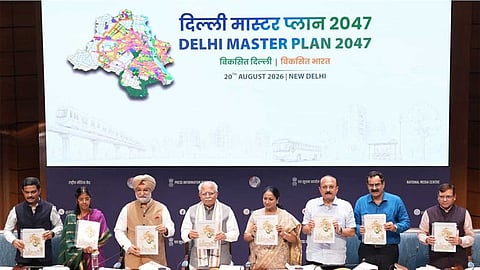

Great cities are defined not only by the infrastructure they build, but by what they preserve, restore and pass on to future generations. Delhi is uniquely endowed in both respects. The Yamuna and its floodplains, the ridge, urban forests, biodiversity parks and neighbourhood greens form its ecological foundation. Simultaneously, its monuments, historic precincts, archaeological sites and traditional neighbourhoods embody centuries of history and culture.
As India advances towards the Hon’ble Prime Minister’s vision of Viksit Bharat-2047, Delhi must demonstrate how a growing metropolis can combine development with environmental restoration and heritage conservation. The Master Plan for Delhi-2047 (MPD-2047) provides an opportunity to place these principles at the heart of the capital’s future.
Natural capital as core infra
Climate change has rewritten the rules of urban planning. Rising temperatures, extreme rainfall, acute water stress, deteriorating air quality and biodiversity loss affect the health and quality of life of our citizens. Consequently, rivers, forests, wetlands, lakes and parks can no longer be viewed merely as environmental amenities or aesthetic additions. They are essential components of urban infrastructure.
MPD-2047 envisages an interconnected green-blue network that integrates the Yamuna, the ridge, forests, biodiversity parks, water bodies, drains, neighbourhood parks and open spaces into an ecological system. Such a network yields strategic benefits.
Green corridors and urban forests clean the air, temper urban heat island effects and shelter native biodiversity. Rejuvenated water bodies, wetlands and floodplains accelerate groundwater recharge and boost the city’s capacity to absorb heavy rainfall. Parks, walking trails and cycling networks promote active lifestyles and offer accessible spaces for community recreation.
Restoring Yamuna and ridge
No vision for Delhi’s green-blue future is complete without the Yamuna. For centuries, it has shaped Delhi’s geography, history and civilisation. Yet rapid urbanisation has placed stress on its ecosystem. MPD-2047 places the Yamuna at the centre of Delhi’s ecological regeneration. Nearly 1,700 hectares of the Yamuna floodplains are proposed to be protected and ecologically restored through systematic restoration initiatives.
To tackle pollution at its source, the strategy focuses on intercepting and treating drains flowing into the river through upgraded sewage treatment infrastructure, constructed wetlands and bioremediation. Together, these measures will restore the river’s ecological health and natural floodplain functions.
The larger objective, however, goes beyond environmental restoration. Delhi must also rebuild its relationship with the river. A proposed 52-kilometre cycling corridor, alongside walking trails, public greens and managed recreational spaces will reconnect citizens with the waterfront. A rejuvenated Yamuna can therefore become both an ecological lifeline and a defining public space for the capital.
Complementing the Yamuna is Delhi’s other major ecological pillar—the Delhi ridge, an extension of the ancient Aravalli range. MPD-2047 plans the ecological restoration of approximately 7,784 hectares of the ridge, prioritising native species and scientific ecosystem management. The objective is not simply to increase the number of trees, but to restore healthier ecosystems capable of supporting local biodiversity and strengthening the capital’s long-term environmental balance.
Keeping heritage alive
Delhi’s natural and cultural heritages are deeply connected. As Delhi modernises, protecting this inheritance becomes even more important. Heritage must remain a living part of the city, protected and preserved, while continuing to serve contemporary needs and remain connected to the lives and aspirations of its people.
MPD-2047 envisages bringing around 1,500 heritage assets under Cultural Resource Management Plans, creating a systematic framework for their long-term protection and sensitive management. This will help move heritage conservation from an isolated effort towards a more structured and integrated approach.
A key part of this approach is adaptive reuse. Heritage buildings can be sensitively adapted for museums, libraries, hotels, offices and cultural activities, allowing them to remain active and useful parts of the city while retaining their historic character.
The plan also seeks to make conservation more practical and economically viable through planning and financial incentives, including Transferable Development Rights (TDR), facade retention and appropriate relaxation of space standards by the competent authority, while ensuring necessary fire and life-safety requirements. The objective is to ensure that conservation is not seen as a burden, but as an opportunity to preserve Delhi’s identity, while giving heritage properties a sustainable future.
MPD-2047 proposes heritage, cultural and festival circuits connecting monuments, historic precincts and public spaces. These can encourage visitors to experience Delhi not simply as a collection of individual monuments, but as a living historical landscape.
A resilient and timeless Delhi
The core strength of MPD-2047 lies in uniting ecological and cultural planning. Delhi’s ecological and cultural assets do not exist independently. Many historic sites are located within or adjacent to forests, water bodies, the ridge, and the Yamuna landscape. Connecting these heritage sites with greenways, cycling paths and revived water systems creates a holistic urban experience.
Imagine a Delhi where restored water bodies become vibrant community spaces; green corridors connect neighbourhoods with biodiversity parks; continuous green corridors link residential neighbourhoods; there are expansive biodiversity parks; residents can walk and cycle along ecologically restored stretches of the Yamuna; and historic precincts become vibrant centres of culture, tourism and local economic activity.
A Viksit Dilli must do much more than just grow. It must breathe better, live healthier and honour the heritage that gives it a soul.
Taranjit Singh Sandhu
Lieutenant Governor, Delhi
