
The producers of castor oil cake must be pleased. No. It is not the kind which might help futures and options players. Units located in special economic zones—which produce castor cakes from indigenous seeds on indigenous machinery—are exempted from customs duty if the output is used in the domestic market. The exemption enables the viability of export units and expands the availability of fertilisers in the domestic market for producers. Budget 2026 is defined by a plethora of such surgical steps.
Union finance minister Nirmala Sitharaman’s ninth essay has landed between hype and hope. The budget has quelled the chorus of hype, the serenade of brass band balladeers calling for a 1991 moment. It has also cheesed off stock market punters who hoped for booster shots, and the hike in security transaction tax has worsened the business model of the get-poor-quickly motley crowd of futures and options traders.
The fact is that the government, in 2025, created the impulse for consumption demand—the recast of the income tax in February, followed by the recalibration of GST rates in October. The question in the run-up to the budget was how the government would address the persistent slide of the rupee vis-a-vis the dollar, how it could stop the sell-off by foreign portfolio investors and the tepid state of foreign direct investment.
Nothing clarifies strategy like a crisis, and given the history of crisis-led transformation, the expectation was for big-bang steps. Budget 2026 has chosen to play it safe, eschewing the let’s-do-something itch that afflicts governments. It has stuck to its tested thesis and a fiscally prudent path. The budget aims to limit the gap between government income and expenditure to 4.3 percent of GDP, implying gross government borrowing of around ₹17 lakh crore. The government will spend over ₹3,800 crore every day or ₹160 crore every hour on interest payments.
The basic approach of the government over the past five years—in the face of reluctant private investment—has been to maintain momentum of growth by topping up the spend on physical infrastructure—the allocation for the year has been upped from ₹11.2 lakh crore to ₹12.2 lakh crore and allocation for defence modernisation has been ramped up to around ₹2.5 lakh crore. Seven new high-speed rail corridors—allocations and timelines for which are yet to be revealed—could enable connectivity and boost growth. There is also a not-so-clear idea of city clusters as economic regions with an allocation of ₹5,000 crore for five years. The question is: Can the government avoid what happened to the smart city programme?
The budget reflects an attempt to backstop economic growth and investment with interventions. Fish caught by an Indian vessel in the exclusive economic zone on the high seas, when landed in a foreign port, will be treated as an export. The time period for exporting the final product has been extended from the existing six months to one year for exporters of leather or textile garments. The entire value of biogas used in blended CNG is exempt from excise. Limits for duty-free imports of specified inputs used for processing seafood for export are hiked. Basic customs duty on specified parts used in making microwave ovens is being exempted to deepen value addition.
It has chosen to address the cogs of growth by unveiling a glut of schemes—each targeting an arthroscopic approach, dealing with the specificity of a nudge rather than mega-ton propulsion. It has sought to tap into the gold rush of data centres by offering a tax holiday until 2047 to any foreign company that provides cloud services to global customers using data centres in India. It creates a new fund of ₹10,000 crore for five years to boost biopharma manufacturing.
Given the global race for rare earths, the budget proposes to support the mineral-rich states of Odisha, Kerala, Andhra Pradesh, and Tamil Nadu in establishing dedicated rare earth corridors to promote mining, processing, research and manufacturing. To promote the manufacture of chemicals, the budget moots supporting states in establishing three dedicated chemical parks via a plug-and-play model. The outlay for electronics component manufacturing increased to ₹40,000 crore and ₹10,000 crore for container manufacturing.
It is not that the schemes do not merit attention. The scheme for promoting India as a hub for assistive devices for the ageing and the ailing has potential across advanced economies if it passes the quality test. A scheme to promote adoption of carbon capture utilisation and storage—important following the India-EU trade deal and for the sustainability story—has an outlay of ₹20,000 crore. There is a scheme for textile parks to promote sports goods exports, and an institute to take khadi global.
With nearly half the workforce dependent on agriculture, the government is challenged in delivering on the promise of boosting farm incomes. The idea of AI-enabled Agri Stack portals for improving farm productivity is promising. That said, the track record of ideas translating into outcomes is rather poor—the fate of the urban challenge fund and the research and development fund is yet unknown. Last budget, a mission for manufacturing was announced. This year, too, there are new committees—one for banking in Viksit Bharat, one called education to employment and enterprise and income disclosure standards.
On the face of it, the budget does not address the issue of rupee depreciation, foreign institutional investor outflows and reluctant private capital formation. The global uncertainties and the discontents do not find explicit mention, but the angst is palpable. Indeed the expectation is that on Monday, when the world markets open, there could be a further slide in the indices and the rupee and a shakeout in gold and silver prices.
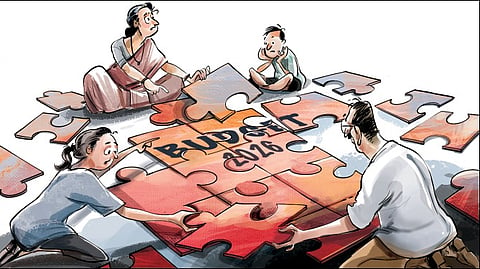
The problem with Budget 2026 is not that it lacks ideas and interventions. The problem is they are lost in the fog of minutiae. Redemption could be through an FAQ and/or town halls. More critically, the government could present an action-taken report at the half-year mark to assuage folks at home and investors in India from other geographies. The government may also consider updating the many funds launched in the past five years—let’s call it the ‘shagun report’, since these are all interventions—and a report on the report by the many committees and commissions.
Shankkar Aiyar | THE THIRD EYE | Author of The Gated Republic, Aadhaar: A Biometric History of India’s 12 Digit Revolution, and Accidental India
(Views are personal)
(shankkar.aiyar@gmail.com)
