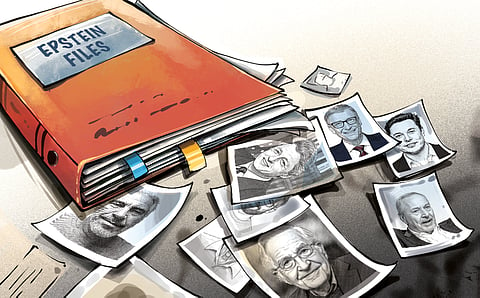

More of Epstein files are out. They have spread more shock and more disgust, while confirming more networks and further establishing the addictions, afflictions and hypocrisies of the super-rich, super-powerful, super-privileged, super-intelligent, super-successful and super-creative. There is no category left on his dubious list. There is everybody from spiritual masters to atheists. From anarchists to academics. From film people to flimsy hedonists. Then there are politicians of all shades and cruelties resembling an ideal beyond ideologies.
In other words, on the Epstein list are the proverbial 1 percent that we often speak about when we discuss the global elite. To watch the extravagance that these absolute types indulge in, to seek gossip about them, to obsess about their fashions and lifestyles, to measure their morality, their marriages and their wreckages is an institutionalised sport for the proverbial 99 percent. It is not only Donald Trump’s threats and arbitrary actions that suggest the end of a world order. It is the Epstein files, too, in a profound way. They offer a layered and metaphorical undoing of everything we thought was real and permanent.
The true shocker in the categories, besides the presence of the predictable—how much more shock can one continue to gather about Bill Clinton, Bill Gates or Elon Musk?—is the existence of the super-conscionable types too, like linguist, grand dissident and philosopher Noam Chomsky. That name casually floating up the stack of a convicted paedophile’s emails has the ability to numb people in ways not known before.
It’s not about casting salacious aspersions for mere association. It’s a new frontier featuring the crumbling hopes of a whole range of people who knew Chomsky’s work and were, suo motu, represented by his moral arguments. It is a moment when cynicism lands not like a torrent, but a tsunami on humanity.
For some others, the mention of the Dalai Lama 169 times in the mails may be similarly distressing. It makes us wonder if there is anyone immaculate and virtuous left anymore.
This kind of large-scale smashing of images and brands perhaps happened last at the height of the Cold War, when two worldviews clashed. When doubts and fences were erected overnight around un-coopted political and cultural figures. It was when icons came tumbling down in town squares when the West effected a change of disagreeable regimes. However, the Epstein files are a bloodless and borderless revolution that has smashed regimes that occupied our minds and ordered around our hearts and habits.
What more is needed to end the world order that we know when a Chomsky, a principled anarchist who wouldn’t succumb to any power in the world, is seen meowing in the labyrinths of Epstein’s noxious mind. One may want to caveat it by stating that all names that figure in the mails need not have crossed the threshold of Epstein’s pleasure rooms or sought a visit to his exotic island. But moral shaming in the age of social media is flat and uniform. The adjectives and invectives reserved for the worst offender also applies to the least offender.
Social media operates on uncomplicated binaries of the good and the bad. It is absolutist in its judgement and does not allow space for human frailties, which in another age would perhaps have had accommodation. We were often taught to separate the work from the personal, and the moral transgressions of an artist or a mahatma. Ethical crises were not overrated. But no more. The new media space thrives on simplistic models of perfection, and its algorithms are taught to place small and big deviations in the same basket. There is only outrage after that, no reasoning. Only sides to be taken—no pondering, no literature and certainly no philosophy.
Even if one assumes that people like Chomsky, one of a few good ones in a lost world, only made an error of judgement due to a momentary dimness of intellect or depletion due to age, it still exposes chinks in their formidable armour that the world thought they alone possessed. And sadly, that armour was about their ability to smell an oppressor or an oppressive act from thousands of miles away. Their moral compass was said to have the most sensitive sensors to track the murmurings of the mind and its morals, power and its putsch. With Chomsky, especially, it is not just the collapse of one argument, but that of an entire universe.
If Epstein’s admission of guilt and conviction in 2008 did not ring the alarm bells for people like Chomsky, one is left to wonder what leverage Epstein had over them and what pillows had smothered their judgement. In a 2019 email, Chomsky nearly empathises with Epstein, recalls his own experiences, and teaches him to dodge the press: “What the vultures want is a public response… how do you prove you are not a neo-Nazi… or a rapist or whatever charge comes along? In general, it’s best not to react… it’s the best advice I can think of.” It reads as if he was desperately manufacturing consent for Epstein within himself. He did not want to see or seek any evidence, his default method when it came to all those who wielded power and ran nations.
Philosophy textbooks say that Chomsky’s ethical analyses were always based on what he called ‘the principle of universality’. By which he meant that at the very least, we should apply to ourselves the same standards we apply to others. He argued that we are fond of using ethical language as a way of protesting against others, but we are less inclined to pass judgement on ourselves. Now, in his own lifetime, Chomsky has been forced to apply his own analyses and hold himself accountable.
As regards the rest of the rich and powerful on the Epstein list, it appears what British writer Jeremy Seabrook wrote a decade ago was accurate and prescient: “In recent years, wealth has been spectacularly rehabilitated, so the rich are no longer seen as jackals or vultures or hyenas or all the other bestiary of exploitation, as they were seen as in the 19th century. They have become kind of philanthropists and benefactors of humanity. We are all pensioners of the rich now.”
Sugata Srinivasaraju | Senior journalist and author of The Conscience Network: A Chronicle of Resistance to a Dictatorship
(Views are personal)
(sugatasriraju@gmail.com)
