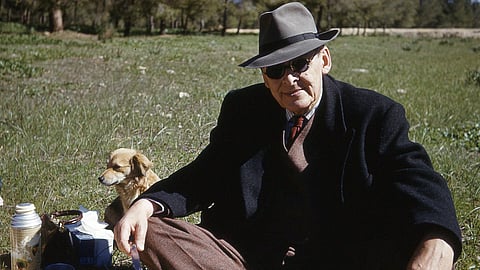

To be an artist is to be alone; there is no escape from it. The basis of art is self-confrontation and its existential environment is solitude. Yet, how difficult a proposition this is in our time when every distraction offers an escape from ourselves? This is not a rhetorical question. As a species, we have never been more ‘outed’ from ourselves than now. Outed in the sense that we panic at the prospect of an inner life.
T S Eliot spoke of being “distracted from distraction by distraction”. In our continuous state of diversion, we failed to notice the day the ‘carbon edition’ of the behavioural gene began its end: February 4, 2004, the day Facebook came into existence for the Harvard community.
Mark Zuckerberg waited another two years before releasing it to the world, facilitating a mutation of that behavioural gene from carbon to silicon. We are no longer the humans we once were. No one has changed mass psychology more since Sigmund Freud than Zuckerberg.
The mobile phone is a weapon of mass distraction. And each person has one. But it is more than that. Social media has birthed a fourth basic drive to rival hunger, sex and power: fame.
One reason we rarely see unappealing faces in media profile pictures is that fame is more easily achieved when the person behind the screen is beautiful. This persists despite recent historical efforts by liberals to institutionalise fairness regardless of colour, race, weight or gender.
But despite their best efforts, across societies, beauty remains a virtue. Beautiful people draw crowds—the old cult of the body—because they offer the illusion of a future beyond mere ‘eye appeal’. Stendhal wrote, ‘Beauty holds the promise of happiness’, underlining the connection between aesthetics, desire and fulfillment. Think of the wars fought for Helen, Sita or Draupadi. If they were plain-looking, this would have been a different world.
Beauty, then, acts as a mask—a persona. If creativity was once defined by the authenticity of the human experience, it has now transitioned to appearance as its primary norm. We have emerged from the depths to the surface. And so, in many ways, we have become superficial.
And this is in keeping with the prevalent mob culture. We hunt in collectives for victims, wounding or killing them figuratively. Judgement outruns facts; outrage circulates faster than thought. Social media has not replaced ancient drives so much as sharpened them. The one who reacts first to draw blood emerges as the new hero to the crowd. He or she is seen as fighting for justice. And, occasionally, he or she is, too.
Is old-fashioned authenticity being shelved in creative fields? I believe so. Ironically, the increasing emphasis on decorum of conduct shifts the focus from the idea of experience and the accompanying fall and rise as markers toward authenticity.
The AI revolution, a vicarious if efficient substitute for real life, is set to become the foundation of Homo sapiens. I remember reading Walter Benjamin’s 1935 essay, The Work of Art in the Age of Mechanical Reproduction, where he argues that technological reproduction—primarily photography and film—destroys the ‘aura’ or authenticity of traditional art.
We have now evolved into a post-truth society where the self is a social media construct. AI is the natural culmination of this dissolution. That we are moving from natural to artificial intelligence is self-explanatory in its direction, and the ultimate abdication of human agency.
In countries like Japan, an increasing number of people are ‘marrying’ or forming romantic commitments with AI, bypassing the complexities and inevitable pains of human relationships. Our aesthetics focus increasingly on pleasure; the future will be sadly bereft of disappointment. We are removing pain from the thalamus area of the brain.
Every age believes its own frenzy signals the end of days. But ours has technologised this frenzy so pervasively that a minute or two away from the phone—a moment without the need to react—feels like punishment. It is the fear of exclusion taken to its pathological limit; our sickening and now helpless need to be in on every party in town. As we lose our individuality to ‘techno-uniformity’, herd instincts take over.
For the reflective person, distraction is no longer episodic; it is a state. Metrics glow like daily verdicts; festivals multiply; podcasts chatter through the night and day. It is a 24-hour celebration, year-round. There is no ‘soul space’, and nothing is a mystery.
The internet is full of experts explaining how to climb stairs ‘properly’; a housewife claims cinnamon tea cures prostate enlargement; a nameless man in a room tells you why Armstrong never landed on the moon. All of them can trend for a while. Tribes form around these short-lived totems.
The universe of endless stimuli demands constant reactivity. To switch off is to be dead. If this is not the new Matrix, what is? This is why solitude—the first condition of the authentic artistic self—is beginning to look like resistance. The artist must become and behave like a guerrilla.
Hemingway said that writing, at its best, is a lonely life. Isolation is the blade that sharpens what we call the soul. It carries the risk of depression and neurosis, but when the world redefines frenzy as the new normal, why not shut the door and choose your own variation of the disorder? At least, it will be designed by you.
C P Surendran | Author whose latest volume of poetry is Window with a Train Attached
(Views are personal)
(cpsurendran@gmail.com)
