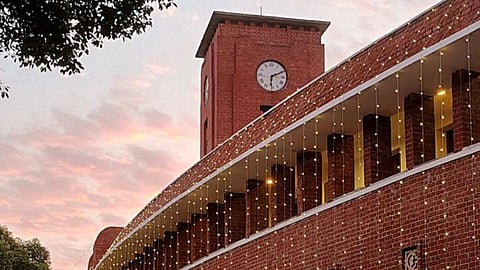

“Nostalgia is not what it used to be,” is one of my favourite quotes, variously attributed to French actress Simone Signoret and American writer Peter De Vries. While its authorship may be in doubt, its ironic humour is not. I got that feeling firsthand last weekend as I went down memory lane to the University of Delhi to mark the centenary of my alma mater.
Shri Ram College of Commerce is not what it used to be, unless you count the main red-brick building laden with teenage memories. But the festive air to mark the institution’s 100th year echoed with revelry, laughter and banter by older folks who were evidently feeling young all over again. This was not exactly a poet’s idea of nostalgia as sweet pain, though I am sure there were silent sighs on missed buses.
The joyous occasion also reflected the times we are in. Graduates from well-regarded institutions are increasingly sought after by big-ticket companies, a far cry from my days when employment prospects were far fewer. But there was a lot of gratitude one could feel in the air. Just as well. I realise that I secured a world-class degree at a monthly fee of less than $3 at the then exchange rate. My education’s real value truly dawned on me when I worked in an international agency as an equal with folks who had graduated from Yale and Oxford.
It is also great to see that one of the most desirable habits of contemporary American culture is catching on in India, though there is a long way to go. Grateful alumni are happy to give back to the institutions that shaped them. SRCC has only just begun that journey, much like most Indian educational institutions. The global reach of Indian alumni, especially in the US, has triggered the imagination for philanthropy to aid one’s alma mater, though the idea of building schools or offering scholarships is not really new for Indians. SRCC, though aided by the government in a post-independence drive for higher education, also owes a lot to its founder, Lala Shri Ram, whose philanthropic footprints are all over the national capital.
Former finance minister Arun Jaitley, probably the best-known alumnus of my college, figured frequently in the centenary conversations. The chairman of the college’s governing board, Ajay S Shriram, recalled how Jaitley once casually suggested that the classrooms be air-conditioned. When the management murmured over the costs, a few messages went out, and within months enough funds were raised from the alumni. All rooms are now air-conditioned, a far cry from my days when slowly-whirring fans would hang from the high ceilings.
The contributions were not surprising, considering the conversations I overheard at the centenary dinner. Investment bankers, private equity moneybags and tax planners were busy exchanging career notes as giant screens flashed profiles of the been-there-done-that brigade. Old boys love to network in alumni meetings. That’s profitable nostalgia.
But the generous alumni movement has only just begun in India and has faced hiccups. The government has not been quite prepared for it, and stirred into action only five years ago to do what might be called an ‘ease of doing business’ equivalent.
In the US, media tsar Michael Bloomberg donated $1 billion to the Johns Hopkins University for medical school tuition. Hedge fund manager John Paulson donated $400 million to the engineering school at Harvard, where he studied management. But the real deal is the way many lesser-known alumni contribute to build humongous endowments.
Harvard today has an endowment larger than $50 billion and Yale—named after its first big benefactor, Elihu Yale, who made much of his money at Fort St George, Madras—has more than $40 billion today. Princeton, Stanford and MIT rank close behind.
But Infosys co-founder N R Narayana Murthy had a rude awakening in the 1990s when he found that he could not donate ₹8 crore worth of shares to IIT Kanpur because regulations did not allow equity-based donations at that time. Murthy said a couple of decades later that had it been accepted, the stake would have been worth ₹2,000 crore. There was also a report on how a scientist had to backtrack from a donation of 8 acres of land to another IIT because it attracted a stamp duty of ₹40 crore that the state government refused to waive.
Nevertheless, individual generosity has pushed ahead. Another Infosys co-founder and current Executive Chairman Nandan Nilekani in 2023 pledged ₹315 crore to his alma mater, IIT Bombay, a year after IIT Kanpur received ₹100 crore from Rakesh Gangwal, co-founder of IndiGo Airlines.
The structured endowment model arrived in India in 2019, when IIT Delhi started a fund with the alumni committing ₹250 crore. Administered as a non-profit, the corpus now stands at around ₹480 crore and aims to reach ₹7,000 crore. We need many more such initiatives.
In 2022, the Union education ministry issued guidelines for central universities to set up endowments to be run by boards headed by vice-chancellors, with rules on how to spend the money while growing the corpus.
There was talk at SRCC about startup incubators to help entrepreneurs and address opportunities in artificial intelligence. With AI disrupting every field including education, pedagogy needs to reinvent itself. Evidently, alumni with real-life experience can pitch in with something beyond money.
Madhavan Narayanan | REVERSE SWING | Senior journalist
(Views are personal)
(On X @madversity)