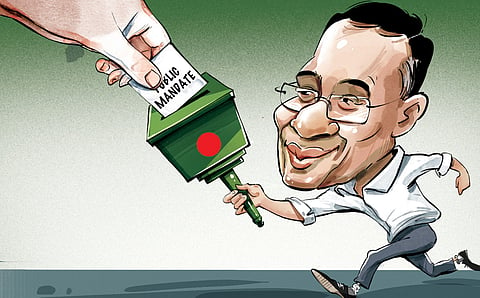

The people of Bangladesh have voted decisively to usher in a transformed political era. Though not inclusive, with the Awami League banned from participation, the election was largely peaceful, marred by sporadic attempts at booth capturing. Predictably, voters have expressed their resounding faith in the mainstream political party, the Bangladesh Nationalist Party (BNP), led by Tarique Rahman, son of deceased former prime minister Khaleda Zia and the future PM. The BNP bagged 212 seats out of 300 in Parliament, notching up a two-thirds majority. Three elected MPs of the BNP are those who were facing death sentences for terror attacks and arms smuggling to Indian insurgent groups. They were acquitted by the Yunus regime, by managing the judiciary.
The coalition of Islamist parties led by Jamaat-e-Islami (JeI) came in a distant runner-up with 69 seats. The National Citizen Party (NCP), formed by the leaders of the student agitation, won only six seats. Predictably, the JeI has pointed fingers at the election commission for malpractices. For both the BNP and JeI, the numbers represent the best performance in any prior election. The rest of the seats were won by smaller parties and independents. The voting percentage has been low, perhaps below 50 percent, though the election commission has projected a figure over 60 percent. Sheikh Hasina’s call to her supporters to boycott the elections certainly kept many voters away.
The election cannot be called truly free, fair or inclusive because of the ban on the largest political party, the Awami League, which was arbitrarily imposed by the interim government’s diktat. The Awami League and Hasina can be faulted on many counts, but to exclude them from the election does not bode well for the future. The election, however, fulfils Yunus’s dream of the ‘minus two’ formula, first propounded during the Army-backed caretaker government in 2007, which sought to exclude both Hasina and Khaleda Zia, the so-called squabbling Begums, from politics. With Hasina living in exile in India and Khaleda passing away last month, that goal has been achieved.
The referendum based on the so-called July Charter, tagged on with the election, has received over 70 percent ‘Yes’ vote. The referendum proposals include over 80 items, grouped into four categories, which seek to reform the governance structure. The referendum has no constitutional sanctity. The referendum is the brainchild of the Yunus regime, ostensibly based on popular demand, mainly from students. The recommendations were crafted by six reform commissions, which listed amendments to the Bangladeshi constitution, reforms of the judiciary, the electoral system, the police, public administration and anti-corruption measures. Some key recommendations include a bicameral parliament, new vice-presidential position, imposing a two-term limit on the PM’s tenure, enhancing presidential powers, expanding fundamental rights, protecting judicial independence and increasing women’s political representation.
It remains to be seen how the referendum issues will be incorporated into the Constitution. It is debatable whether the general public understands the implications of these recommendations, but the Yunus regime forced all political parties to accept the referendum and campaign for a ‘Yes’ vote. According to the latest figures, it would appear that no more than 12 percent of voters cast their ballots in the referendum. The new parliament is expected to implement the reforms within 270 days. Will the new parliament implement it, refer it for legal opinion or form a parliamentary committee to examine it? These are some questions that have cropped up. The BNP has promised to implement the referendum reforms. The BNP’s main challenge will be to live up to the aspirations of the youth who wanted change. Hence, the demand for good governance will remain a high priority, and BNP’s ability to deliver acceptable outcomes will determine its success in government.
The electoral verdict has firmly rejected the Islamist coalition led by the JeI, including its coalition partner, the NCP, formed by the students’ agitation leaders, conveying a clear message that the people don’t trust Islamist parties or student agitation leaders to deliver good governance. The people of Bangladesh do not want to live in an Islamic state and under Sharia law. Moreover, the JeI’s role in the 1971 genocide and targeting minority Hindus is deeply etched in public memory. In the voters’ perception, the JeI remains a proxy of Pakistan and is therefore untrustworthy. Many women voters reject the JeI’s regressive views on women. The JeI’s leader publicly stated that his organisation can never have a woman leader and women’s role in public life is akin to prostitution. The JeI did not put up a single woman candidate. As for Hindu voters, they would have opted for the BNP as the less oppressive choice.
The JeI’s charter states that ‘In deciding any matter or accepting any working policy, Jamaat shall give stress only on the commandment and principles of Allah and his apostle, Mohammed PBUH’. Since the JeI did not acknowledge Bangladesh’s Constitution as the source of all laws, it was banned as a political party by a Supreme Court judgement. This happened during Hasina’s tenure and was another reason for the JeI’s targeting of Hasina during the agitation. The JeI’s youth wing, the Shibir, provided the storm troopers for the attack on Hasina’s official residence, following her evacuation and flight to India.
The voters of Bangladesh have opted for stability and restoration of constitutional government. The people want to see the back of the unconstitutional interim government, which was imposed on the hapless country in August 2024, following the regime change operation that successfully ousted PM Sheikh Hasina from power. The interim government, led by Muhammad Yunus, a Nobel Peace Laureate, was a nominee of the US whose deep state conceived and implemented the regime change operation, using American NGOs which front for the CIA and its rentier state Pakistan, working in tandem with the JeI.
Ousted former PM Sheikh Hasina has called the national election a "carefully planned farce", whereas Yunus termed it a “birthday for new Bangladesh”. Soon after the voting concluded, Hasina's Awami League posted a message on behalf of its leader expressing her gratitude to all the citizens for rejecting the ‘farcical election of the murderous-Fascist Yunus".
In an official pre-election statement, the Awami League said “In this situation, we demand the cancellation of this voter-less, illegal and unconstitutional election, the resignation of Yunus, the withdrawal of false cases and the release of all political prisoners as well as teachers, journalists, intellectuals and professionals, the removal of the suspension imposed on the activities of the Awami League, and the restoration of the people’s voting rights through the arrangement of a free, fair and inclusive election under a neutral caretaker government.” There is no love lost between Hasina and Yunus, long at loggerheads over Yunus’s political ambition and dubious commercial dealings.
The interim government’s 18-month rule was marked by large-scale mismanagement, lawlessness and economic decline, with the minority Hindu community bearing a disproportionate burden of the violence. During this period, the JeI was the de facto ruler with the American appointee Yunus as its willing puppet. Bangladesh will be better off as the interim government becomes a thing of the past. Whether Yunus will say goodbye and walk into the sunset remains an issue. There have been rumours of ‘deals’ in which Tarique was acquitted of all corruption and murder cases, a quid pro quo for making Yunus the president. The American hand in this ‘deal’ cannot be ruled out.
For India, there is an opportunity to work toward a reset in bilateral ties, which the Yunus-JeI regime deliberately downgraded. The Yunus-JeI coalition, backed by Pakistan, deliberately fanned anti-India sentiments, exploiting the Hasina factor. Reflecting the poor state of bilateral relations, India reduced its financial assistance to Bangladesh in its latest budget. The progressive Islamisation of Bangladesh and its spillover effect into India’s neighbouring states is a cause for worry that demographic changes are being brought about by the illegal migration of Bangladeshi Muslims. It is noteworthy that the JeI won in several constituencies bordering West Bengal. Bangladesh will remain a contested arena for big powers.
The BNP has announced that its government will have good relations with all countries. There is an anti-India lobby within the BNP that will seek to harm India’s security interests. If these MPs are given ministerial positions, it would not be a positive signal for bilateral ties. Bangladesh, regardless of the government in Dhaka, will remain a vital neighbour, given the geographical reality, India’s strategic interests, and the Act East Policy. It would be unrealistic to expect India-Bangladesh relations to attain the level of close engagement they achieved during Hasina's tenure under the BNP government. But substantial engagement can be revived if the BNP government sticks to its electoral pronouncements.
Pinak Ranjan Chakravarty | Former High Commissioner to Bangladesh and Secretary in the Ministry of External Affairs
(Views are personal)
