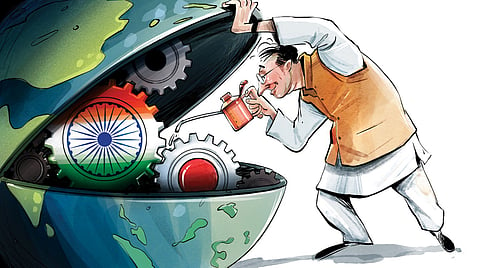

Japan rarely produces political moments that feel genuinely transformative. Its post-war politics have been marked less by dramatic rupture than by careful continuity; leadership changes within a broad consensus. But the decisive mandate that has brought Prime Minister Sanae Takaichi, Japan’s first woman to hold the office, to power is different. It’s not merely a social milestone; it’s a moment of strategic reckoning. India cannot afford to ignore this moment.
With a commanding parliamentary majority and renewed political authority, Tokyo now possesses something rare: the capacity to act decisively. Whether it chooses to do so will shape not only Japan’s future but the wider balance of power across Asia.
Since the Meiji Restoration of 1868, Japan has shown an extraordinary ability to reinvent itself under pressure. The leaders of Meiji understood that survival in a world dominated by imperial powers required bold transformation. They adopted Western institutions without surrendering cultural identity. That lesson reverberates through Japan’s history: in its rise, its wartime tragedy and its remarkable post-war reinvention as a pacifist economic powerhouse under the Yoshida Doctrine, which prioritised economic recovery and relied on the United States for security.
Today, Japan appears to be entering what might be described as a post-Yoshida moment, when the assumptions of strategic restraint are being reconsidered in light of a far more demanding geopolitical environment.
Today, Japan faces another such turning point; arguably the most consequential since the end of the Cold War.
The electoral verdict reflects a public mood that recognises the gravity of the strategic environment. The rise of China, intensifying geopolitical competition, technological fragmentation and uncertainty about American commitments have eroded the comfort of strategic ambiguity. Prime Minister Takaichi’s appeal rests partly on her willingness to articulate what many Japanese have long sensed: that the country must move beyond cautious incrementalism toward strategic normalisation, a Japan prepared to assume greater responsibility for its own security and for regional stability.
Foreign policy will test whether this mandate brings real change. The alliance with the United States remains indispensable. Yet, it’s entering a more complex phase. Washington’s strategic focus is increasingly divided. Its domestic politics—with Trump at the helm—bring unpredictability that allies cannot ignore. Tokyo must preserve the alliance, while also building the ability to act more confidently when needed.
China remains the central strategic variable. Economic interdependence coexists uneasily with deep geopolitical rivalry. Maritime frictions in the East China Sea, persistent grey-zone pressures, and the ever-present risk of a Taiwan crisis underscore the fragility of the regional equilibrium. Japan’s shift toward stronger deterrence reflects not adventurism but recognition that stability must be actively sustained. Defence spending will go beyond two percent of the national income, and the nuclear option is being debated.
Yet, Japan’s challenge is also internal. Demographic decline, fiscal constraints and debates over economic reform will test the government’s ability to convert political capital into durable policy. Strategic ambition must be matched by economic resilience.
For India, the implications are profound—and they require a degree of strategic clarity that goes beyond familiar talking points.
I was in Tokyo at the height of the strategic partnership between Prime Minister Narendra Modi and the late Shinzo Abe, when the relationship carried an unmistakable sense of purpose. There was a shared conviction that India and Japan could together shape the Indo-Pacific, not merely respond to it. Conversations in policy circles and academic forums alike reflected a quiet confidence. The two countries were entering a new phase of cooperation—one anchored not only in shared interests but in a deeper alignment of outlook. That spirit—grounded in trust, strategic imagination and political will—infused the partnership with momentum. That spirit now needs to be revived with urgency.
On November 23, 2025 Prime Minister Narendra Modi and Takaichi held a bilateral meeting on the sidelines of the G20 summit in Johannesburg. Recent meetings of the foreign and defence Ministers in the India-Japan ‘2+2’ framework underline the institutional depth of the relationship. These dialogues have reaffirmed cooperation across maritime security, defence technology and regional strategy. However, they also serve as a reminder that sustained engagement must now translate into sharper coordination and concrete outcomes.
Too often, however, India has treated the relationship with Japan as comfortable rather than consequential—a partnership of goodwill rather than one of strategic depth. In a region that is itself entering a post-Yoshida strategic environment—where economic interdependence can no longer substitute for hard security—such complacency would be a mistake. If Japan, under Prime Minister Takaichi, is entering a phase of strategic activism, India must respond with equal seriousness.
First, defence cooperation should deepen dramatically. The logic of maritime geography alone argues for closer coordination across the Indian Ocean and the Western Pacific. Joint exercises must evolve into sustained operational familiarity. This includes enhanced information sharing, coordinated patrols and collaboration in emerging domains such as cyber and space. Co-development of defence technologies would strengthen deterrence and signal long-term commitment.
Second, economic engagement must be elevated into a strategic compact focused on resilient supply chains in critical sectors—semiconductors, clean energy, advanced manufacturing and digital infrastructure. India must ensure policy coherence and regulatory predictability to match its strategic ambitions.
Third, diplomatic coordination should become systematic, ensuring that New Delhi and Tokyo act in concert on regional challenges.
Strategic autonomy does not mean strategic hesitation. For India, treating Japan as a central pillar of its external strategy is not a departure from principle but its logical evolution in a changing world.
At a time when authoritarian models claim decisiveness as their advantage, the partnership between India and Japan demonstrates that democracies can combine legitimacy with strength. This is not merely a matter of values; it’s a strategic necessity.
Prime Minister Takaichi’s mandate has created expectations in Japan that cannot be easily deferred. Her leadership will be judged by whether she can translate political momentum into structural reform and position Japan as a confident actor in regional affairs.
The emerging order in Asia will not be shaped solely by great powers but by the ability of countries like India and Japan to act with foresight and conviction. The Modi-Abe era showed what is possible when political will aligns with strategic vision; reviving that spirit’s now imperative. History reminds us that moments of transition are fleeting. Japan has been given such a moment. India must recognise that it has been given one too. This is not a moment for routine diplomacy; it’s a moment for resolution.
Amitabh Mattoo | Dean, School of International Studies, JNU; former member, National Security Advisory Board
(Views are personal)
