
William Dalrymple recently sputtered like a lit fuse on X at an “irritating and ignorant article” in The Guardian that had asked why India has over 100 literary festivals but low book sales and no culture of reading. Is it because entertainments like Bollywood are included in festivals? Why did Dalrymple feel irritated when the argument about poor sales and low readership has been around for decades?
The article by Amrit Dhillon only added the contrast between the smallness of the publishing industry in India and the boom in literature festivals, led by the Jaipur Literature Festival that Dalrymple co-founded. She offered supporting quotes from authors, booksellers and publishers. All of them affirm that the book trade moves slowly, but Indians like a nice jamboree. This rather harmless allegation burst like an inflamed boil.
Blame the name. The literature (or literary) festival is a British creature of post-war provenance―the oldest is at Cheltenham, an annual feature from 1949, and the best-known is at Hay‑on‑Wye, established in 1988, which exported the concept and the name overseas. In India, JLF adopted the format in 2006, grew exponentially and encouraged entrepreneurs with literary leanings―and organisations which understand that literariness works like angel dust―to get in on the game. Writing became performative.
In the beginning, there were book fairs, not literary festivals. In medieval Europe, trade fairs at commercial centres like Leipzig attracted booksellers and printers, who then launched book fairs. The Frankfurt fair, the biggest business-to-business book expo, is purely a trade fair for the sale of international rights. It lets in retail buyers only as an afterthought. Interaction of readers with writers and publishers, a hallmark of literary festivals, is limited to the weekend.
In India, book fairs preceded literary festivals. The New Delhi World Book Fair opened in 1972 in conjunction with the Asia 72 trade show. Both were held at the Pragati Maidan exhibition complex, a classic design by architect Raj Rewal that the present government has demolished in a random act of vandalism to make room for Bharat Mandapam.
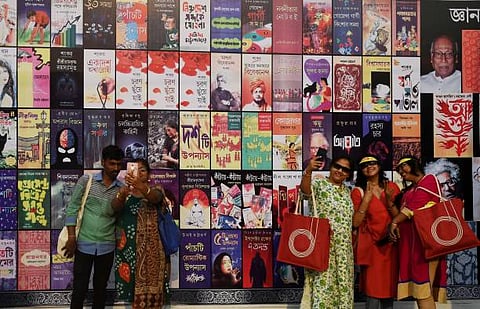
India’s biggest book event is the International Kolkata Book Fair, started in 1976, which draws over 20 lakh visitors. It’s a very serious fair—rare titles like Revelations of Divine Love by the 13th century anchoress Julian of Norwich can be found there (I know, I bought a copy). The fair also features literary entertainments like readings and discussions by prominent writers and publishers, and Kolkata’s significant set circulate freely. So do phalanxes of pamphleteers selling crank treatises proposing a geocentric universe or divination by observing crows (Kak Charitra). It’s a mixed bag, like a country mela, which is where it gets its Bengali name from―Boi Mela.
A mela suggests not a trade fair for bookish audiences and writerly stars, but rural harvest festivals. There’s the Poush Mela in nearby Santiniketan, for instance, where highbrow and lowbrow mingle in a strangely uplifting cloud of food, music, poetry, handicrafts, activism and pot. In India, the traditions of the deadly-serious book fair and the entertaining festival have merged. People who don’t like this say it devalues books. The rest say that it brings more people into the fold of readers. These are opinions, not facts.
The older allegations which started this thread—books don’t sell in India and there’s hardly a culture of reading—must be inconclusive because, invariably, the discussion is about publishing in English, which is a fraction of the Indian publishing landscape. The whole vista is very varied, from risk-averse publishers who print textbooks to offset speculative losses in literary publishing, specialists like Amitav Ghosh’s publisher Ravi Dayal and Vikram Seth’s publisher P Lal, and idealists running small presses, usually into the ground.
Besides, in Indian publishing, for every fact there’s an alternative. The industry formalised only recently and it is still normal for writers to submit a manuscript without a contract and to hand over rights during a casual phone call, with no written record. Frames of reference also matter. In response to the article in The Guardian, which stated that Indian print runs are low and that 10,000 copies make a bestseller (a fact in English publishing), HarperCollins India CEO Anantha Padmanabhan pointed out that the Malayalam novel Ram C/O Anandhi by Akhil P Dharmarajan and Too Good to be True by Prajakta Koli sold 3 lakh and 2 lakh copies in a year (an alternative fact). The context: both are young social media phenomenons and Koli works in OTT cinema. Of course they’d have the numbers. Amish pioneered that strategy when he embraced digital media promotion.
Beyond English, on which the spotlight is fixed, Indian publishing is a vast landscape. If you consider sellers of used books―who often participate in trade fairs―you’ll find the numbers climbing fast. And if you look into the darker corners of this world where the pirates are silently at work, you’ll find hoards that go uncounted. That’s why, when no one’s looking, many writers ask the bootleggers at traffic lights how their novels are doing. The pirate estimate can be more revealing than formal sales figures. A market with such varied cultures of reading, and so many languages, styles and niches, can’t be treated as a single, orderly entity bound by universal rules.
Pratik Kanjilal | SPEAKEASY | Senior Fellow, Henry J Leir Institute of Migration and Human Security, Fletcher School, Tufts University
(Views are personal)
(Tweets @pratik_k)
