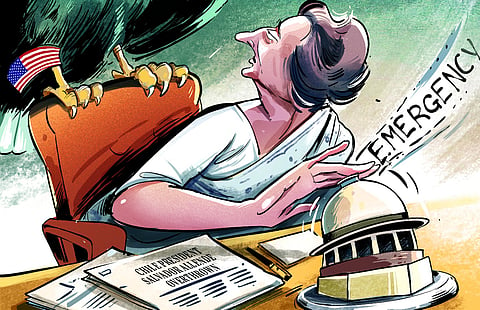

Taking Venezuelan President Nicolás Maduro and his wife Cilia Flores out of their Caracas home in the middle of the night and transporting them across land, air and water to New York City was a wild script that only Trumpian realism could produce. Reason, cultivated by decency and diplomacy, cannot easily delineate why the US government did what it did, and how much more it wishes to unsettle the world.
Many have tried to argue that the US has lost its moral authority from this one act of extravagant crudity and ruthlessness. But one wonders if the US, over the past century, ever aspired to moral authority. It has been singularly obsessed with unqualified authority, sans frontier, backed by the dollar and military machines. An Epsteinian metaphorical strand of deceit, which carries the power to consume even conscience-keepers like Noam Chomsky, has perhaps always been part of this worldview.
Perhaps it is only weak countries that aspire to moral authority. Henry Kissinger, the controversial American diplomat who normalised the US foreign policy of regime changes in Latin America and across the globe, had an interesting comment on India’s foreign policy under Jawaharlal Nehru. This was after Indira Gandhi had visited the US in November 1971 during Richard Nixon’s first presidential term, and had famously not gotten along with him.
Kissinger wrote: “We took at face value Nehru’s claim to be a neutral arbiter of world affairs. We hardly noticed that this was precisely the policy by which a weak nation seeks influence out of proportion to its strength.” Further extending his reading to Indira Gandhi, he said that “her almost hereditary moral superiority” and “moral pretensions” irritated Nixon. Forwarding moral currency, it could be assumed, has been viewed as a sign of camouflaged poverty by the US. Therefore, it would naturally not be bothered about moral authority.
Since we are speaking about Indira Gandhi, it may be instructive to mention a pestering thought and a lurking fear that occupied her mind in the early 1970s. It has resonance today, when Maduro has just been ‘abducted’ by the US. According to people who worked closely with Indira Gandhi, she thought over 50 years ago that she could similarly be dislodged by the US with the help of the “notorious” Central Intelligence Agency. She seriously entertained the thought that there was a “foreign hand” fomenting trouble in India, designed to end her rule.
The idea strengthened in Indira Gandhi’s mind after what happened in Chile, a country south of Venezuela on the Latin American map. In a CIA-backed operation in September 1973, Chilean President Salvador Allende was killed and a puppet regime under General Augusto Pinochet was installed. Indira Gandhi imagined that the fate of Allende, a fiercely independent socialist, could become her fate as well.
Indira Gandhi had by then antagonised Nixon, who was behind the fall of Allende. The 1971 war with Pakistan, which led to the creation of Bangladesh, had upset the US’s strategic plans in South Asia. India had exploded a nuclear device in May 1974 to the chagrin and shock of the US. Plus, India’s growing ideological alignment with the erstwhile Soviet Union had led to Cold War suspicions and frostiness. India as a poor country under Indira Gandhi, with what Kissinger described as her “moody silences” and “moral views”, had exasperated the US.
One of Indira Gandhi’s closest advisors, P N Dhar, in his 2000 book titled Indira Gandhi, The Emergency, and Indian Democracy, wrote: “Indira Gandhi herself had apprehensions of foreign involvement in the affairs of the country on the pattern of what had happened in Chile… According to syndicated columnist Jack Anderson, the International Telephone and Telegraph Company (an American multinational) and the CIA had organised Allende’s overthrow in 1973. Indira Gandhi believed every word that Jack Anderson wrote on Chilean affairs. Since she herself was known to be high on Nixon’s hate-list, she had become apprehensive of what she called ‘the foreign hand’. Intelligence reports about plots to overthrow Mujib’s government in Bangladesh added to her fears.” Sheikh Mujibur Rahman was assassinated on India’s Independence Day in 1975.
Indira Gandhi’s biographer Katherine Frank also wrote that her protagonist was “genuinely afraid that she would be overthrown and destroyed” in the same manner as Allende. This fear of a CIA-backed ouster was different from one that had enveloped Indira Gandhi’s mind soon after the victory over Pakistan in 1971. She had then asked General Sam Manekshaw, point blank, if he intended to take over from her soon, as rumours to the effect were rife in Delhi.
Indira Gandhi’s apprehension—since 1973, till the point the Emergency was proclaimed and later—was that the movement led by Jayaprakash Narayan had American support and dollars. She was unwilling to concede that it was a fund-starved, home-grown movement largely of her own making. The media attention that J P got in the US in 1974 made her even more suspicious. Her contention was that the same US had been indifferent to J P in 1971 when he had campaigned for the freedom of Bangladesh.
Indira Gandhi had also told West Bengal Chief Minister Siddhartha Shankar Ray and UK’s Labour Party leader Michael Foot that she did not “want to suffer the fate of Allende”. Two other warnings of the US’s alleged intentions against her are said to have come from Cuban President Fidel Castro and USSR leader Leonid Brezhnev. Castro had apparently told her “You are next” during his stopover in Delhi on 17 September 1973 on his way to North Vietnam. This was less than a week after Allende had been assassinated. Indira Gandhi received Castro and saw him off at the airport with her entire family in attendance.
Indira Gandhi had met Allende twice. Once at an international conference in 1971 and earlier, in 1968, in Chile before he became president. Three years after he was assassinated, in 1974, Indira Gandhi hosted his widow and daughter, Hortensia and Isabel Allende, in New Delhi. That was about solidarity, signalling to the US and courage.
In terms of details and modus operandi, Maduro’s fate has been very different from that of Allende in 1973. The exact scenarios that Indira Gandhi had imagined about her possible overthrow remain undocumented for history.
Sugata Srinivasaraju | Senior journalist and author of The Conscience Network: A Chronicle of Resistance to a Dictatorship
(Views are personal)
(sugatasriraju@gmail.com)
