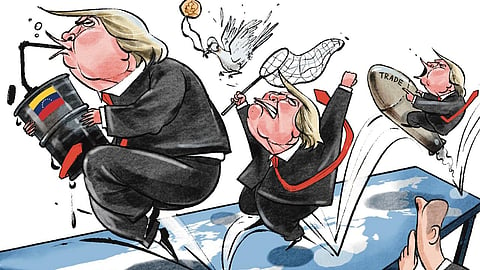

The new year has begun with a military adventure. In a move that stunned the world, the established government of Venezuela was overthrown, and President Nicolás Maduro and his wife were dragged from their beds in Caracas, flown to the US, and imprisoned in New York. Not since the invasion of Iraq has the US made such an aggressive geopolitical gesture.
Yet, even the Iraq campaign was less crassly executed. When George W Bush sought to avenge the assassination attempt on his father by Saddam Hussein, he at least constructed the pretext of ‘weapons of mass destruction’ and assembled a multinational coalition with Britain, Australia and Poland. In Venezuela, there was no such cover. Declaring Maduro the chief of a cocaine ring, Trump captured the leadership and exulted in his victory over a smaller, weaker Latin American neighbour—one that happens to possess the world’s largest oil reserves.
Psychologists might argue this aligns with the diagnosis of ‘malignant narcissism’—a blend of narcissism, antisocial behaviour, paranoia and sadism—attributed to Trump by psychologists. In Trump’s mind, no predecessor—not Biden, Clinton or Obama, not even George Washington or Abraham Lincoln—can match him. He initially sought to subdue the world through punitive tariffs, though the efficacy of this economic warfare remains debatable. It is likely the American consumer suffered most, evidenced by the quiet withdrawal of tariff hikes on over 200 food products. While US inflation hovers between 2.8 percent and 3 percent, many economists argue it would have cooled further without his protectionist levies.
Initially, Trump indulged his narcissism through a crusade for the Nobel Peace Prize. He claimed credit for preventing conflicts globally, including the short India-Pakistan war—a claim India firmly repudiated. During his angry election campaign, he vowed the Ukraine war would end the day he assumed office. Yet, the reality is starkly different. Russia continues near-daily missile strikes on Ukraine’s energy grid, leaving civilians freezing while its forces press forward with the objective of capturing Kupyansk by February.
Having largely failed in his mission of making the world kowtow to him by unilaterally imposing tariffs and in his mission to make Russia capitulate by ending their war against Ukraine, Trump has now turned to using his military to crush weak countries. He claims to have taken Venezuela, which he says will now be under American control until the situation is to his liking. The Venezuelan Vice President, Delcy Rodríguez, went on television and demanded the immediate release of Maduro and his wife Cilia Flores, calling Maduro “the only president of Venezuela”. It is yet to be seen how Trump will establish his dominance over Venezuela in the days to come. He has even threatened American boots on the ground if Rodríguez “doesn’t do what is right”. She has subsequently toned down her rhetoric.
Trump’s ambitions appear boundless. In typical style, he also warned Colombian President Gustavo Petro to “watch his back”, stating that “a sick man governs Colombia” and “Operation Colombia sounds good to me”. He reiterated that “we do need Greenland absolutely” and “Cuba is ready to fall” in the absence of Venezuelan oil. If the Trump of 2025 was a peace-seeker chasing a Nobel, the Trump of 2026 is on a warpath. A resource-based neo-colonialism is taking shape, placing Latin America in grave peril.
Global condemnation has been mixed. China and Russia denounced the invasion but are unlikely to intervene; Beijing is focused on economic growth and internal anti-corruption drives, while the Ukraine war consumes Moscow. Brazilian President Lula da Silva stated the US crossed “an unacceptable line”, a sentiment echoed by Spain, Chile, Colombia, Mexico and Uruguay. Conversely, Argentina and Ecuador seem overjoyed.
Where does India stand on this flagrant violation of sovereignty? As has been the practice of our foreign ministry lately, we chose to play it safe while dealing with the US. Our boldness seems reserved for neighbours, where we invent new forms of “cricket diplomacy”—refusing to allow players in the IPL or preventing players from shaking hands. On global aggression, we prefer to remain mute like bureaucrats in uncertain situations.
We began 2025 with optimism. Prime Minister Modi’s “close friend” was back in the White House. We perhaps overestimated that intimacy, just as Trump underestimated India’s resilience. Trump’s policy is transactionally predatory: he seeks to expropriate resources, whether Venezuelan oil or Indian market access. He viewed India merely as a dumping ground for US agricultural goods, miscalculating the strength of Indian democracy and its farmers. Modi himself learned this lesson in 2021, when he was forced to repeal market-friendly agricultural reforms—introduced initially during the pandemic—after facing the uncompromising ferocity of farmers in North India on the cusp of the Uttar Pradesh elections.
Nor is the situation such that India has to yield to pressure from the US or any other country. In 2025, India’s economy experienced what analysts termed a ‘Goldilocks moment’—a rare period of high growth and low inflation. Foreign exchange reserves are at an all-time high. The tweak in economic policy towards the demand side, rather than exclusively the supply side—effected over the last couple of years and, hopefully, further strengthened this year—has resulted in burgeoning domestic demand. Inflation has not grown out of control. Despite Trump’s tariffs, exports have been healthy.
The Venezuelan situation need not affect the oil market unduly, as sanctions have reduced flows from the country to a trickle, a factor already priced in by buyers. Politically, the PM is in a strong position domestically, with the opposition divided and the Congress in disarray except in states with firm coalitions, such as Kerala. His foreign policy remains somewhat uncertain, and the BRICS coalition, which could resist hegemonic forces, has not yet put forward concrete measures to stabilise the global economy.
In the final analysis, we would do well to remember that Trump is an ‘episodic man’, as American psychologist Dan McAdams described him. He shifts from episode to episode without memory of the past or worries about the future. We need to closely monitor the evolving global situation and adjust our policies to outmanoeuvre an unpredictable man.
K M Chandrasekhar | Former Cabinet Secretary and author of As Good as My Word: A Memoir
(Views are personal)
(kmchandrasekhar@gmail.com)
