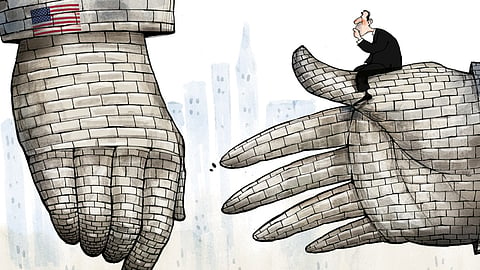

The new year began well for India-US relations. Most of December went without US President Donald Trump’s annoying pinpricks, usually accompanied by brazen insults from his courtiers in the administration. December offered a welcome change from the rest of Trump’s first year in office during his second term and hope sprang for a rosier 2026 in the hearts of Indian diplomats in Washington.
India’s public unfailingly gets worked up over everything that emanates even from outright non-entities in Washington. If Indians dispassionately scrutinised relations with the US, they will realise that two remarks by Trump about India so far in the new year were not suo motu presidential statements. US Senator Lindsey Graham got Trump into talking about India aboard Air Force One on January 4. Graham dragged India into his press gaggle while explaining the status of his Senate Bill to impose severe secondary sanctions on countries buying discounted Russian oil. Trump had to intervene. In the second instance the following day, at the annual policy retreat of Republican members of the House of Representatives, Trump spoke longer about India. But he spoke in response to an earlier reference to tariffs at the retreat.
One certainty about India-US relations in 2026 is that they are not headed for any great heights, unlike in the Bill Clinton or George W Bush presidencies. It will not even be like the four years of Trump’s immediate predecessor, Joe Biden. Since the Narendra Modi government has decided to be passive and not confront or challenge Trump at every turn—like China’s tit-for-tat attitude—it is unlikely that bilateral relations will nosedive.
Overall, New Delhi-Washington engagement will be on a plateau. The earlier hopes of a thriving multi-faceted bilateral partnership have already been belied with Trump in the White House. These expectations mostly fructified from 2021 until the US drifted into election mode at the end of 2023. To use a railway terminology, the engine of this engagement is now routinely chugging along and will continue to do so. It will not become a bullet train, as many in India had fervently hoped.
Such a depressing assessment is because the Trump administration has no India strategy or policy. It requires two hands to do high-fives. At the moment, only India’s arm is raised. The American one is sheathed and lowered. Sadly, this policy paralysis extends to the Capitol Hill as well. The twin chambers of the US Congress, which stood shoulder-to-shoulder with India for 30 years in advancing the New Delhi-Washington bonhomie is de facto leaderless, having become doormats to the president. Rare exceptions involve defending legislative privileges.
The present Congress has none of the earlier passion for India on Capitol Hill, at best a minimal interest when prodded by lobbyists hired by the Indian mission on Embassy Row. Therefore, the most important pillar of Indian foreign policy for a quarter century since Clinton’s visit to India—the relationship with Washington—has become unstable. It is unnerving for South Block, where policymakers of the ministry of external affairs sit, because they had taken this relationship for granted to be on perpetual rise.
It is not uncommon for the foundations of foreign policy in every country to change, often because a country’s politics has changed. Bangladesh is one example. The US is another. What the architects of Indian foreign policy must ponder is whether the switch in the US to a Make America Great Again approach will be permanent. A reasonable conclusion is that even after Trump ceases to be president, Trumpism may outlast him. The Republican Party has been recast in Trump’s ideology—some would say lack of any ideology. It would be well nigh impossible for his successors in the Grand Old Party to put the genie back in the bottle.
That means India must not expect that its compact with the US, which was the biggest factor in many decisions, will be restored in 2029 when Trump’s successor, from whichever party, takes office. India needs a new US policy. Atal Bihari Vajpayee refashioned the attitude to Washington—and vice versa—after the nuclear tests of 1998. Without putting in place a whole new policy framework similar to what Vajpayee did, India-US relations will remain on a plateau. It may even stagnate.
It has been clear throughout the wasted year of 2025 that New Delhi and Washington are now only talking at each other, not talking to each other in any meaningful way. Take China on the other hand. Its engagement of the Trump administration ranges from rare earths and chipmaking tools to cutting edge technology in multiple areas and managing competition for regional influence.
Granted, the world has become bipolar with the US and China seeking to carve up everything between them. What does India, which has been asserting that we are living in a multipolar world, do under the circumstances? It is an uphill struggle. Europe has been trying to craft new policies, new security strategies and stop being freeloaders of the US. Japan, under its new Prime Minister Sanae Takaichi, may do the hitherto unthinkable: go nuclear for its protection. The Gulf rulers are hedging their bets without going back on their recent proximity to China and Russia. All this is possible because the Trump administration’s reflexes on China, Japan, Europe and West Asia are credible and flexible. But with New Delhi, Washington’s reactions presently are merely knee-jerk. So, New Delhi is adrift by way of response.
It was no different in the first Trump presidency. The advantage then was that Trump did not even appoint a Senate-confirmed assistant secretary of state for South Asia throughout his four-year tenure. There was no US ambassador in New Delhi for a long time. Only one person in the National Security Council ran the administration’s India policy. But Lisa Curtis was a seasoned India hand, committed to the relationship. Complementing her was Taranjit Singh Sandhu, India’s ambassador in Washington. No Indian diplomat has a wider or deeper understanding of the US or contacts at all levels than Sandhu, with his four postings in America. Now, on both sides, too many cooks who lack the necessary expertise are spoiling the broth.
K P Nayar | Strategic analyst
(Views are personal)
