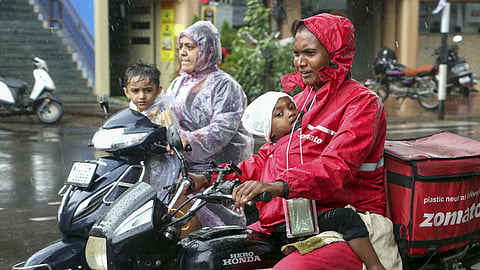

When delivery workers in several major cities logged out of their apps in a coordinated manner near the end of last year, it forced India to confront an uncomfortable truth. While business circles continue to celebrate the emergence of business models that promise speed through technological prowess, the 10-minute delivery proposition must also be seen for what it is: a social experiment whose costs are disproportionately borne by those with the least power to refuse.
For many young urban migrants and new entrants in the labour market, platform work has become a default option rather than a short-term stopgap. Yet, research by the International Labour Organization has consistently noted that this growth has been accompanied by a fundamental reorganisation of work itself, where stable employment is replaced by task-based engagements governed by algorithms.
In this system of management, performance is continuously monitored through delivery times, customer ratings and acceptance rates, while the decision-making remains opaque to workers. Studies under the Oxford Internet Institute’s Fairwork Project show that such opacity generates income volatility and heightens workers’ dependence on platform-determined incentives. The health and cost implications are borne by the workers rather than the firms that profit from these systems.
Against this backdrop, the recent log-outs must be understood as a sign of structural strain. They raise pressing questions about how India’s platform economy is governed, who absorbs the costs of speed, and whether the current regulatory frameworks are equipped to deal with the form of work.
Much of the sector’s defence of ultra-fast delivery rests on technical explanations. They argue that delivery times are determined not by rider behaviour but by dense networks of neighbourhood warehouses, optimised routing and short distances. In theory, this frames speed as a logistical outcome rather than a labour issue.
However, studies by the International Transport Workers’ Federation and Fairwork India highlight that time pressure is experienced not simply in terms of distance but through the cumulative micro-delays resulting from traffic congestion, access barriers in apartment complexes, weather disruptions and order batching that remain invisible to algorithmic systems. Our cities are not spreadsheets, and the friction that defines everyday urban life is rarely captured in neat delivery-time calculations.
Platforms rely on automated metrics, not human supervision, to determine workers’ access to future orders. Thus, they shape worker behaviour while denying employer obligations. The lack of transparency makes it difficult for workers to contest penalties or understand how to improve their standing.
This opacity has material consequences. Research by the Centre for Sustainable Employment and the ILO shows that platform workers often experience income instability even during periods of high demand, as incentive structures shift unpredictably and penalties are imposed retroactively. In such conditions, workers may prioritise speed over safety as a rational response.
In India, the Code on Social Security, 2020 recognises gig and platform workers as a distinct category—an important conceptual step. Yet, the recognition has not translated into robust protection. By linking eligibility for insurance and benefits to minimum engagement thresholds—90 days on one platform or 120 days across several—the State has inadvertently mirrored the logic of the platforms themselves.
In a system marked by high churn, unpredictability and frequent account deactivations, many workers will never remain visible long enough to qualify. The continued classification of workers as independent contractors further allows platforms to shift operational risks outwards. Fuel price volatility, insurance gaps and the absence of paid leave are treated as individual problems rather than systemic features. This fragmentation weakens collective voice even as dependence on platform income deepens. What emerges is a new kind of urban buffer class—present when demand surges, absent when liabilities arise. Flexibility, once framed as empowerment, increasingly resembles instability by design.
If India is to preserve both innovation and dignity, the next phase of platform regulation must prioritise transparency over speed. One practical step would be the creation of a publicly-visible fairness index for gig platforms—an independently governed rating system that evaluates companies on labour integrity rather than delivery velocity. Much like energy efficiency labels or food safety standards, it would allow consumers, regulators and investors to see what currently remains hidden.
The index’s key dimensions could include income viability (net earnings meeting local living wages), time realism (delivery promises adjusted dynamically for traffic, weather and peak congestion), due process (a human-led mechanism to contest suspensions and penalties), and social protection (insurance and accident cover from the first day of work).
The goal is not to halt innovation, but to re-anchor it in social reality. The protests should be read as a warning signal. They point to a widening gap between the speed promised to customers and worker security. India needs to re-think its quick-commerce terms. If platform growth is to align with broader development goals, attention must shift from headline innovation metrics to the everyday working conditions. Convenience, after all, is a design choice—not a natural law.
Tulsi Jayakumar | Professor, economics; and Executive Director, Centre for Family Business and Entrepreneurship at Bhavan’s SPJIMR
(Views are personal)
