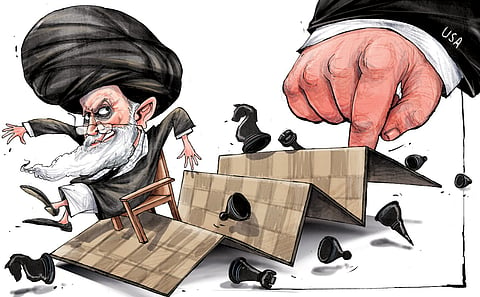

What began as protests against soaring inflation and currency collapse across Iranian cities on December 28 quickly evolved into broader political demands, including calls for reform and, in some quarters, regime change, posing the most serious challenge to the Islamic Republic since the 1979 revolution. As confrontations escalated, violence by protestors and the authorities claimed lives, underscoring the gravity of the moment.
Donald Trump’s response was characteristically forceful. Posting on social media platform Truth Social, he warned that the US was “locked and loaded” should Iranian security forces continue killing protesters. Behind the rhetoric, however, lies a more calculated posture: Washington has reinforced its naval presence in the region, imposed new punitive tariffs on governments engaging with Tehran and kept the option of military intervention conspicuously on the table—without signalling imminent action.
The central question confronting regional and global powers is not whether Iran will collapse tomorrow, but what the consequences would be if a long-running pressure campaign—combining economic sanctions, domestic unrest, the persistent threat of force, and Israel’s two-decades-long shadow war—ultimately succeeds in toppling the Islamic Republic. While Tehran has survived repeated crises, the convergence of pressures in 2025-26 marks a departure from anything it has previously faced.
Why things are different this time is that, by December 2025, the US dollar had surged to nearly 145,000 Iranian tomans, inflation stood at 42.2 percent, food prices had risen 72 percent, and healthcare costs by 50 percent from the previous year. Compounding these pressures was Iran’s declining regional influence following the collapse of the Assad regime in Syria—long regarded as Tehran’s most crucial Arab ally.
Unlike the uprisings of 2009, 2019, and 2022, the current protests are broader in both geography and social composition. They extend well beyond the major cities into smaller towns and rural areas, and they draw participation from students, workers, women and ethnic minorities alike—suggesting a deeper structural discontent.
Before examining Trump’s threats, it is essential to understand the systematic campaign that helped prepare the ground for regime destabilisation: a multi-decade covert effort by Israel’s Mossad. This campaign has served twin objectives—degrading Iran’s strategic capabilities while reinforcing its portrayal in Western narratives as an inherently unstable and dangerous state, all under the cloak of plausible deniability.
“Mossad has treated Iran like its playground for years,” observed Holly Dagres, a senior fellow at the Washington Institute. “From assassinating nuclear scientists to sabotaging nuclear facilities, Israel has consistently demonstrated the upper hand in this shadow war.”
The campaign that began in earnest in 2007 with the assassination of nuclear physicist Ardeshir Hosseinpour has expanded through targeted killings, cyberattacks and infrastructure sabotage. Israeli intelligence has reportedly exploited socioeconomic vulnerabilities within Iran, recruiting operatives from marginalised communities and relying on encrypted communications and cryptocurrency transfers. Some recruits, according to reports, received training abroad in countries including Georgia and Nepal.
In June 2025, Iranian authorities announced the dismantling of several Mossad-linked sabotage networks, seizing Israeli-made Spike anti-tank missiles, suicide drones and explosives allegedly intended for attacks on critical infrastructure and residential targets. State television aired footage showing intelligence officers intercepting trucks carrying advanced drones through Tehran.
What distinguishes 2025-26 is also the transition from covert conflict to overt confrontation. Iranian security agencies presented what they described as tangible evidence of foreign-directed subversion, including televised confessions from alleged Mossad operatives detailing recruitment through social media by handlers based in Europe. These recruits were reportedly instructed to procure equipment, attend protests, chant specific slogans and transmit the footage abroad.
By the time Trump threatened intervention earlier this month, the groundwork had been laid. Over two decades, the shadow war has humiliated Iranian institutions, amplified internal fractures and cultivated a global narrative of regime incompetence and brutality.
Against this backdrop, Trump warned that the US could strike Iran at “levels they’ve never been hit before” if the protests were violently suppressed. His remarks followed the dramatic US abduction of Venezuela’s deposed president Nicolás Maduro—an episode closely watched in Tehran as a signal of Washington’s willingness to act.
On January 12, the administration announced 25 percent tariffs on any government continuing commercial engagement with Iran, reinforcing its strategy of maximum pressure through both military and economic means.
The collapse of the Islamic Republic would represent more than regime change. It would complete a historic arc that began in 1979, potentially restoring Iran to a role aligned with the US’s strategic interests after nearly half a century of hostility.
Before the revolution, Iran under Shah Mohammad Reza Pahlavi was Washington’s principal regional ally—a bulwark against Soviet influence and radical Arab nationalism. Under the Nixon Doctrine, the Shah functioned as America’s regional policeman, supported by vast oil revenues and deep intelligence cooperation. US and allied monitoring stations in Iran provided critical data on Soviet missile capabilities, making Tehran one of Washington’s most valuable partners outside Nato.
Amid these dynamics, India emerges as one of the most affected—but least discussed—stakeholders.
For New Delhi, Iran is not merely an energy supplier or diplomatic partner. Chabahar Port, Iran’s only deep-sea port with direct access to the Indian Ocean, offers India strategic access to Afghanistan and Central Asia while bypassing Pakistan. It shortens supply routes by thousands of kilometres and underpins the International North-South Transport Corridor linking India to Russia and Europe.
In 2024-24, India-Iran trade reached approximately $1.68 billion, with Indian exports—mainly agricultural products and pharmaceuticals—accounting for $1.24 billion. Political instability in Iran threatens to disrupt port operations, inland transport and customs procedures, with cascading effects across Eurasian supply chains.
More ominously, fragmentation along ethnic lines could place Chabahar—located in restive Sistan-Baluchistan—at risk, potentially undoing India’s investments. A post-regime Iran aligned more closely with Washington might deprioritise India, while China—already entrenched at Pakistan’s nearby Gwadar Port—could expand its influence.
India reportedly has nearly $240 million in export payments exposed to the current turmoil, highlighting the immediate vulnerabilities.
A chaotic transition in Iran would likely exacerbate energy market volatility, forcing India to deepen reliance on Gulf suppliers and absorb higher costs. Iranian instability would also hurt Indian farmers, particularly basmati rice exporters, for whom Iran remains a crucial market.
Perhaps most overlooked is the diaspora dimension. Nearly 97 lakh of India’s overseas citizens reside in Gulf Cooperation Council states, generating close to 40 percent of India’s remittance inflows. Any regional upheaval triggered by Iran’s collapse would place these communities—and India’s economic lifelines—at risk.
New Delhi, thus, faces a profound strategic dilemma. Washington’s campaign to isolate Tehran has repeatedly collided with India’s regional interests. Sanction waivers for Iranian oil imports were withdrawn in 2019, and in 2025 US prosecutors targeted the Adani Group over alleged sanctions violations—sending an unmistakable signal that India must choose.
While some US analysts privately acknowledge that India will retain limited engagement with Iran—particularly over Chabahar—they also recognise that any vacuum left by India will be filled by China. Yet, India’s constrained ability to balance these pressures reflects a shrinking geopolitical manoeuvring space.
As protesters risk their lives on Iran’s streets and Washington escalates its threats, one reality stands out: the fall of Iran’s regime would not mark an ending, but the beginning of a far more volatile chapter—one whose consequences will reverberate across West Asia and beyond for decades.
Waiel Awwad | Senior journalist specialising in Asian affairs
(Views are personal)
